
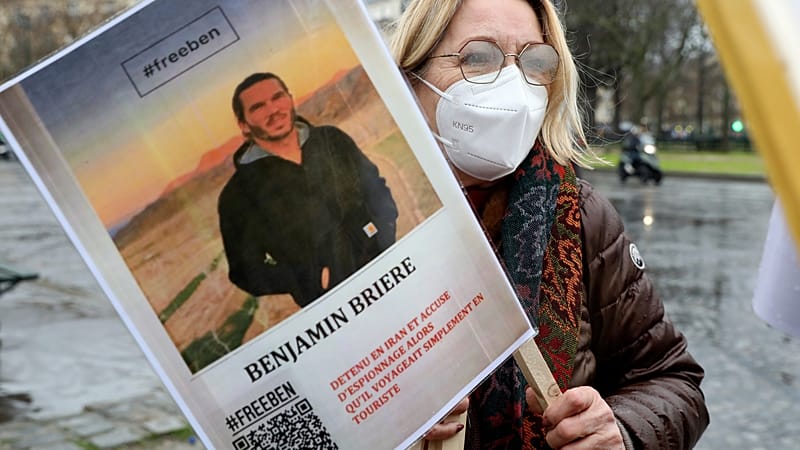
Almost three years since his release from Iran, former captive Benjamin Brière stated that his return to France signified the start of a new challenge.
The individual who was held in Tehran for 1,079 days before being released in 2023 stated that the French government provides minimal assistance toformer hostagesworking on restoring their lives.
Imprisoned in 2022 for eight years and eight months due to accusations of espionage and spreading propaganda against the Iranian government, the Lyon-born individual stated that his release was nearly as distressing as his initial arrest.
As stated in an interview by Brière with French media Le Journal du Net, former captives frequently face the challenges of their detention’s administrative, financial, and psychological impacts without support.
Following his return to France, Brière mentioned that he found out he had been excluded from various public systems, such as the national health insurance program and France Travail, the nation’s government-run employment service.
He mentioned that he had to struggle to regain his rights, including with tax officials, even though he had not been able to handle such issues while imprisoned in Iran.
Why I didn’t submit my taxes
That moment, he stated, quickly became bizarre. “They questioned me about why I hadn’t submitted taxes for the last four years. I told them I was in prison and therefore couldn’t have done it,” Brière said.
The tax official responded that even while in prison, you are still required to submit your tax return… However, I was in an Iranian prison. After that, I was informed: ‘In that case, your family could have done it.’
According to Brière, the exchange highlighted a significant misunderstanding of the experiences endured by former detainees.
In his initial year of imprisonment, he claimed he had no opportunity to communicate with his family. During the second year, he was permitted only 15 minutes on the phone every four to six weeks.
“Taxation was certainly not my main concern,” he explained. Despite eventually understanding his circumstances, he mentioned that this experience was just the beginning of a series of administrative challenges.
He mentioned that he experienced a time of significant financial difficulty. Without any immediate earnings to pay for food, shelter, or mental health services, he had to depend on family members for assistance.
He mentioned that therapy alone costs him over €500 each month. Even though Brière still had several months of unemployment benefits remaining, he stated he had to engage in a prolonged administrative battle to obtain them.
His situation was only settled following direct action by a member of parliament with the Labour Ministry.
In addition to his personal circumstances, Brière highlights the stress experienced by families when a loved one is detained overseas.
He mentioned significant legal expenses, the necessity for certain relatives to pause their own lives to support the case in the media and with the French foreign ministry, along with other costs that families often have to bear on their own.
Collaborating with the advocacy organization SOS Otages, Brière has recently advocated for the establishment of a distinct legal category for former French captives.
He also requested a temporary stipend to assist with essential living expenses throughout the reintegration phase, ensuring that former detainees are not entirely dependent on family assistance or regular social welfare.


 jasdooit
Leave a comment