
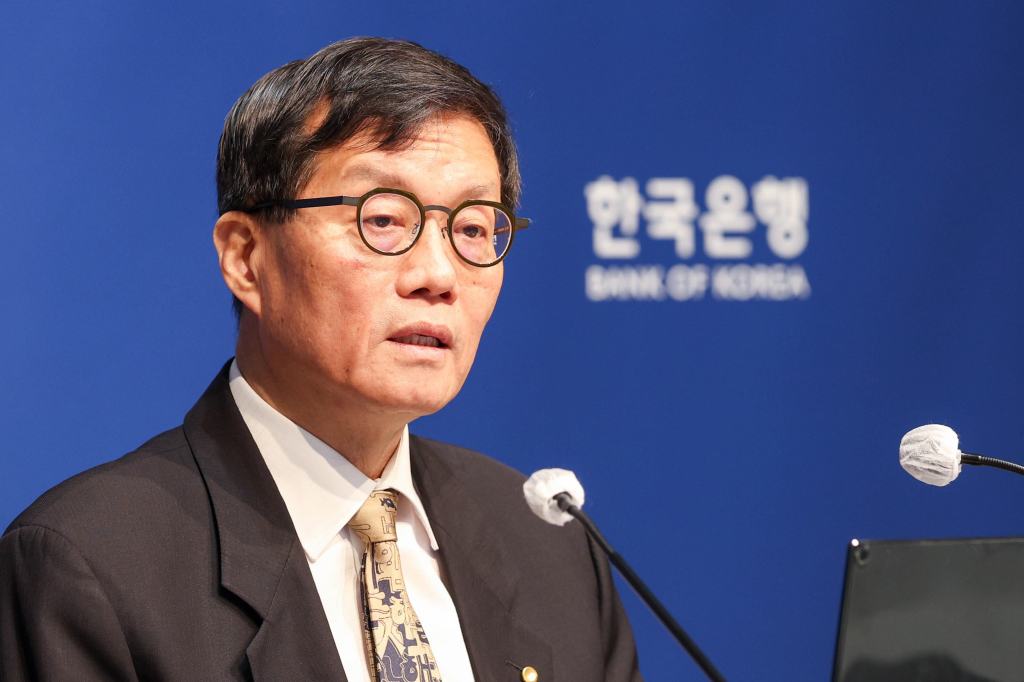
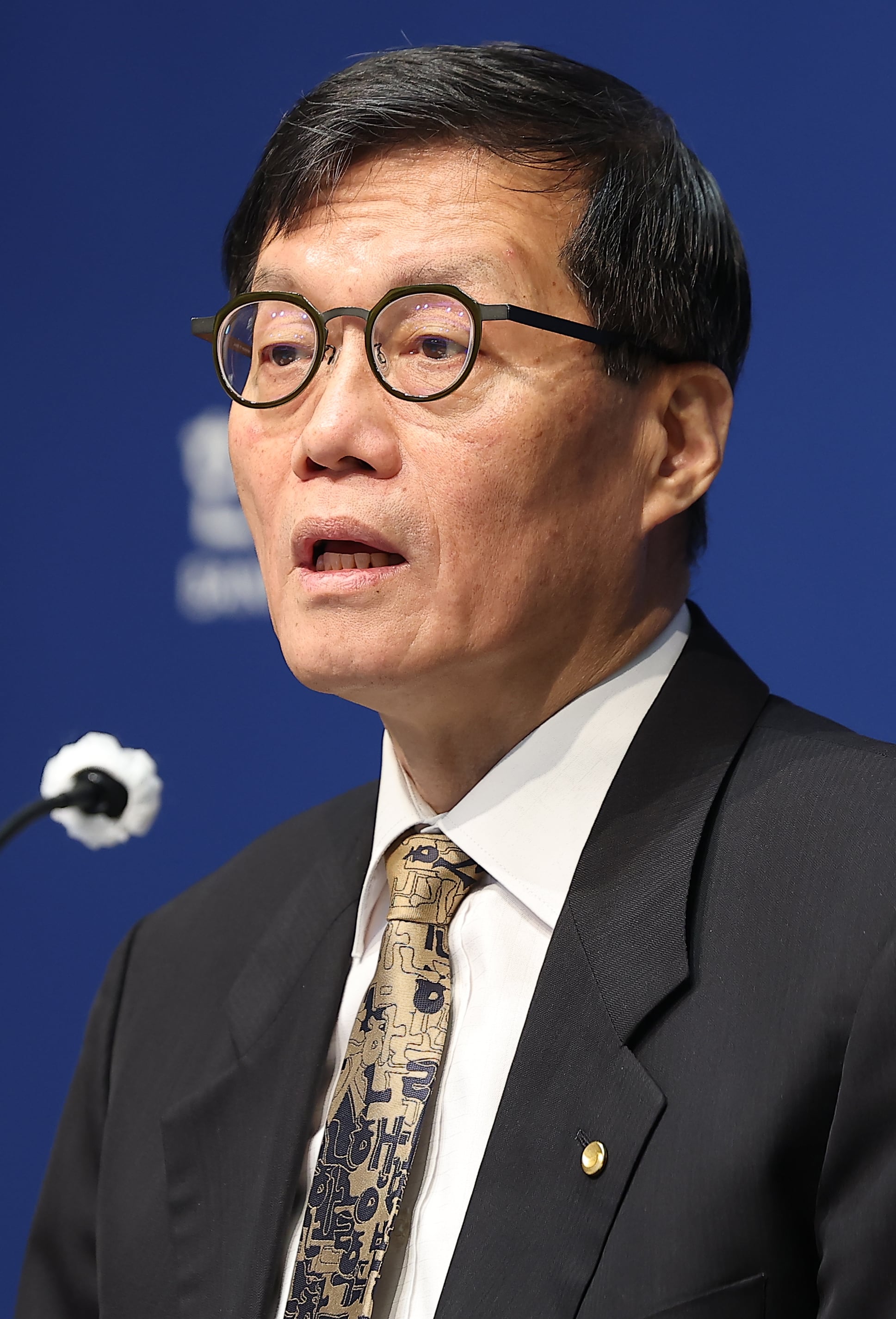
South Korean Central Bank Governor Rhee Chang-yong, wrapping up his four-year tenure on the 20th, participated in his last Monetary Policy Board meeting on the 10th, which he chaired, sporting a striking gold tie featuring Korean letters—a representation of the “Rhee Chang-yong style.” Following the meeting, during a press conference, he repeatedly expressed disappointment over the won’s exchange rate increase caused by the Middle East conflict that began at the end of February, while maintaining an overall positive outlook. In response to worries about “stagflation,” where economic slowdown and inflation happen together, he stated, “The likelihood is low for now,” but also noted, “It is hard to rule out the possibility of stagflation if the worst-case situation occurs, such as damage to energy infrastructure and long-term consequences.”
The exchange rate of the won, which had dropped to the 1,420 South Korean won per dollar range at the beginning of the year, went beyond the 1,500 South Korean won mark during the Middle East conflict, hitting its highest level since the 2009 global financial crisis. Although it somewhat stabilized after news of a ceasefire, it remained elevated, closing the week at 1,482.5 South Korean won per dollar on the 10th. Governor Rhee said, “I don’t regret my past interest rate policies, but I am disappointed to leave the position with the exchange rate still high,” and added, “Predicting exchange rates is extremely challenging, but if the situation in the Middle East stabilizes, it could fall as quickly as it rose.” He recalled, “I had just finished dinner with staff from the International Department after the exchange rate slightly dropped at the end of February, and that was when the Iran war broke out,” laughing and saying, “Because President Donald Trump didn’t help…”
Governor Rhee proposed that the conflict in the Middle East might have a more significant effect on South Korea’s economy compared to the Russia-Ukraine war. He stated, “In 2022, Europe, which heavily relied on Russian natural gas, was greatly impacted, but this time, Asian nations such as South Korea, Japan, and Taiwan, which depend significantly on Middle Eastern crude oil, are facing more severe consequences,” and noted, “South Korea’s currency exchange rate and prices may respond more intensely.”
Governor Rhee, who assumed office in April 2022, has received recognition for taking decisive action against economic challenges including global inflation, the U.S.-China trade disputes, martial law, and high currency exchange rates. Nonetheless, views are split regarding the “structural reform initiatives,” during which the Bank of Korea conducted in-depth studies on societal issues such as declining birth rates, an aging population, entrance examination systems, climate change, and medical treatments essential for sustaining life. While some commend the central bank’s broader involvement, others believe it should have concentrated more on monetary policy.
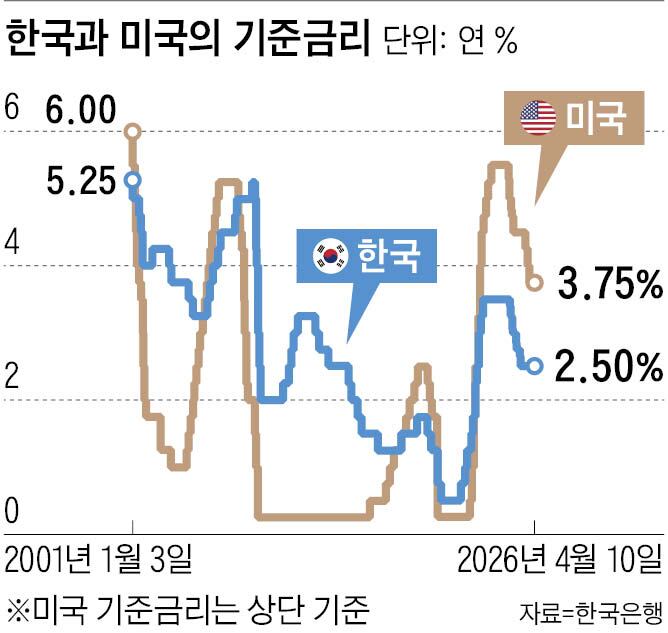
When questioned about his final reflections, Governor Rhee remarked, “I have spent a significant period as a professor and government official, and I am looking forward to pursuing new ventures after my term.” It is known that he has privately mentioned a wish to take on new challenges through unexplored projects. In terms of assessing the past four years, he said, “I will provide more details before leaving,” but then added with a smile, “I was criticized for pointing to ‘Seohak ants, Korean retail investors purchasing foreign stocks’ as a reason for the high exchange rate, but I was simply explaining the situation—definitely not blaming them.”
Regarding the government’s additional budget, he stated, “I look at it favorably since it utilizes surplus tax income, rather than borrowing,” but expressed concerns, “It is essential to reassess if allocating 4.8 trillion South Korean won in fixed local education funding is appropriate.” He added, “Although such funding was crucial for education previously, decreasing student numbers caused by low birth rates and increasing challenges such as elderly poverty necessitate a review of the current method of automatically distributing taxes to education funds.”
Governor Rhee downplayed worries regarding his successor, Governor nominee Shin Hyun-song, who has more than half of his assets in foreign currency, calling it “unnecessary anxiety.” He remarked, “Although public opinion might differ, I wonder why there’s so much concern about bringing in someone with overseas experience,” and said, “I have no doubt that Nominee Shin’s loyalty surpasses his financial holdings.” The confirmation hearing for Nominee Shin is set for the 15th.

 jasdooit
Leave a comment