
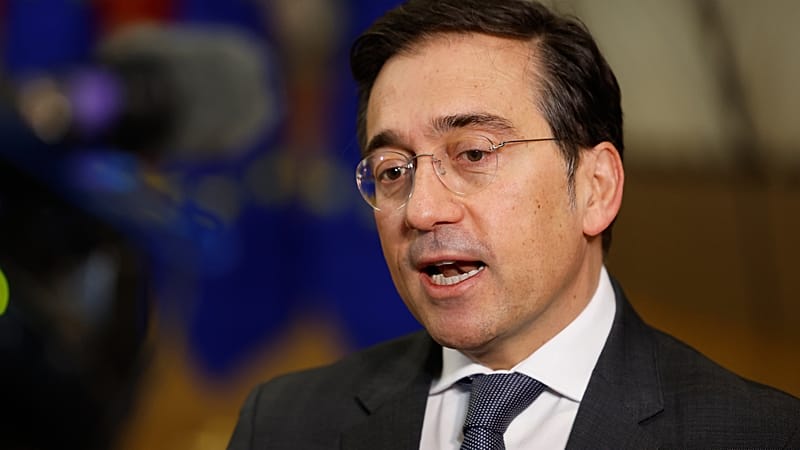
Obtaining access through the Strait of Hormuz goes beyond NATO’s responsibilities, stated Spanish Foreign Minister José Manuel Albares Bueno following U.S. President Donald Trump’s expression of dissatisfaction with the alliance’s inaction regarding this critical waterway.
“NATO is not involved in this conflict. We, the allies, have not been notified or sought for input,” Albares stated on Friday during a speech in the Spanish Senate.
The Middle East lies outside of NATO’s area of responsibility, and thus, not only we but also numerous allies have conveyed the same view: NATO will not get involved in this conflict.
The remarks align with Spain’s critical stance towards the US action against Iran, which the nation has described as a clear breach of international law. Last month, the leftist administration prohibited American aircraft involved in the conflict from using its airspace.
Spain, however, did enter into ajoint leaders’ statementearlier this week vowing to “support maintaining freedom of movement in the Strait of Hormuz”.
It emerges as NATO Secretary General Mark Rutte seeks to encourage allies to form a special mission aimed at ensuring free and secure passage through the narrow shipping route, which is now tightly controlled by Tehran.
The near-total closure, which persists following the ceasefire agreement, has caused disruptions to global supply chains, driven up energy costs, and increased concerns about stagflation. Approximately 2,000 ships and 20,000 sailors are still stuck in the Persian Gulf.
Trump has frequently criticized NATO allies for not sending military resources to Hormuz, a region with challenging terrain that benefits Iran’s unconventional combat strategies and significantly raises dangers for sailors, ship operators, and insurance companies.
In recent days, Trump has brought up again his warning to withdraw the US from the 77-year-old transatlantic partnership and take control of Greenland from Denmark.
“NATO wasn’t present when we required their support, and they won’t be there if we need them once more. Recall Greenland, that vast, poorly managed chunk of ice!!!” he posted on Truth Social, in all capital letters.
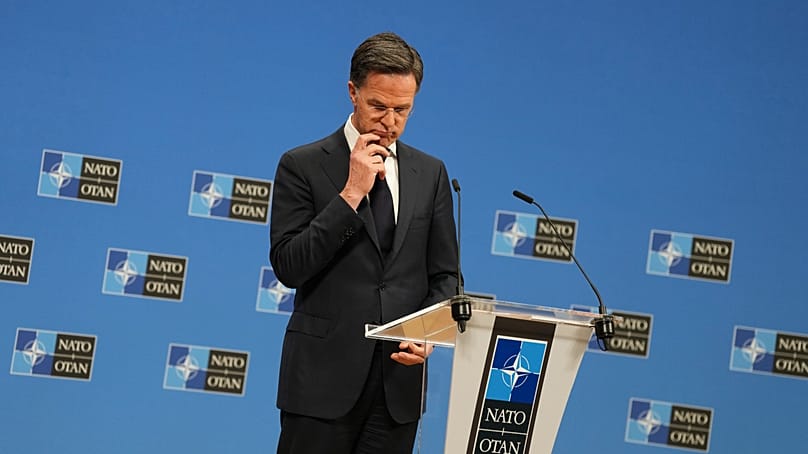
Attempting to ease conflicts,Rutte met with Trumpat the presidential residence on Wednesday.
The gathering, which was unusually not open to the media, was characterized by Rutte as a “very honest, very transparent conversation.” A NATO representative later stated that the Secretary General was “in touch with allies” regarding the protection of Hormuz.
The spokesperson stated, ‘It is evident that the United States seeks tangible commitments and measures to guarantee freedom of navigation in the Strait of Hormuz.’
A NATO operation would necessitate agreement among its 32 member nations, a standard that opposition from Spain, and potentially other countries, would render unachievable. Turkey’s Minister of Trade, Ömer Bolat,told Euronewsthat NATO members are not required to provide support.
While the NATO treaty is limited to European, North American, and Turkish territories, along with islands under their control, the alliance has previously conducted missions in Afghanistan, Libya, and Iraq, demonstrating that its reach can be expanded in reality.
German Chancellor Friedrich Merz has stated that his country will support the reopening of Hormuz provided there is an international mandate. However, an effort this week to approve a resolution in the UN Security Council was blocked by the vetoes from China and Russia.
In the meantime, the United Kingdom is gathering a group of willing nations, including more than 40 countries from various parts of the globe, to ensure freedom of movement in the vital waterway. This loose alliance may enable circumventing NATO’s more rigid structure.
British Prime Minister Keir Starmer discussed with Trump on Thursday the importance of developing a practical strategy to resume shipping operations as soon as possible, according to Starmer’s office. However, London has not provided any specifics regarding what this plan might entail.


 jasdooit
Leave a comment