
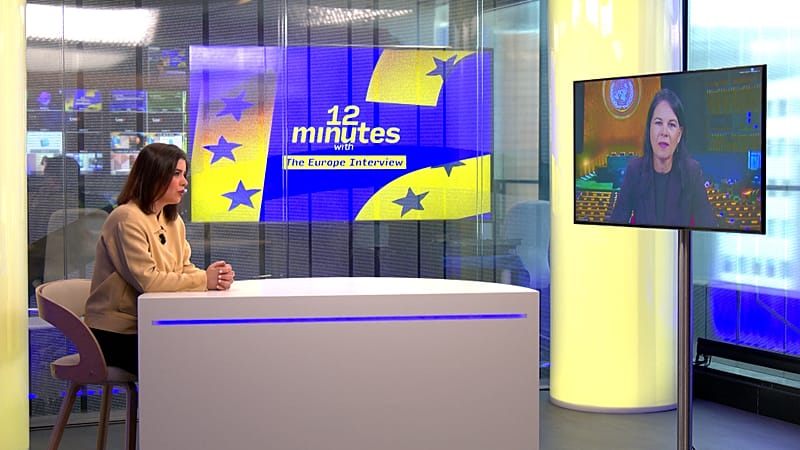
The responsibility for ongoing conflicts cannot be attributed to the United Nations, stated Annalena Baerbock, the President of the United Nations General Assembly (UNGA), during an interview with Euronews.
Alternatively, she contended, the blame should be directed towards the member states.
“If a country initiates an aggressive war, it’s not the United Nations that is failing, nor is the Charter unclear in stating that such a conflict is prohibited; rather, it is the member state that knowingly violates the Charter by proceeding with the war,” Baerbock stated during an interview on Euronews.12 Minutes With.
“That is why the UN requires pressure from other member nations as well,” said the former German minister of foreign affairs.
The United Nations has, in recent years, encountered increasing scrutiny, including from its own member countries, for what some perceive as a fundamental inability to carry out its primary responsibility of ensuring global peace and security.
In a speech at the UNGA last year, U.S. President Donald Trump accused the organization of not taking action to address rising conflicts, criticizing what he described as “empty words” that “don’t end wars.”



Nevertheless, Baerbock pointed out that the UN is not a single entity, but rather a group of 193 “highly varied member nations.” She further mentioned that, in this regard, the UN’s operations resemble those of national legal systems, which also involve various participants.
“We have clear guidelines stating that you must not take any lives. Regrettably, murder continues to occur,” she stated.
But no one would argue, ‘Okay, we should eliminate the criminal code now, since we cannot stop the murders.’ Police and society [must also] address it, and the same applies to the UN. We rely heavily on the member states.
Veto problem
As stated by Baerbock, the primary challenge for the UN in dealing with current conflicts stems from the veto authority that certain members possess within the Security Council, the body responsible for ensuring global peace and security.
China, France, Russia, the United Kingdom, and the United States—referred to as the “Permanent Five” (P5) or “Permanent Members”—have permanent positions and the right to veto, enabling them to prevent any UN resolution from passing.
This blockage granted to a specific set of members has, in recent years, caused considerable debate, as it greatly limits the council’s capacity to achieve global peace.
In recent years, Russia and the United States were the primary causes of this stagnation, preventing actions concerning Ukraine and the circumstances in Gaza. In 2024, the permanent members used eight vetoes on seven draft resolutions, the highest count since 1986. Last year, the Council experienced two US vetoes regarding Gaza and two Russian vetoes related to Ukraine.
“Regrettably, in these times, not all member states fulfill their responsibilities, but [instead] utilize their veto powers to protect violations of international law,” Baerbock stated.
If you employ a veto in a manner that prevents the Security Council from reaching a decision, and afterward you express frustration about the lack of agreement, it is clearly also the responsibility of those who are exercising the veto.
This deadlock within the Security Council has sparked renewed demands for major changes to limit this authority, as well as increase permanent seats for Africa and Latin America.
In March 2025, UN Secretary-General António Guterres introduced the UN80 reform initiative to celebrate the organization’s 80th anniversary. The initiative seeks to simplify the UN’s structure, responsibilities, and financial operations, and involves measures to restrict the veto authority of the UN Security Council.
Nevertheless, the P5 show limited interest in implementing changes that could reduce their authority or impact. “And regrettably, it requires the consent of every member of the Security Council.”
Some worry the UN is encountering another challenge stemming from the US, specifically the so-called Peace Board. It was initially endorsed by the UN Security Council as a monitoring body for the Gaza ceasefire, but Trump suggested during the Board’s introduction that it might evolve into something more extensive.
However, Baerbock dismissed worries that the Peace Board might challenge the UN.
“There is a valid explanation for why, at the UN, each member state, regardless of its size or power, holds an equal position at the table. This represents a distinct responsibility and also the specific role that the UN can fulfill,” she stated.
Member states, including those who joined the Peace Board, clearly stated that this issue pertains only to Gaza, and for any other matters related to peace and security, it will continue, for valid reasons, to be the responsibility of the United Nations, where no payment is required.
In contrast to the UN, nations selected to be part of the Peace Board can join without any expense for a maximum of three years, but are required to pay $1 billion (approximately €852.1 million) each to remain after this initial period.
 jasdooit
Leave a comment