
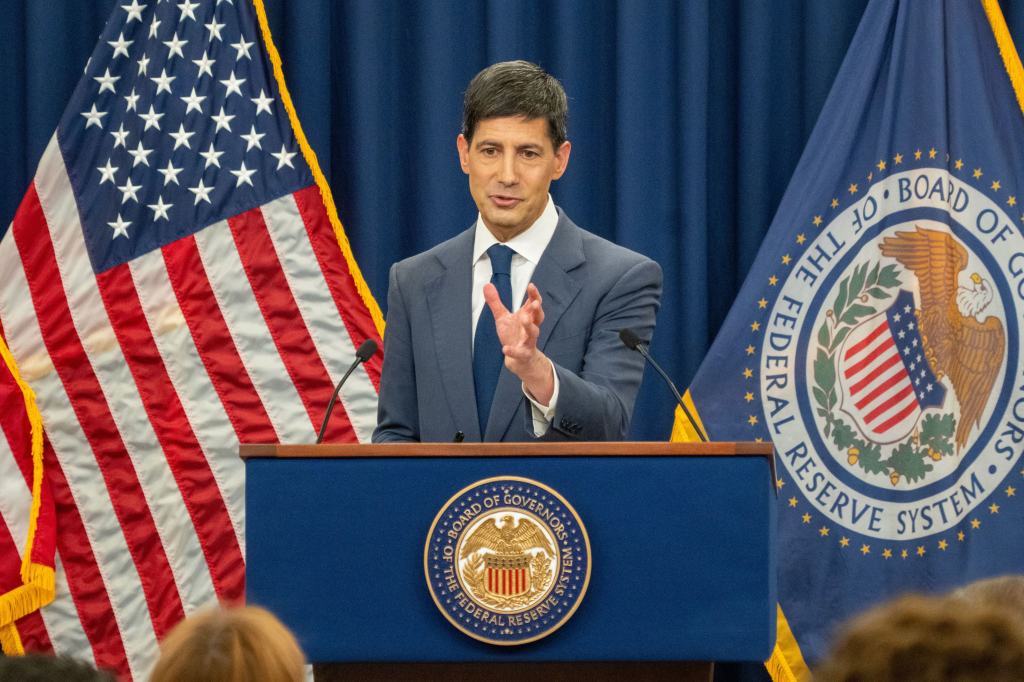
The plan introduced by Kevin Warsh, the newly appointed head of the U.S. Federal Reserve, has led to various understandings on Wall Street. Following the conclusion of the Federal Open Market Committee meeting on the 17th, which determines the benchmark interest rate, Warsh indicated the future course of the Fed through a statement and press conference. While some observed that his approach was not as extreme as anticipated, others highlighted that, despite his seemingly gentle demeanor, he seemed committed to transforming the Fed’s structure following the 2008 financial crisis.
Warsh’s first press conference since assuming his role highlighted notable differences compared to the period under his predecessor, Jerome Powell. The Federal Reserve usually issues a statement following its rate decisions. This time, the statement consisted of just 132 words, considerably shorter than the 246 words in the previous April statement. Warsh recognized this change, commenting, “It’s a bit shorter, simpler, and we’ve removed some outdated expressions.”
A major emphasis for markets was the elimination of the so-called “forward guidance,” a term used to indicate policy direction. Forward guidance came into play after the 2008 financial crisis when the Fed reduced rates to nearly zero (0–0.25%) and utilized statements to suggest extended low rates. Investors depended on these signals to anticipate rate movements. Nevertheless, the Fed has now chosen to omit such guidance from future communications.
Furthermore, the “dot plot,” a graphical representation of the 19 Federal Reserve officials’ interest rate forecasts, might soon be phased out. Launched in 2012 during the tenure of former Chair Ben Bernanke, the dot plot offered market insights similar to forward guidance. Warsh did not present his personal forecast during this meeting, indicating a move towards more general communication regarding future interest rate decisions under his administration.
Experts link these changes to Warsh’s longstanding views on the Federal Reserve’s function. He is against the present approach of providing detailed information about interest rate projections, claiming that specific forecasts in guidance and dot plots may limit the Fed’s adaptability. He also points out real-world challenges, stating that economic prediction is uncertain when inflation fluctuates greatly.

Opinions on Warsh’s approach vary. Loretta Mester, former head of the Federal Reserve Bank of Cleveland, commended the elimination of “standard wording,” noting that “it is challenging to remove once established.” On the other hand, Bob Michele, chief investment officer at JP Morgan Asset Management, cautioned, “Reduced transparency leads to increased speculation, uncertainty, volatility, and risk premiums.”
Although Warsh seemed more approachable than anticipated—responding to inquiries thoroughly and keeping the dot plot—experts believe he is likely to advocate for significant changes. The future of post-crisis practices, such as the chair’s routine press briefings, is still unclear. CNBC characterized his style as a “glove-covered regime shift” and a “subtle revolution.”






Leave a Reply