
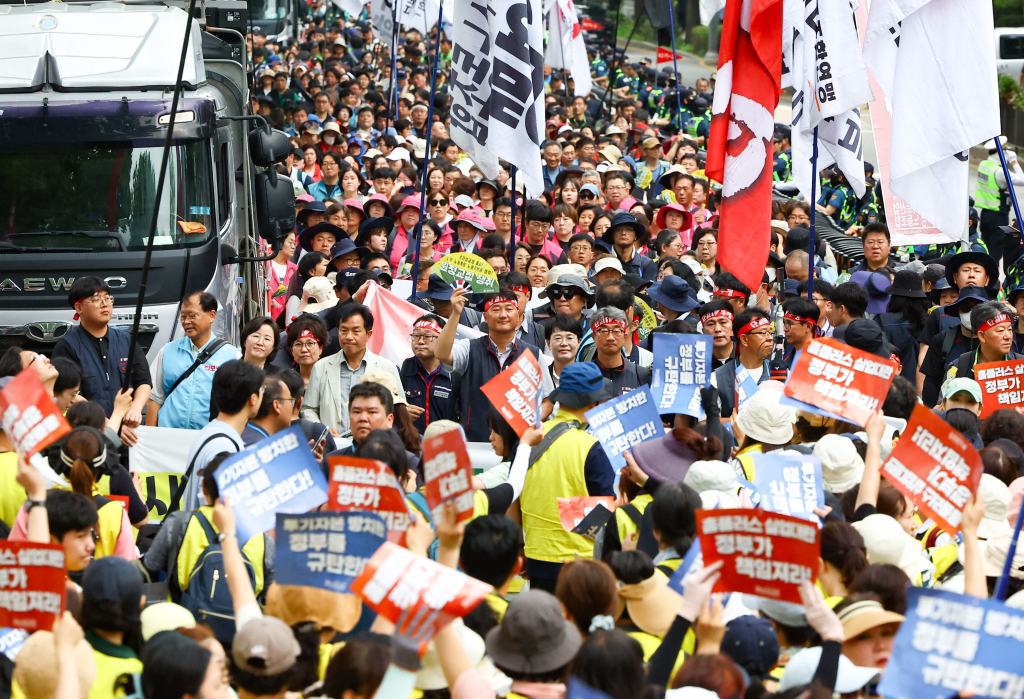
The governing party and administration are said to be accelerating the creation of laws to oversee private equity funds following the Homeplus incident. With demonstrations against worker dismissals and a rising number of supplier insolvencies increasing concerns about Homeplus’ potential collapse, Cheong Wa Dae, the ruling party, and the government seem to be attributing the issues to private equity funds.
As reported by sources from the Democratic Party of Korea and the Financial Services Commission on the 20th, the Democratic Party intends to accelerate the approval of private equity fund regulatory bills suggested by legislators in conjunction with the Financial Services Commission.
The legislation seeks to update the current Capital Markets Act. Important clauses mandate that private equity funds (general partners, GPs) in charge of managing the fund must submit details not only about their performance-related pay but also about the salaries of top executives to the Financial Services Commission. Persistent non-compliance with these reporting requirements could lead to the cancellation of their registration.
These proposals were developed following a party-government meeting on December 1, 2025, between the Financial Services Commission and the Democratic Party. Towards the end of 2025, Rep. Han Jeong-ae (Chair of the Policy Committee) and Rep. Yoo Dong-soo (Chair of the National Policy Committee) each introduced two bills. Nevertheless, they have not been addressed or debated within the Financial Services Committee, which is responsible for such matters.
On the 15th, the Homeplus Franchisee Association and the Mart Labor Union organized a demonstration in front of Cheong Wa Dae, calling for their right to survive. A representative from the ruling party mentioned, “Worries about the seriousness of the matter have increased inside Cheong Wa Dae, with demands to accelerate solutions. There are also accounts of disciplinary actions taken against those involved.”
Nevertheless, opponents claim that enacting laws quickly driven by political considerations might hinder the transformation of the market and favor foreign investment, while only imposing rules on local private equity funds.
◇ Mandatory Disclosure of Executive Pay, Cancellation of Registration for Breaches
The main focus of Rep. Han Jeong-ae’s legislation changes the reporting responsibility to companies (general partners, GPs) that oversee institutional private equity funds. Private equity funds are organized as limited partnerships, with GPs handling fund management—such as MBK—and LPs like the National Pension Service contributing capital.
Previously, the reporting entity was the fund itself, which frequently did not have a physical office or distinct identity. The bill seeks to address these gaps by making the general partners, who are the real managers, responsible.
Reporting obligations have also been increased. General Partners (GPs) are required to reveal the compensation they receive from funds, including the methods used to calculate it. Furthermore, remuneration received by key executives from funds or GPs must be disclosed. Funds are also required to periodically report on the financial condition of the target company and special purpose companies (SPCs) created for acquisitions. If debt from leveraged buyouts (LBOs) surpasses two times (200%) the net assets (total assets minus total liabilities), the Financial Services Commission must be informed within two weeks, along with details regarding the reasons, effects, and management strategies.
Rep. Yoo Dong-soo’s legislation enables the Financial Services Commission to cancel the registration of general partners if they do not meet reporting requirements. This includes general partners or their executives who fail to accurately report compensation, the financial condition of target companies, or special purpose companies.
The legislation also enhances the criteria for qualifying as a GP investor. For example, the financial condition and public reputation of key shareholders, such as Kim Byung-joo, head of MBK Partners, would be examined. It also requires compliance officers for GPs of a specific scale, improving internal oversight.
◇ Europe Imposes Regulations, U.S. Relies on Market Forces
The suggested changes introduced by Representatives Han and Yoo mirror approaches seen in Europe. The European Union’s Alternative Investment Fund Managers Directive (AIFMD) mandates the disclosure of overall and performance-related compensation within annual reports. Additionally, it limits the extraction of assets through dividends for a period of two years following an acquisition. Should a fund gain control over a non-publicly traded company, it is required to notify worker representatives via the board. Major or recurring violations may result in the revocation of a license.
On the other hand, the U.S. does not have particular rules aimed at private equity fund managers. Although the Securities and Exchange Commission (SEC) implemented disclosure regulations for private equity fund managers in 2023, a federal court struck them down in June 2024, arguing that they exceeded authority. Rather, institutional investors such as pension funds address concerns through direct discussions.
The obligation to disclose information publicly varies depending on whether a company is listed. Prominent firms such as Blackstone, KKR, Apollo, and Carlyle are publicly traded, which means that the pay of founders and chief executives is disclosed individually. Publicly listed companies may also have the ability to recover excessive performance-linked compensation from current or former executives if their financial reports are found to be inaccurate.
Unlisted companies, on the other hand, are not legally required to provide information.
◇ Excessive Regulation Might Lead to Unintended Consequences
Private equity funds emerged as market-oriented organizations aimed at addressing restructuring challenges during the Asian financial crisis and the global financial crisis. They are recognized for purchasing struggling companies, enhancing their financial and operational performance, and reintroducing them to the market.
Nevertheless, enhancing regulations following the Homeplus incident might reduce the size of the restructuring market. Purchasing struggling companies typically involves using debt, and stricter lending rules could result in healthy companies having no potential buyers, forcing them into liquidation.
Mandatory requirements such as designating compliance officers and improving IT systems raise fixed expenses, placing a financial strain on mid-sized private equity funds. Following the 2021 Lime and Optimus fund scandals, increased oversight responsibilities for sales companies and custodians resulted in closures among smaller and mid-sized fund managers. There are worries that more stringent regulations might strengthen the dominance of larger firms.
Inside the party and government, it is expected that the private equity fund regulatory bills will be brought up during the National Assembly Financial Services Committee’s upcoming questioning session on the 21st. The Democratic Party also intends to conduct a hearing at the committee level on the 27th to examine accountability for the Homeplus crisis.


 jasdooit
Leave a comment