
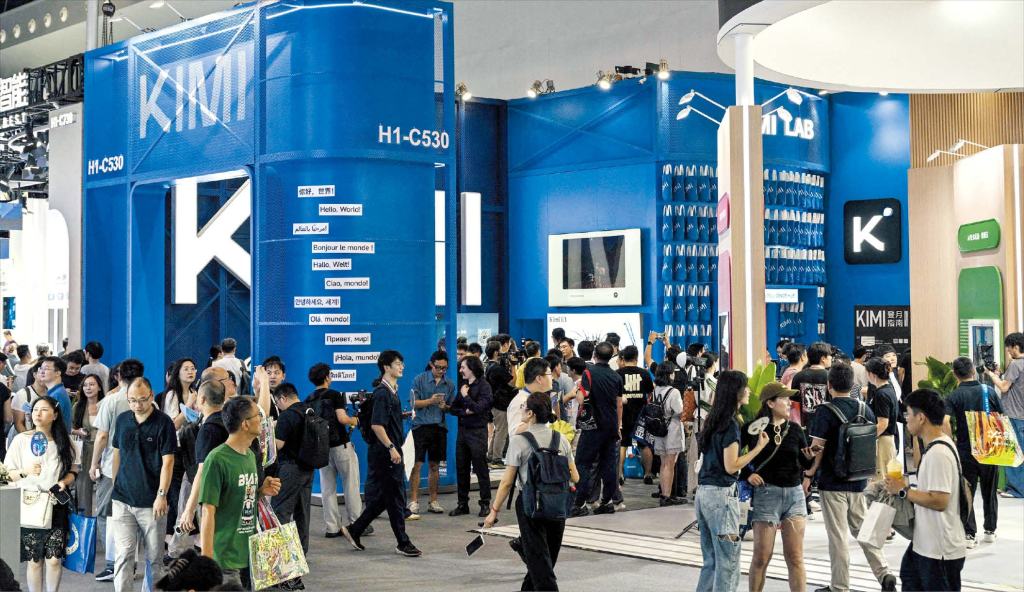
A Chinese artificial intelligence (AI) company, Munsot AI, has caused a decline in U.S. tech stocks, especially those related to semiconductors, following the launch of its open-source model ‘Kimi K3.’ This has led to increased focus on the stock performance of Samsung Electronics and SK Hynix on July 20.
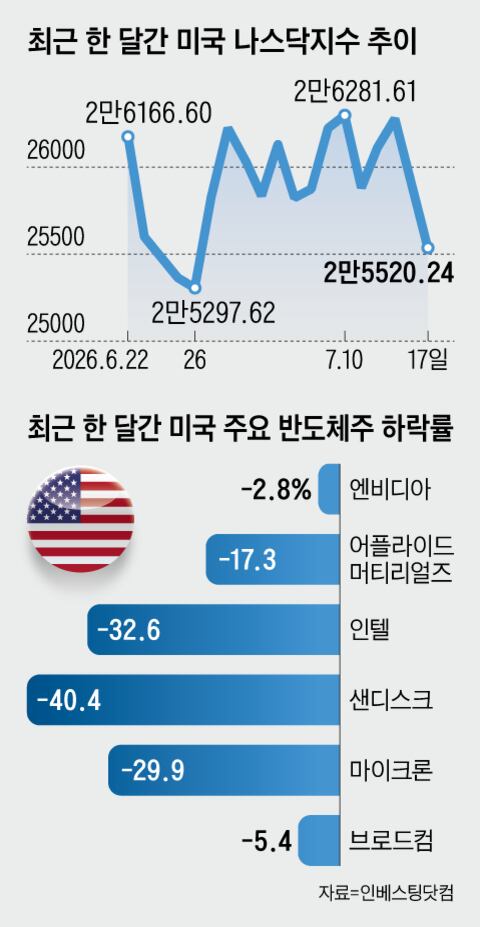
On July 17, the Nasdaq Composite declined by 1.40% to end at 25,520.24. The S&P 500 also fell by 1.01%. Major chipmakers such as NVIDIA (-2.2%), Applied Materials (-5.6%), Intel (-2%), and SanDisk (-4%) experienced notable drops. South Korean markets remained unaffected by the downturn because of a public holiday.
**◇ Shock from Kimi K3, a Chinese AI Startup Munsot AI**
The catalyst was Munsot AI’s launch of the open-source model ‘Kimi K3,’ which is said to compete with OpenAI’s ChatGPT and Anthropic’s Claude. This triggered a decline in U.S. semiconductor stock prices. Experts caution that if U.S. AI companies lose their competitive advantage, their major infrastructure investment strategies might encounter challenges. This resembles the market response in January 2025 when a model from the Chinese AI company DeepSeek was released, leading to a significant fall in New York markets.
Gary Yu, an analyst from Morgan Stanley, remarked, “Chinese large language models (LLMs) are becoming comparable to U.S. leaders in terms of size, effectiveness, and expenses.” He further mentioned, “We anticipate the appearance of more globally strong Chinese LLMs.” Robin Zhu Bernstein, another analyst, described the model as a ‘home run,’ highlighting, “China’s pace of innovation is now unquestionable.”
Kimi K3 costs $3 and $15 per 1 million input and output tokens, making it the priciest Chinese large language model. However, it is still more affordable compared to U.S. AI models that come with significant subscription charges. There are worries that Chinese AI might soon start affecting the revenue structures of U.S. AI companies, raising concerns about a potential bubble in U.S. AI stock prices.
Nevertheless, caution remains. Following the ‘DeepSeek shock,’ U.S. markets swiftly rebounded, and major tech companies increased their AI infrastructure investments.
**◇ Accelerating Semiconductor Fatigue?**
For South Korea, the concern is that global fluctuations in the semiconductor industry could intensify the declining trend of the KOSPI, which is significantly reliant on semiconductors. In recent times, semiconductor stocks have started to show signs of exhaustion. Samir Samana, head of global equity strategy at Wells Fargo, stated, “We have been worried that technology stocks, particularly semiconductors, have risen too quickly and too much in recent weeks. The market seems to have found a justification for selling.” The Nasdaq has increased by 9.8% year-to-date, while the Philadelphia Semiconductor Index has jumped 64.8%. Ryan Detrick, chief market strategist at Carson Group, noted, “The market appears to be experiencing semiconductor fatigue. Overvalued prices are returning to reality.”
An important question is whether the industry has reached its peak. This highlights the attention being given to upcoming earnings reports from major tech companies, including Microsoft, later this month. Yugo Tsuboi, chief strategist at Daiwa Securities, stated to Bloomberg, “As Chinese memory semiconductor companies attract interest, expectations of a slowdown in global memory price increases are growing. It’s becoming more difficult for stock prices to reflect the belief that corporate profit growth will continue to accelerate.” Hiroshi Namioka, chief strategist at T&D Asset Management, noted, “Although TSMC and ASML reported strong results, semiconductor stocks experienced selling pressure, indicating that market expectations were too optimistic.”




Leave a Reply