
SEOUL – South Koreans in their 20s and 30s, the country’s most avid users of artificial intelligence, are also driving a reading renaissance that is reshaping the domestic publishing market.
The share of South Korean adults who read at least one book a year, whether in print, digital or audio format, has steadily declined for more than a decade, falling from 72.2 percent in 2013 to 38.5 percent in 2025, according to the culture ministry’s 2025 National Reading Survey.
Young adults, however, appear to be going against the trend as they maintain the highest reading participation among adults.
The proportion of individuals in their 20s who read regularly was 75.3 percent, and for those in their 30s, it was 66.4 percent. Meanwhile, a different government survey conducted by the science ministry on internet habits revealed that these same age groups also exhibited the highest levels of generative AI usage, at 75.3 percent and 71.1 percent respectively.
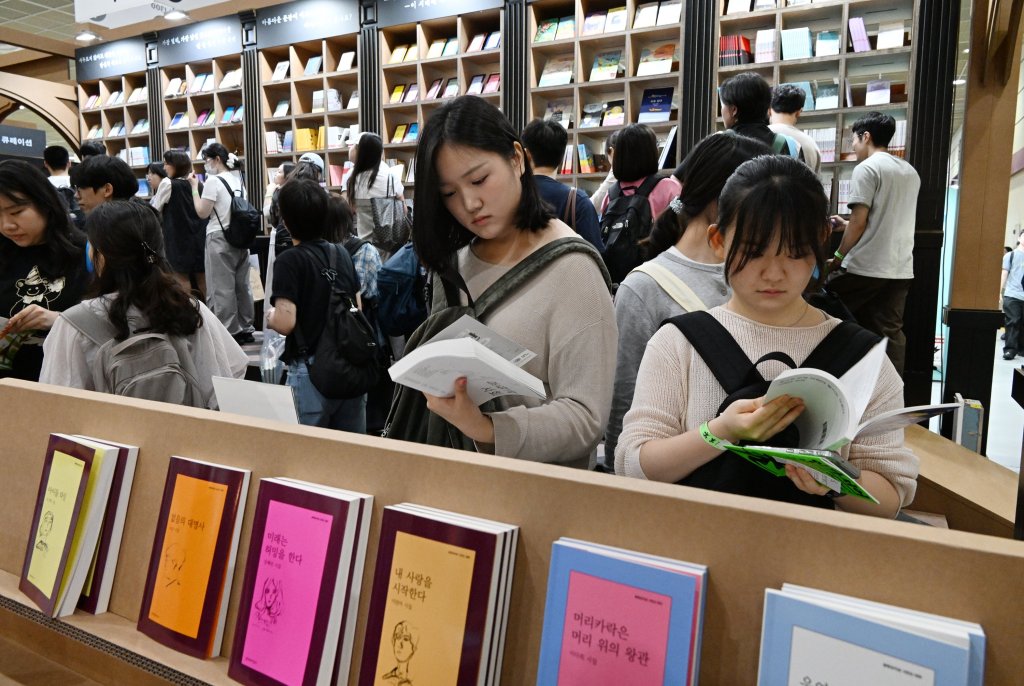
Their excitement was clearly visible at the Seoul International Book Fair, which took place at the COEX convention center in late June, as crowds formed long lines around the building before the entrance opened at 10 a.m.
People gathered at booths operated by leading publishers such as Minumsa, while a booth where attendees selected a bookmark and got a corresponding book suggestion attracted one of the longest lines of the day.
Oh Da Young, a 21-year-old university student, stood in a long checkout line at the Minumsa booth holding an armful of thick literary classics.
She said she read 24 books last year, ten times the national adult average, and has set an even higher goal for this year, driven in part by a small reading circle with two friends, where they swap books and share reviews.
“I became interested in books because the people around me like reading,” Oh said, adding that she prefers physical books to electronic ones, noting that “when you actually buy a book with your own money, you really feel like you own it.”
Minumsa has become a notable example of this trend, with its revenue increasing by 23.8 percent in 2025 despite the overall trade book market declining by 6.9 percent, causing it to move from 11th to 8th position among leading publishers, as reported by the Korean Publishers Association’s annual market study.
The publisher has cultivated a loyal group of younger fans in part through its popular YouTube channel, where editors discuss literature and recommend titles in a casual, accessible style.
The book fair itself has seen its attendance surge from around 100,000 visitors in 2022 and 2023 to some 160,000 this year, according to the fair’s operations office.
Social media has contributed to the trend, with the emergence of “text-hip” — the concept that reading is fashionable — motivating young individuals to showcase their reading routines online and transforming books into symbols of cultural identity. Numerous attendees at the fair were observed taking pictures at publisher stands.
Lee Moon Ju, 37, mentioned that she sometimes shares favorite quotes from the books she has read on social media, stating that she does this purely for her own enjoyment.
Park Ji Yong, a 34-year-old experiencing the book fair for the first time, mentioned that his interest in self-development prompted him to start reading a few years back — a reason that aligns with the reading survey, where “self-improvement” was the second most frequently cited motivation for adults to read, following “enjoyment.”
He currently reads as many as 10 books per semester while enrolled in university.
Park, who also frequently employs AI technologies, mentioned utilizing Google’s Gemini to enhance his comprehension of literature, such as requesting explanations for references in Japanese writer Haruki Murakami’s “Kafka on the Shore” and seeking recommendations for his next reading from different genres based on his previous reads.
“I ask questions such as, ‘I just finished this book, and this keyword appeared — can you explain its significance within the story?’” Park said.
Oh,” she said, “I track my reading through an app named Repov and also utilize AI for my school assignments.
Not everyone in the generation is enthusiastic about AI, but Kim Han Bi, a 21-year-old who is visiting the fair, mentions that she steers clear of the technology because she considers its sources untrustworthy, opting instead to consult books and academic journals.
I genuinely believe the reading trend is emerging due to AI,” Oh stated, presenting her own perspective. “As people rely heavily on AI, they are spending less time reading and reflecting, and I think they understand they must return to reading books to develop their own thoughts and communicate effectively.




Leave a Reply