
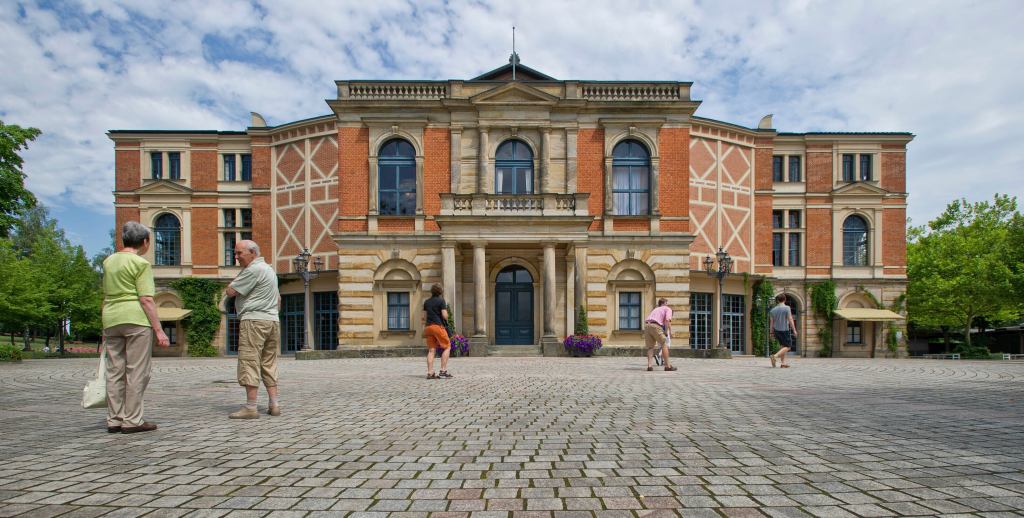
I attended Wagner’s opera *Twilight of the Gods*, and at one moment, the World Trade Center from the September 11 attacks appeared on stage. Former German Chancellor Helmut Kohl and a commemorative stamp marking German reunification also showed up in quick succession. The audience was confused, and following the show, they expressed their dissatisfaction by booing and whistling at the AI production team.
This was the setting at the Bayreuth Wagner Festival in Germany, as reported by AP News on August 2 (local time). For the first time in the festival’s history, artificial intelligence was incorporated into the performance, with the production team choosing previous shows and historical records for the AI to analyze and create fresh visual elements. *Twilight of the Gods* is a narrative rooted in Germanic and Nordic mythology, illustrating the collapse of heroes and deities. The festival organizers sought to demonstrate through AI-generated visuals how *The Ring of the Nibelung* has been understood within Germany’s national myths and during significant political and social transformations over the last 150 years.
The issue stemmed from the AI-created video. The audience lacked sufficient context to grasp why the 9/11 tragedy—a genuine historical event—was featured on Wagner’s stage. Although the festival organizers claimed that this confusion and the resulting questions were intentional as part of the performance, the audience perceived it as a random collection of historical images. Singers, musicians, and the conductor were praised, but only the AI production team was met with boos.
If the problem during the performance was not adequately explaining the AI visuals, a government agency encountered another issue: not filtering errors generated by AI. Recently, the U.S. Department of State included an AI-created inaccurate map of Africa in its presentation materials for the International AIDS Conference in Rio de Janeiro, Brazil. Nigeria was shown in the center of the Sahara Desert, Mozambique in the Horn of Africa, and Côte d’Ivoire, a country in West Africa, was positioned on the eastern side of the continent. The image also kept a watermark from an OpenAI tool.
Google Earth encountered criticism for a feature that let users generate realistic fake scenes on real maps. Google used its image-generating AI, *Nano Banana 2*, on Google Earth, allowing the creation of virtual environments over satellite, aerial images, and 3D maps. When tested by BBC, the images could easily show a collapsed Eiffel Tower, Egyptian pyramids disappearing into a sinkhole, and Russian military tanks in central Kyiv, Ukraine. Although digital watermarks were added, it was discovered that some verification methods could be circumvented. Google temporarily halted the feature within 48 hours of its launch due to rising concerns about the spread of false information.
The characteristics of the three events vary. Nevertheless, when entities perceived as reliable—such as the Wagner Festival, the U.S. Department of State, or Google Earth—distribute AI-generated material, it tends to be regarded as truth or a deliberate communication. This is why it is essential to examine content for errors prior to its release and explicitly state that it was produced by AI, along with the rationale for its application.



Leave a Reply