
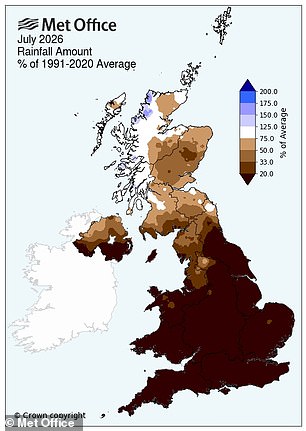
It’s confirmed – last month was the driest July on record in England and Wales, theMet Office has confirmed.
Starting in 1836, England experienced its driest July ever, receiving only 6.5mm of rain throughout the whole month.
That represents only 10 percent of its typical monthly average – and is less than half of the prior record of 13.4mm, established in 1911.
Wales received only 9.3mm of rain in July – equivalent to 9% of its typical monthly average.
And with only 1.9mm of rain, Southern England has been especially arid, facing its driest month ever recorded.
Met Office Science Manager, Dr Amy Doherty stated: July 2026 has proven to be an exceptionally notable month in the UK’s weather history.
Both England and Wales have temporarily noted their driest July in history – Wales also its shared hottest. Southern England has experienced its driest month ever recorded, while England and Wales have each had their sunniest month ever observed.
The mix of record-low moisture, extraordinary heat, and unmatched sunlight has resulted in one of the most remarkable summer months in our historical data.
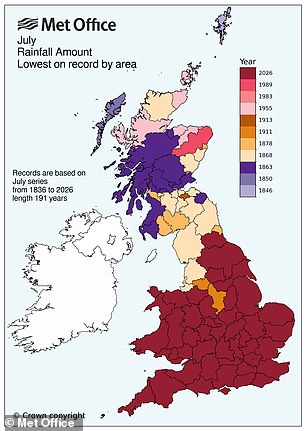
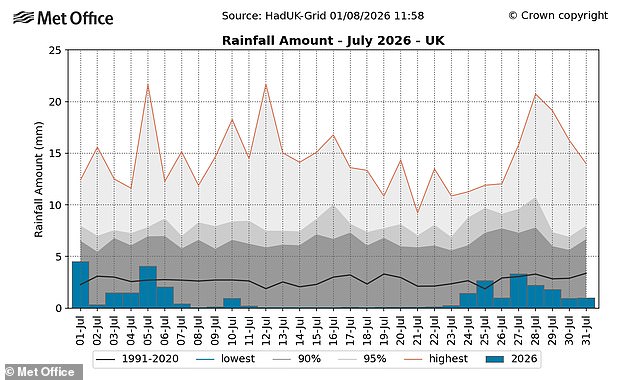
Throughout the whole of the UK, last month ranked as the third least rainy July in history.
There was 28.9mm of rain, representing 35 percent of the long-term average — the least rainfall recorded nationwide in July since 1868.
Although England and Wales experienced very little rainfall, the situation was quite different in Northern Ireland and Scotland.
Northern Ireland experienced its eighth least rainy July in history, whereas Scotland received 69 percent of its typical rainfall, making it the only region that didn’t come near setting any records.
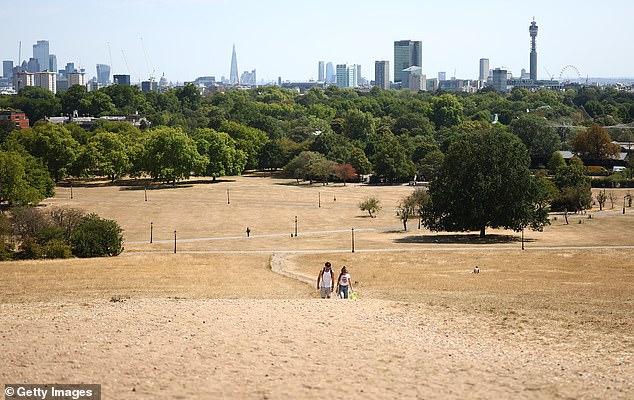
At the county level, at least 19 counties experienced less than 1mm of precipitation throughout the entire month.
Among them were: Berkshire, Dorset, East Riding of Yorkshire, East Sussex, Essex, Gloucestershire, Greater London, Herefordshire, Isle of Wight, Kent, Leicestershire, Lincolnshire, Northamptonshire, Nottinghamshire, Oxfordshire, Rutland, Surrey, Warwickshire, and West Sussex.
Helen Wakeham, Chair of the National Drought Group and Water Director at the Environment Agency, stated: ‘Prolonged dry weather reduces our water supply, and the high temperatures lead to increased usage.’
This is a challenging mix, and we are witnessing the consequences on our farmers, our wildlife, and the quantity accessible for public and commercial purposes.
Every industry is making efforts, and we appreciate the public for adhering to the restrictions that are in effect, ensuring there is sufficient water for all this summer.
We hope everyone remains safe and well-hydrated in the hot weather, but each drop we conserve is a benefit for nature and farming.
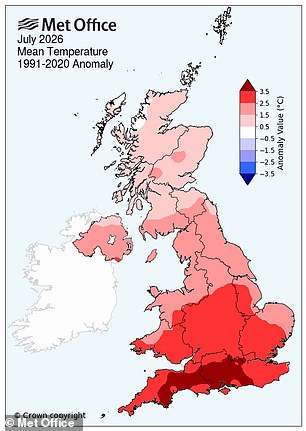
As another heatwave is taking place, it’s not surprising that July was also notably hot.
In total, the UK experienced its second highest temperature in July ever, with a mean temperature of 17.4°C.
In the meantime, Wales experienced its jointly hottest period, sharing the record with 2006 and 1983, with an average temperature of 17.8°C.
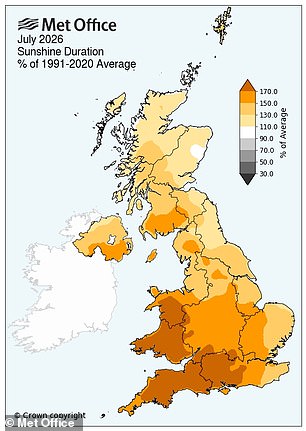
Furthermore, there was an unprecedented amount of sunlight last month.
Since 1910, the UK, England, and Wales have each experienced their most sunny July on record.
In the future, the Met Office cautions that the dry weather is expected to remain for residents in southern parts of the UK.
It mentioned that the upcoming week will bring more unstable weather to certain parts of the UK, although intense and continuous rainfall is mainly concentrated in the northern regions.
Those located more towards the southeast will experience minimal rainfall, although occasional isolated showers might occur in central and southern England.
Temperatures will slowly drop during the latter part of the week, with any remaining heat mostly limited to the easternmost parts of England on Tuesday, and a return to typical conditions for most by the end of the week.




Leave a Reply