
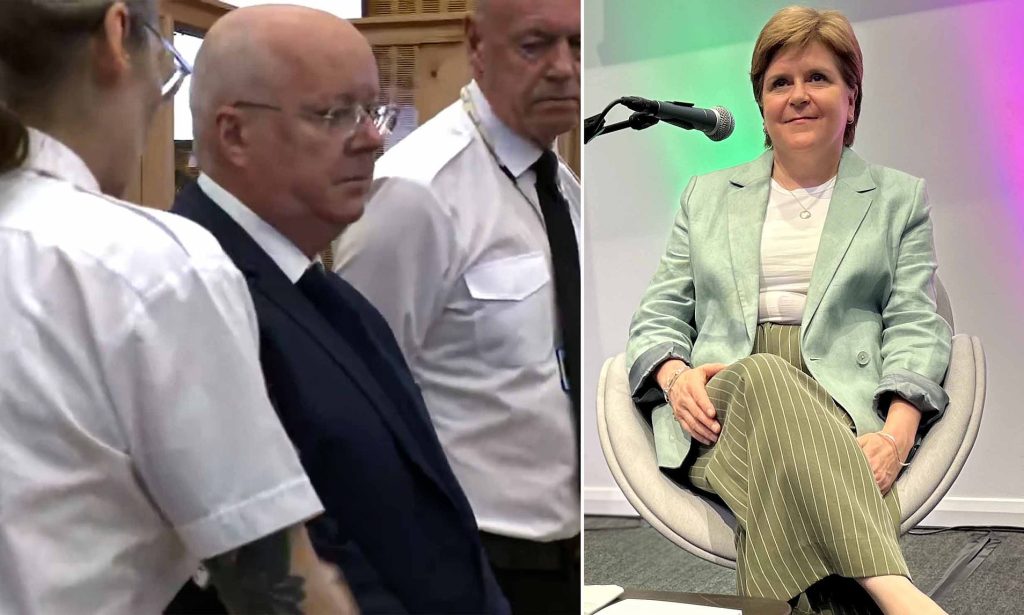
The highest judge in Scotland decided that Peter Murrell’s response to his prison sentence should not be recorded, following worries that he might become a social media joke.
Lord Pentland, serving as the head of the Scottish judiciary as Lord President, determined that it would be ‘inappropriate’ for the formerSNPHead of the company to be recorded when his sentence was announced.
He made his choice following the judge in the case stating that it would be ‘invasive’ and might be widely shared on social media – ‘potentially as a meme or GIF’.
Murrell, who is Nicola SturgeonHer estranged husband received a five-year and three-month prison sentence after pleading guilty to embezzling over £400,000 from the SNP.
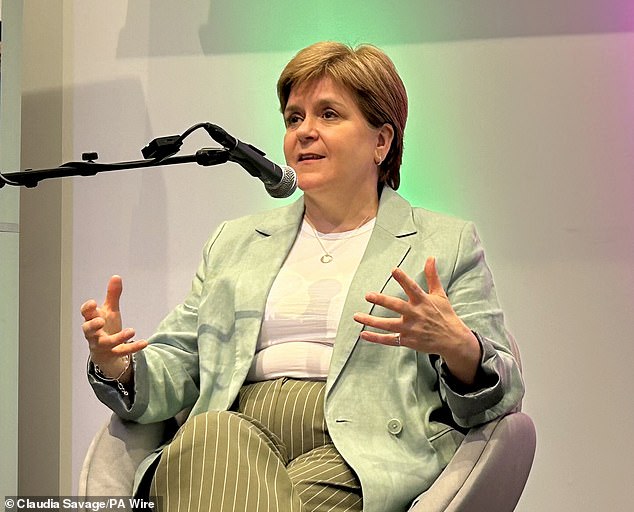
Ms. Sturgeon this week directed her anger towards her ex, claiming he subjected her to ‘suspicion, humiliation, and vilification’.
A portion of Murrell’s sentencing trial was captured by theBBCin June, covering his arrival and departure from the court.
However, documents made public under freedom of information laws show that there was resistance to granting permission to record Murrell’s reaction as he was being sentenced.
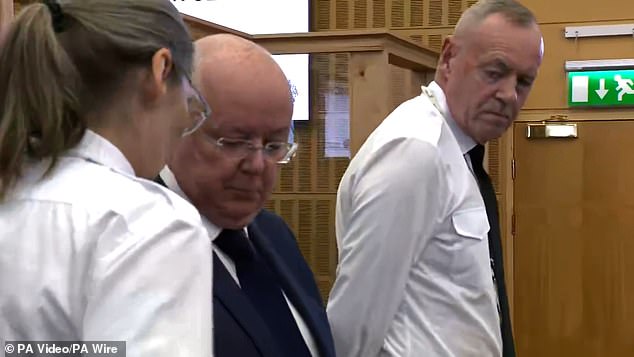
The messages, released by the Daily Record, reveal that Lord Young, the judge involved in the case, stated in an email: ‘This is a major development, and to be frank, I believe it has gone too far and is becoming overly invasive for the accused.’
I experience discomfort knowing that the defendant’s response, or absence thereof, to the verdict will be scrutinized and rewatched—potentially as a meme or GIF—in the future.
If, in this instance or any other upcoming situation, the defendant’s demeanor could be seen as indifference or even satisfaction regarding the sentence given, it may contribute to public discussion about the harshness of the punishment. I believe everything becomes very hard to manage.
Lord Pentland agreed with his point, stating: ‘I concur with Lord Young that the additional request would be unsuitable. It must be denied. They are allowed to record him arriving at and departing from the dock.’
A request for a sketch artist to be present in court was approved.
Dr. Nick McKerrell, a law professor at Glasgow Caledonian University, stated: “The implementation of cameras in Scottish criminal courts has been extremely slow. Lord Young’s remarks highlight the reason for this.”
Recording intricate legal discussions for television is one aspect. This has become standard in civil courts. However, capturing the defendant, jurors, and witnesses in real-time goes beyond acceptable limits.
A representative from the Judicial Office for Scotland stated: ‘The public is invited to attend the courts and observe all aspects of the proceedings firsthand, allowing them to gain insight into the processes and reasons behind them. For individuals unable to be present in court, recording specific sections of the proceedings in a regulated manner provides a reliable and impartial representation of justice being administered without exaggerating or undermining the seriousness of the cases.’
The Scottish courts have led the way in open justice, allowing cameras since 1992. Filming has always required approval and a thorough evaluation of its effect on the fairness of the proceedings for everyone involved. In recent years, permission has been granted to record more court sessions, such as trials for documentaries, section 76 hearings, high-profile civil cases, and live streaming of the Inner House of the Court of Session and the Criminal Appeal Court.
Filming of sentencing remarks has been permitted for several years, but this is limited to the Judge or Sheriff, with no other individuals in court being recorded. In some cases, to enhance comprehension of the sentence, filming of the plea in mitigation for news coverage has also been allowed. Nevertheless, the defendant has never been captured on camera during sentencing for broadcast purposes. We keep engaging with broadcasters and the media regarding open justice and thoroughly review any related applications.
In a fresh introduction for the upcoming paperback edition of her book “Frankly,” Ms. Sturgeon comments on Murrell’s punishment.
Accusing those who “were quick to cast suspicion my way,” Ms. Sturgeon states: “To say I feel entirely and totally betrayed is an understatement.”
It’s not only because he has lied to me and upended our lives. That would be bad enough.
But he has also brought me under suspicion, embarrassment, and abuse. It is evident that in all his actions, for whatever motive, he never considered me at all.
She also mentioned that “although I was angry, it was difficult not to feel worried about him,” as he had become “more and more isolated, quiet, and unwilling to communicate” throughout the three-year police inquiry.
However, she remarked: ‘I no longer need to experience any of that.’






Leave a Reply