
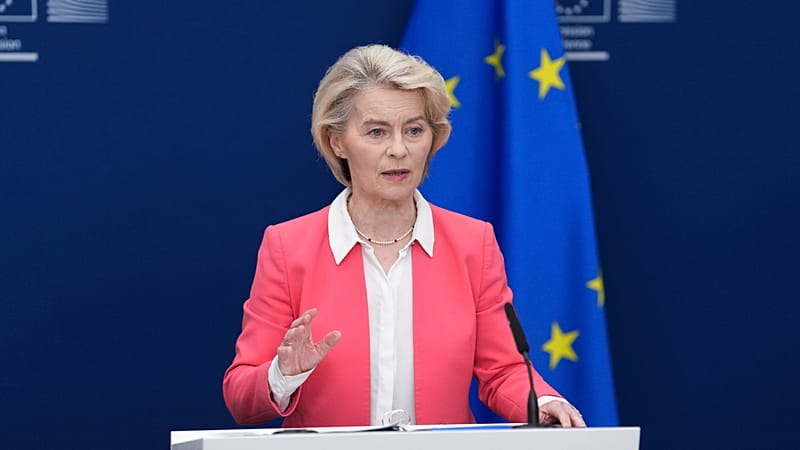
The President of the European Commission, Ursula von der Leyen, urged for enhanced border security and tangible barriers at key locations along EU borders after the Ceuta incident, as stated in a letter addressed to Spanish Prime Minister Pedro Sánchez, which was reviewed by Euronews on Monday.
The president of the commission aimed to reduce hostilities with Spain following Sánchez’s allegations that some EU leaders were exploiting the migration situation in Ceuta to criticize his administration.
Last Friday, approximately 60,000 non-EU individuals crossed into the Spanish territory of Ceuta, representing the highest number of border entries ever documented in Europe within a brief timeframe. Following several days, the majority of the migrants went back to Morocco, and conditions within the enclave have now largely stabilized.
At least 72 individuals lost their lives while trying to cross, according to local officials in Ceuta, who reported on Sunday.
Although Ceuta is situated on the African continent and none of the migrants made it to mainland Europe, the pictures caused significant responses from European governments and the European Commission.
Sánchez has faced criticism from other European governments over how he managed the crisis, while the Spanish leader has accused his colleagues of being “selfish, divisive, and illegal.”
“In this incident, it is evident that we need to take additional steps to reinforce our borders at key locations, through continuous surveillance and the implementation of physical barriers when necessary,” von der Leyen stated in the letter.
Following the event, 22 European Union governments sent a letter to EU institutions on Saturday requesting an emergency video conference of interior ministers, scheduled for Tuesday.
Among the suggestions to be reviewed during the meeting is the return of border checks inside the EU’s Schengen zone.
In her letter, von der Leyen also mentioned an active EU-Morocco agreement regarding migration that is being processed, to avoid such scenarios.
“We are currently collaborating with the Moroccan authorities to establish a more organized and future-oriented partnership with the EU,” she wrote.
“In collaboration with Spain, particularly regarding matters concerning Ceuta and Melilla, we could strengthen border management early-warning systems and increase our technical and financial assistance to Morocco,” added the president of the European Commission.
The European Union has established numerous bilateral agreements with African nations, some of which are designed to stop unauthorized departures and the movement of migrants who might later attempt to reach Europe.
Many civil society groups have criticized these agreements, alleging that the EU has not sufficiently safeguarded migrants’ fundamental rights.






Leave a Reply