

Recently, while talking about the World Cup with a Japanese journalist, I came across the comment, “This time, South Korea’s image in Japan has deteriorated because of football. It will have a negative effect on Korea-Japan relations.” There has never been a period where Korea-Japan leaders were as close as they are now, and South Koreans admire Japan’s football—so what does this mean?
The problem started when news reports arrived in Japan after South Korea was unable to automatically qualify for the Round of 32. On June 25, South Korea placed third in their group, with hope resting on other matches. While hoping Japan would beat Sweden by a large margin, the 1-1 draw resulted in headlines such as, “Japan didn’t help either.” Some media outlets criticized Japan’s strategy, stating, “Japan never helps regardless of what they do” and “Did Japan not want to win?” Domestic criticism emerged: “Why should Japan help us?” and “Blame your own inability to perform.”
These reports arrived in Japan. Responses ranged from, “Stop blaming others” and “I don’t understand Koreans.” Nevertheless, the general view was, “It’s good that there are still sensible Koreans,” which helped prevent hostility toward Koreans from growing.
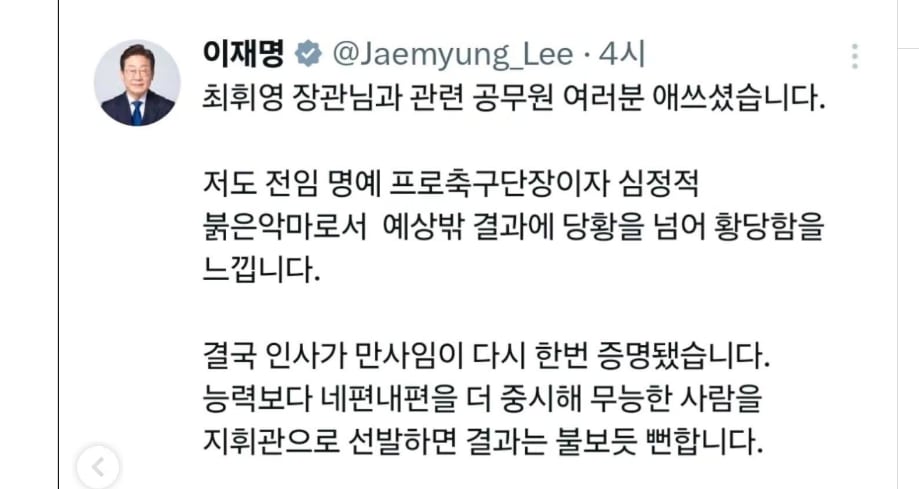
Stoking the controversy was President Lee Jae Myung’s social media update. Two days after South Korea’s elimination in the Round of 32, President Lee Jae Myung stated, “Beyond shock, I feel absurdity. If you appoint an incompetent person as a commander, the outcome is clear,” openly criticizing head coach Hong Myung-bo. The word “incompetent” appeared to surprise Japanese audiences more. Major newspapers reported on the story, with a Yahoo Japan headline receiving over 9,400 comments. Responses flooded in: “Even if there are problems, a leader publicly criticizing the national team is unthinkable” and “Who would want to coach South Korea now?”
Although the Japanese admiration for Hong, who previously played in the J-League, could have played a role, the bigger surprise was, “How could a president…?” The criticism extended to South Korea’s political culture and national traits. Remarks such as, “Koreans casually look down on others and their countries” and “It’s like watching public executions in North Korea” appeared. I remembered a Japanese individual stating, “Watching South Koreans criticize players or the team after a loss makes them seem unhappy.”
Certainly, the national team’s performance was frustrating. Problems involved the coach’s absence of strategy, confusing choices of players, and the Korea Football Association’s established monopoly. Nevertheless, individuals in nearby countries perceived the president as a head of state rather than part of the “Red Devils.” This event appears to have created skepticism in Japan: South Korea could strongly criticize them if situations shift. The leader’s individual attacks harmed the country’s reputation.
South Korea faced significant losses during this World Cup—beyond just four missed years and an early exit in the Round of 32, it also revealed a disgraceful side to its neighbors due to poor emotional control and impulsive comments. Over the next four years, I hope both the sport and its people can regain dignity through structured reforms and greater maturity.


Leave a Reply