
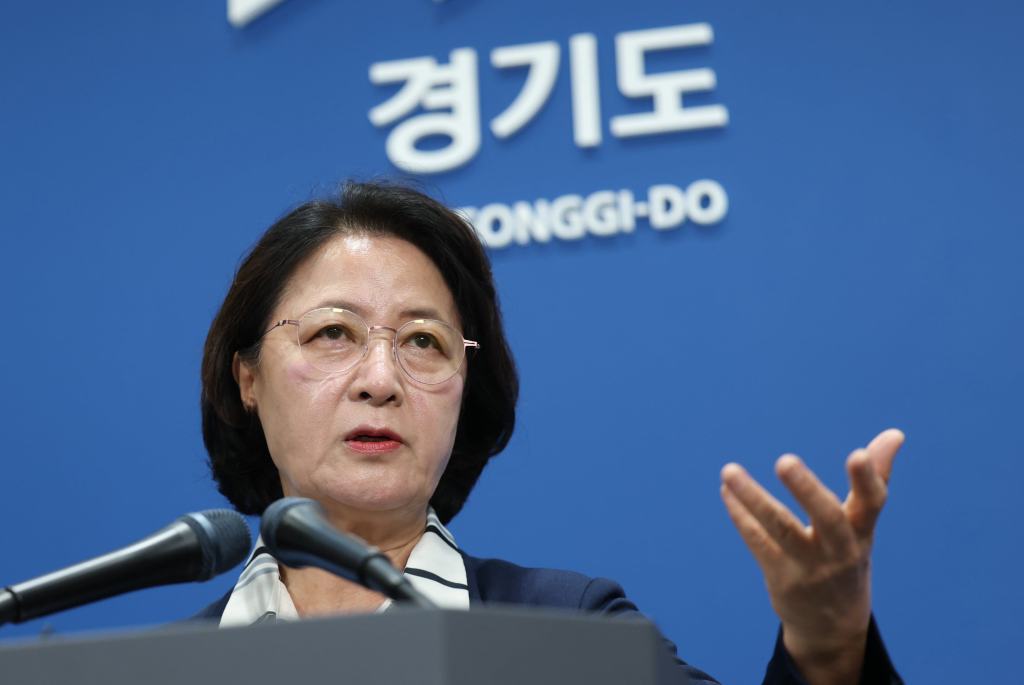
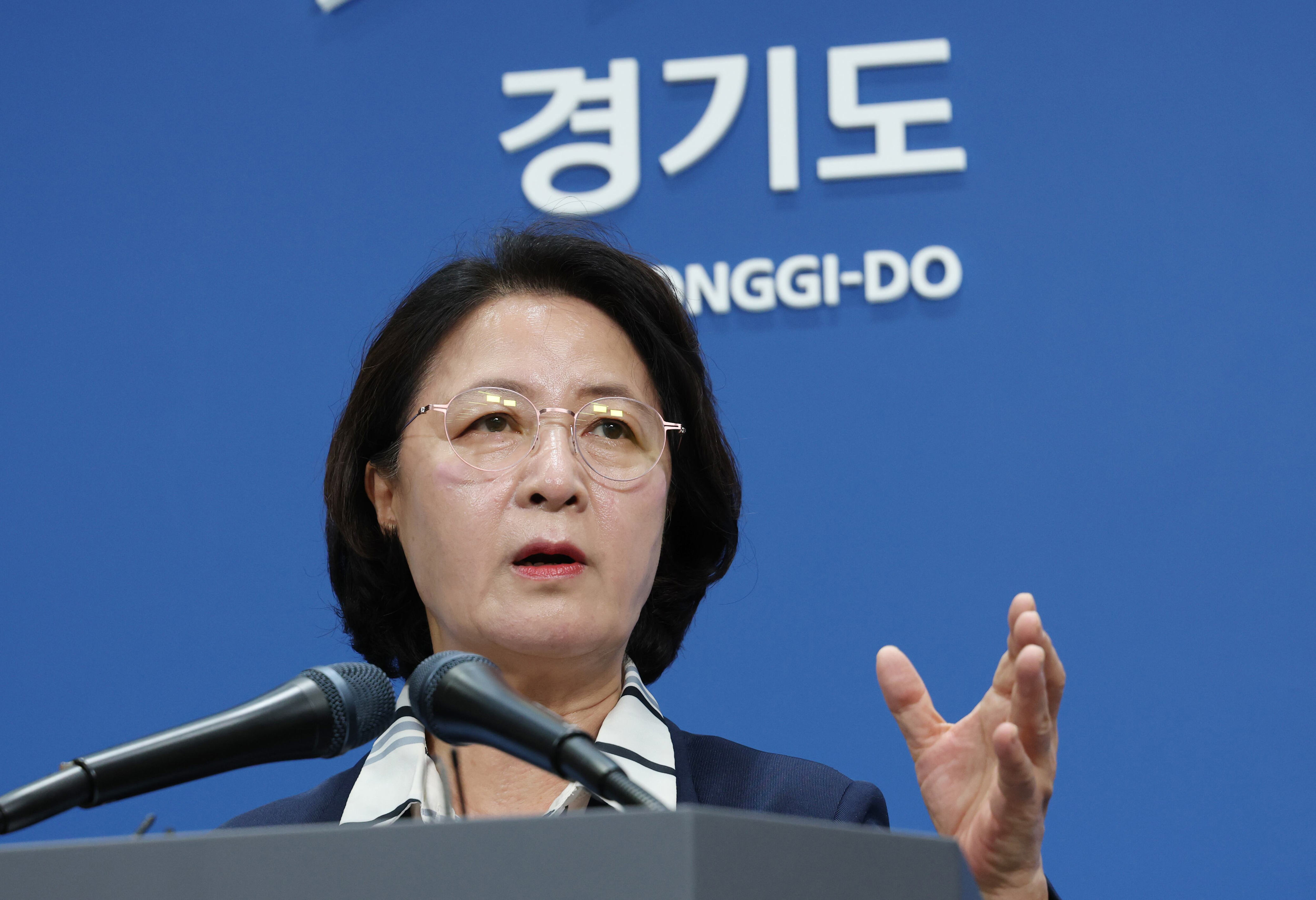
Gyeonggi Province Governor Choo Mi-ae held a press event at the Gyeonggi Provincial Government office on August 5, stating, “Starting now, I officially announce a ‘fiscal emergency’ in Gyeonggi Province.” Governor Choo, who assumed her position on July 1, mentioned, “During the previous Governor Kim Dong-yeon’s term, funds for numerous daily life and essential projects this year were only allocated for nine months rather than twelve, due to a lack of available resources.” She further noted that funding for the remaining three months (October to December 2026) for certain daily life initiatives had not been set. These include 123.4 billion Korean won for elderly long-term care, 1 billion Korean won for developing pediatric emergency medical facilities, 3.4 billion Korean won for supporting school meals using environmentally friendly agricultural products, and 8 billion Korean won for postpartum care assistance. Governor Choo emphasized, “Gyeonggi Province needs to immediately implement a supplementary budget cut of around 770 billion Korean won.”
As of June this year, Gyeonggi Province reported its debt to be 7.0415 trillion South Korean won. This consists of 1.9117 trillion won in local bonds and 5.1298 trillion won obtained from financial sources, representing an 83% rise compared to 3.8362 trillion won in 2022 when former Governor Kim Dong-yeon assumed office. Governor Choo pointed to the issuance of local bonds and reallocations of funds during Kim’s time in office as factors contributing to the financial crisis. Former Governor Kim was also affiliated with the Democratic Party of Korea, similar to Governor Choo.
In 2025, Gyeonggi Province issued local bonds on three occasions, amounting to 943 billion South Korean won, which was almost 99.6% of its annual quota. Governor Choo mentioned, “With three additional budgets in 2025, the province utilized around 558.8 billion South Korean won from different designated funds for general financial purposes.”
Governor Choo highlighted the drop in real estate transactions as a major reason for the province’s reduced financial resources. More than half of Gyeonggi’s tax income comes from acquisition taxes, mainly related to property. However, tax income from these acquisition taxes decreased from 11 trillion Korean won in 2022 to about 8 trillion Korean won this year because of fewer real estate deals. This reduction is linked to government measures like the land transaction permit system. Moreover, Governor Choo noted that the acquisition tax revenue from the third phase of new city development fell from an expected 650 billion Korean won to 230 billion Korean won, as the Korea Land and Housing Corporation (LH) directly developed public housing areas.
Governor Choo said, “Although tax revenue is declining, the financial obligations that Gyeonggi Province needs to manage are quickly rising.” She mentioned that welfare expenditures, which now make up 49% of the overall budget, are projected to reach 60% because of the increasing number of elderly residents. Indeed, Gyeonggi’s welfare budget went up from 12.2 trillion Korean won in 2022 to 17.3 trillion Korean won this year. Provincial matching funds, which are allocated based on national funding, also increased from 1.6 trillion Korean won in 2022 to 2.5 trillion Korean won this year. Even though the province’s total budget is around 41.7 trillion Korean won, Governor Choo pointed out that as of July this year, only 3.5 trillion Korean won is available for the province to use freely.
As per the Ministry of the Interior and Safety, Gyeonggi’s fiscal independence rate (using the updated revenue classification) stands at 54.39%, placing it second among the 16 major metropolitan areas across the country, after Seoul (74.04%). The province’s level of financial autonomy, which reflects the percentage of funds it can manage independently, is 62.13%, ranking it ninth.
The Ministry of the Interior and Safety has the authority to classify a local government as a “fiscal crisis entity” when its financial risks are considered significant, according to factors like the debt-to-budget ratio and overall fiscal deficit ratio. The ministry mentioned that Gyeonggi Province is not currently under consideration for deliberation as a fiscal crisis entity.
Concerning Governor Choo’s announcement of a fiscal emergency, the Democratic Party expressed criticism, stating, “Continuously highlighting the financial crisis to create worry among Gyeonggi residents is not appropriate. Rather than turning the fiscal crisis into a political issue, we will concentrate our efforts on developing effective solutions to address residents’ worries.” This implies doubt about the political intentions behind the declaration. Local political figures speculated that Governor Choo intended to set herself apart from her predecessor and provide a rationale for advancing her own policy agendas. The People Power Party remarked, “It is positive that the ‘lost eight years’ financial record under previous Governors Lee Jae Myung and Kim Dong-yeon, and the necessity for responsible and austerity-based financial management, have finally been recognized. However, the impact of budget reductions will be felt by regular citizens, small business owners, and disadvantaged groups.”



Leave a Reply