
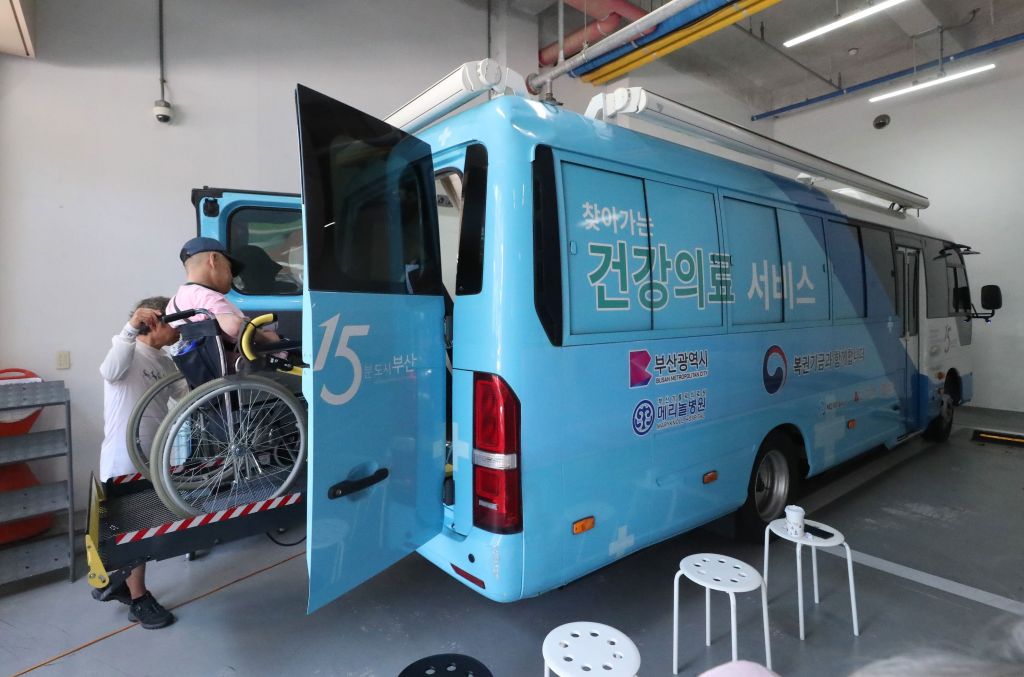
Approximately 1 p.m. on August 6, a sky-blue bus arrived at the parking area of the Seo-gu Center for the Disabled in Dongdaesin-dong, Seo-gu, Busan. After traveling along the winding, hilly roads, the elderly and disabled individuals began boarding one after another. They underwent eye exams inside the bus, which was equipped with medical equipment. Dr. Lim Seong-eun, an ophthalmologist, examined the eyes of A, an 86-year-old, the oldest patient, through a microscope. “Ma-ni, your cataracts are very serious. At this stage, you will gradually lose more vision, so I recommend surgery,” she said. Dr. Lim, who started working on the bus earlier this year, mentioned, “Sometimes, most of the elderly patients examined that day had cataracts but were not aware of it.”
This bus has been managed by Busan Metropolitan City since 2021. It provides daily transportation to welfare centers that have specialists in otolaryngology, neurology, internal medicine, family medicine, and ophthalmology, aiming to assist elderly and disabled individuals who find it difficult to visit hospitals. Although “mobile clinic buses” occasionally go to remote rural areas, Busan’s five medical buses are unique in that they regularly cover 125 out of the city’s 206 neighborhoods. Doctors are sent from local hospitals such as Pusan National University Hospital, Haeundae Bumin Hospital, Maryknoll Hospital, and Busan Catholic Medical Center. So far, almost 50,000 people have received treatment. A representative from the Busan Metropolitan Government stated, “Although Busan is a large city, the rapid aging population means many elderly miss their treatment schedules, which is why these medical buses are necessary. One in four Busan residents (24.8%) is 65 years or older, making it the fastest-aging metropolitan area in South Korea.”
In contrast to conventional rural mobile clinics, where patients typically have to go to hospitals to get their test results, Busan’s medical buses are equipped with on-site ultrasound and blood testing capabilities. There are plans to implement AI diagnostic systems. These would enable non-specialists to identify various illnesses. Jang Hyuk-jae, CEO of Ontact Health, a healthcare startup that created the bus’s technical systems (and also a professor in the cardiology department at Severance Hospital), stated, “AI has already detected patients with atherosclerosis by analyzing images from an ophthalmic microscope. In the future, medical buses that visit welfare centers with large elderly populations could identify and prevent a wide range of diseases.”




Leave a Reply