
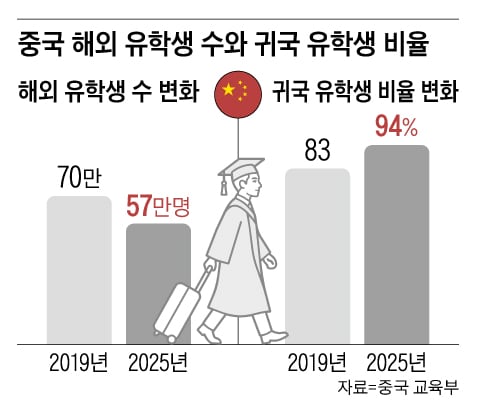
Statistical data indicates a notable decline in the number of Chinese students pursuing education abroad, whereas the count of “Haigui” (individuals who studied overseas and returned to China) has hit an all-time high. As reported by the British weekly *Economist* on the 6th, citing information from the Chinese Ministry of Education, approximately 570,000 Chinese individuals studied abroad last year, representing a drop of 130,000 compared to 2019, which is the lowest figure since 2016. On the other hand, about 540,000 Chinese returnees made up 94% of those who left the country. The *Economist* linked this shift to increasing costs associated with studying abroad during China’s economic slowdown, reduced job advantages provided by foreign degrees, and stricter visa requirements in Western nations such as the United States. The so-called “overseas study premium,” once considered a sure path to success in China, has now lost its previous impact.
First, the cost-effectiveness of studying overseas has significantly decreased. According to the Chinese education company Xinfeng, the average annual expense for studying abroad reached 605,000 Chinese yuan (around 130 million Korean won) this year, representing a 20% rise compared to 2023. At the same time, the starting salary for returnees from abroad in China averaged 12,800 Chinese yuan per month, which is only about 20% higher than that of graduates from local universities (10,700 Chinese yuan). With the real estate downturn and economic stagnation placing greater financial pressure on China’s middle class, the benefits gained from overseas degrees, which come at a cost of hundreds of millions of won, are now minimal.
The views of Chinese companies towards foreign degrees have also evolved. In China, there is an increasing perception that one-year master’s programs in countries such as the U.K. and Australia are simpler to access and complete, leading to less advanced skills than those obtained from three-year local programs. Companies now place more emphasis on hands-on work experience and ability to adapt to Chinese business culture, which has resulted in a preference for local graduates. Some regional governments have even introduced limitations on employing overseas graduates for public sector roles.
The growing competitiveness of Chinese universities has also led to a decrease in the desire to study overseas. Peking University and Tsinghua University are positioned 13th and 14th, respectively, in the QS World University Rankings, as Chinese institutions are quickly improving their research capabilities, especially in the fields of science and engineering.
The stricter visa checks implemented by the U.S. and other Western nations for Chinese students have also caused consequences. As per the U.S. Center for Immigration Studies (CIS), the number of F-1 student visas granted to Chinese citizens between May and August last year fell to 40,034, which is half of the seven-year average. The U.S. has increased scrutiny of Chinese students in high-tech disciplines and made it more difficult for them to find jobs after graduation. China’s state-owned *Global Times* condemned the U.S. for turning educational exchanges into a political issue by branding Chinese students as security risks without any substantial proof of espionage.
The pathway for foreign professionals to enter China continues to be restricted. Despite the Chinese government implementing a visa system last year aimed at drawing in international scientists and engineers, its practical application remains limited, as reported by the Hong Kong-based *South China Morning Post* (SCMP) on the 9th. According to China’s National Immigration Administration, the number of residence permits issued to foreigners in 2023 reached 711,000, which is 85% of the levels seen in 2019 before the pandemic. Approximately 237,000 of these permits were granted for employment reasons.
Some people believe that the decrease in Chinese students going overseas might limit the flow of Western technology and knowledge over time. Previously, those who returned served as intermediaries, introducing advanced technology, management practices, and local connections to China. As U.S.-China tensions reduce academic and research collaborations, the ongoing drop in student numbers could further diminish personal ties between China and the West.






Leave a Reply