
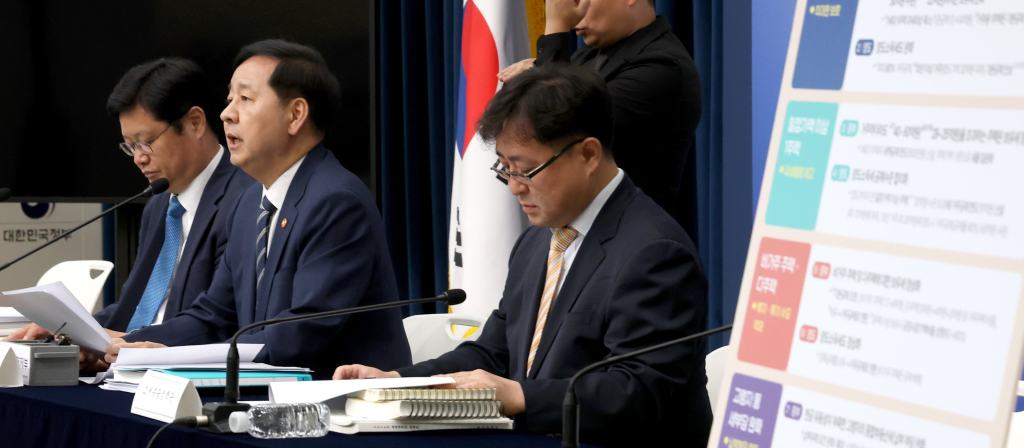
On August 7, President Lee Jae Myung directed a complete examination of the government’s proposed changes to the Individual Savings Account (ISA) system and strategies to stop “stock price suppression,” only four days after the tax reform plan was unveiled on August 3. The reforms were intended to encourage domestic investment and stop major shareholders from taking advantage of gaps for inheritance purposes, but they encountered criticism for diminishing current ISA benefits and introducing weaknesses in the stock price suppression prevention measures. Here is an analysis of the concerns.
◇ISA: 5-Year Agreement, No Carry-Forward… “Long-Term Investment Advantages Diminished”
The government intends to launch a new “productive finance ISA” aimed at encouraging local investment. Investments in local stocks and local stock funds will be tax-free, with no restrictions on interest or dividend earnings. The yearly contribution cap is 20 million South Korean won, the overall limit is 200 million South Korean won, and the account can be maintained for a maximum of 10 years.
The issue arises from the simultaneous decrease in benefits for current general ISAs. General ISAs only tax the net profit resulting from combining gains and losses from various products. For instance, if one product gains 10 million Korean won and another loses 6 million Korean won, only 4 million Korean won is subject to taxation. The general category provides an exemption of up to 2 million Korean won, while the low-income category offers an exemption of up to 4 million Korean won, with a 9.9% tax applied to any amount exceeding these limits.
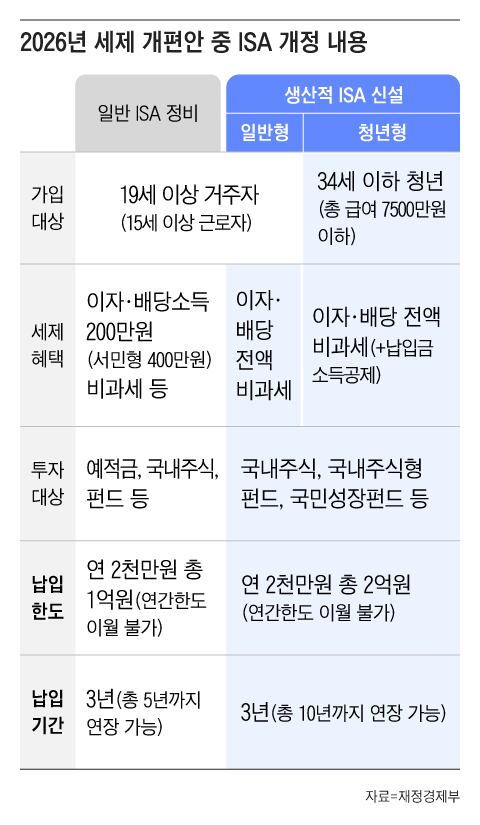
At present, accounts can be extended without any time limit following a required 3-year holding period. Taxes are postponed, enabling the reinvestment of savings, and over extended periods, gains and losses within one account can be balanced. However, the new reform restricts the contract duration to a maximum of 5 years. Every five years, profits and losses must be finalized, and a fresh ISA needs to be established, which disrupts the compounding effect and prevents the combination of gains and losses. If the first ISA experiences a loss of 5 million Korean won and the second ISA achieves a gain of 10 million Korean won, the two accounts’ gains and losses cannot be merged. The 10 million Korean won gain in the second account will be taxed, even though the overall net profit is only 5 million Korean won.
The ability to carry forward unused contribution limits will also be eliminated. If only 5 million Korean won of the 20 million Korean won annual limit is utilized this year, the remaining 15 million Korean won will not be transferable to the following year. Although individuals who can contribute 20 million Korean won annually will not be affected, young people with lower incomes or self-employed individuals with inconsistent earnings will face a disadvantage.
The newly introduced productive finance ISA no longer includes overseas index ETFs such as the S&P 500 and Nasdaq 100. Although these investments remain accessible via regular ISAs, the terms regarding the contract duration and contribution rules have become less favorable. Investors have expressed dissatisfaction with the cutback on existing ISA benefits, viewing it as an attempt to encourage a shift towards local stocks. Current account holders will maintain their existing contract periods, but any extensions beyond 2027 will be restricted to a maximum of five years. Additionally, the removal of carryover limits will affect their contributions.
◇Focusing on 1,300 Businesses, Just 130 Impacted
“Stock price suppression” means influencing or decreasing stock prices in order to minimize inheritance or gift taxes. At present, tax calculations are determined by the average stock price over a four-month period (two months prior and two months following the inheritance or gift date). Despite a company having substantial assets, lower stock prices lead to reduced taxes, encouraging large shareholders to postpone dividend distributions or stock repurchases.
The initial proposal introduced by Representative Lee So-young of the Democratic Party of Korea focused on publicly traded companies having a price-to-book ratio (PBR) under 0.8x. PBR reflects the stock price in relation to a company’s net assets. For instance, if the net assets per share amount to 100,000 Korean won but the stock price is 50,000 Korean won, the PBR would be 0.5x.

The legislation mandated revaluing stocks by factoring in cash, real estate, manufacturing facilities, and earnings, guaranteeing a minimum value of 80,000 Korean won per share. Around 1,200 to 1,300 publicly traded firms were anticipated to be impacted. Nonetheless, opponents contended that using a single 0.8x PBR for every sector was illogical. The 0.8x benchmark originated from valuations of unlisted stocks, where the minimum is 80% of net asset value. A 2025 report highlighted that in May 2025, real estate had a PBR of 0.32x, finance stood at 0.65x, IT services at 1.4x, and pharmaceuticals at 2.59x. The government determined that businesses with low PBRs due to industry-specific factors could face unjust taxation.
The updated government strategy focuses on firms with price-to-book ratios in the lowest 25% (KOSPI) or 10% (KOSDAQ) over the past 12 out of 13 half-years. Firms that have reduced their corporate value due to dual listings or the issuance of convertible bonds, with stock prices falling more than 30% from previous levels, are also covered. The National Tax Service Valuation Deliberation Committee will decide final outcomes.
However, using the long-term low PBR criterion identified only 84–87 KOSPI and 43 KOSDAQ companies—approximately 130 in total, which is one-tenth of the initial projection. If a company leaves the low PBR category twice within 13 half-years, it is removed, enabling major shareholders to temporarily boost stock prices via dividends or buybacks to evade regulation.
The tax criteria have also faced criticism for being insufficient. If stock price suppression is verified, the higher value between 130% of the present valuation and the average stock price over a period of 6 months to 6.5 years will be used. However, the average PBR for the targeted companies was estimated at 0.27x (KOSPI) and 0.29x (KOSDAQ). Even a 30% rise would only bring the PBR up to 0.35x. Extended periods of low stock prices could further reduce historical averages. Entrusting the determination of suppression to the National Tax Service committee introduces uncertainty in tax obligations and increases the potential for legal conflicts regarding tax law principles.





Leave a Reply