
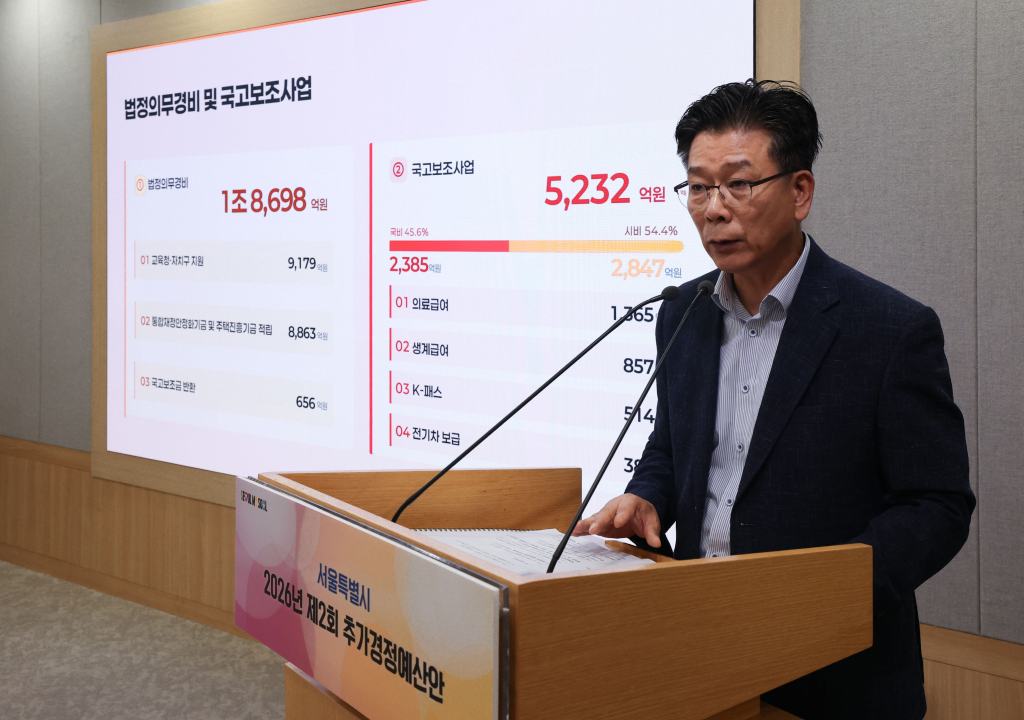
The Seoul Metropolitan Government has prepared a second additional budget of 2.8061 trillion South Korean won to cover legally required expenses that need to be accounted for during the year and to revive citizens’ living standards while boosting economic growth.
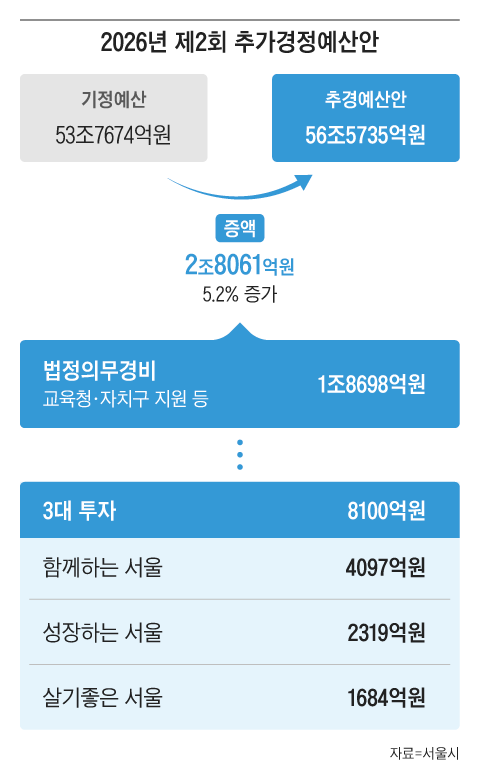
On the 10th, Seoul revealed during a press conference at City Hall that it has developed the “2026 Second Supplementary Budget” worth 2.8061 trillion South Korean won, representing a 5.2% rise over the current budget, and has submitted it to the Seoul Metropolitan Council. Should it be approved, the city’s budget for this year will amount to 56.5735 trillion South Korean won.
In early April, the city created an initial additional budget of 1.457 trillion South Korean won to manage rising oil prices, currency fluctuations, and interest rates resulting from turmoil in the Middle East. At that time, it accounted for 152.9 billion South Korean won in expenses related to support for high oil price damage, reduced the Climate Card by 30,000 South Korean won per month for three months, and increased the distribution of the ‘Seoul Love Gift Certificate’ from 150 billion South Korean won to 300 billion South Korean won.
This additional supplementary budget encompasses legally required expenditures, assistance for young people, small business operators, and individuals facing housing insecurity, along with funding for emerging sectors. Although macroeconomic conditions have improved, the city believes that issues like youth unemployment and the challenges of housing and living expenses continue to persist.
Lee Dong-ryul, who is leading the Seoul Metropolitan Government’s Planning and Coordination Office, stated, “The youth unemployment rate in June stood at 7%, while the proportion of ‘deficit households’—those whose spending surpasses their available income—increased from 26.1% in the first quarter of last year to 27.4% in the first quarter of this year,” and he added, “We have prepared this additional budget to ensure that the benefits of economic recovery are felt in people’s everyday lives.”
About two-thirds of the additional budget is made up of legally required expenditures. A total of 1.8698 trillion South Korean won was allocated: 917.9 billion South Korean won for education offices and autonomous districts according to the 2025 financial year settlement, 886.3 billion South Korean won for reserves of the Integrated Fiscal Stabilization Fund and Housing Promotion Fund, and 65.6 billion South Korean won for returning national treasury subsidies.
Approximately 810 billion South Korean won will be allocated to initiatives that citizens can experience directly. These are categorized into three areas: ‘Growing Seoul’ (231.9 billion South Korean won), ‘Together Seoul’ (409.7 billion South Korean won), and ‘Liveable Seoul’ (168.4 billion South Korean won).
Under the heading “Growing Seoul,” 5.6 billion South Korean won will support a pilot initiative offering 500,000 young people aged 19 to 29 access to cutting-edge generative AI tools, including coding resources. The project will run for approximately one year starting in October, with three months of funding allocated for 2026 and the remaining nine months included in next year’s primary budget.
An extra 4.4 billion South Korean won will boost the night-time economy. The city has set aside 1.1 billion South Korean won to distribute 10 billion South Korean won in temporary ‘Dalbit Gift Certificates’ for use at five ‘Dalbit Night Markets’ throughout Seoul, offering a 10% discount.
Furthermore, 40.3 billion South Korean won will support the expansion of electric vehicle usage, raising the goal from 21,000 to 27,000 vehicles and increasing fast chargers for electric buses from 48 to 89. The number of autonomous taxis operating at night in Gangnam will also rise from 3 to 19.
Under “Together Seoul,” 222.1 billion South Korean won will be used to enhance living support and healthcare assistance. As the median income level increases, the number of people receiving living support is expected to rise from 316,000 to 328,000, while those receiving healthcare assistance will increase from 264,000 to 279,000.
Housing assistance will be allocated 44 billion South Korean won, increasing the number of beneficiaries from 347,000 to 364,000 households. An extra 13 billion South Korean won will provide 689 public rental housing units close to transportation centers.
For the ‘Liveable Seoul’ initiative, 17.7 billion South Korean won will be used to replace 368 old subway cars on Lines 6 and 7. To address heavy rainfall, 7.2 billion South Korean won will support the construction and expansion of rainwater pumping stations in Yangjae 2, Yeongdeungpo, and Geumho. The flood-affected Siheung-dong area will get 1 billion South Korean won for additional rainwater storage basins.
A total of 76.3 billion South Korean won will be allocated for marriage, childbirth, and child-rearing support. The number of public wedding venue support cases will rise from 400 to 550, medical cost assistance for pregnant women over the age of 35 will be extended to 28,000 individuals, and infertility treatment support will increase from 60,000 to 80,000 instances.
Lee said, “This additional budget covers critical projects such as legally required expenditures, programs supported by the national treasury, and initiatives aimed at improving livelihoods, taking into account available resources and schedules,” adding, “Once approved by the council, we will implement it quickly to aid citizens’ lives and plan for Seoul’s future.”



Leave a Reply