
The head of Hong Kong’s Labour Department has announced plans to update the city’s heat stress warning system, following a former weather official’s comments.called the mechanism “decorative”for issuing solely the minimum warning during unprecedented high temperatures.
Labour Commissioner Sam Hui stated on Tuesday that his department will collaborate with the Observatory to enhance the warning system’s ability to detect “unusually high temperatures.”
Hui mentioned that he and his team were confused when the recent rise in temperatures did not lead to an increased alert through the Labour Department’s Heat Stress at Work warning system.
“When we noticed that the Heat Stress at Work warning system wasn’t activated as temperatures changed on Saturday and Monday, we had many questions,” he said in Cantonese.
Hui’s comments follow Hong Kong’s recent eventshighest temperature on recordon Sunday, the Observatory noted a temperature of 36.9 degrees Celsius at its Tsim Sha Tsui office due to the effects of Tropical Cyclone Dolphin.
Even with the high temperatures, the Labour Department’s heat stress warning system stayed at its lowest “amber” level throughout the weekend, leading former Observatory head Lam Chiu-ying todisregard the system as “confusing” and “ornamental.”
‘Hot and humid’
The alert system includes amber, red, and black warnings, and suggests various rest plans for workers who are outside or in non-air-conditioned environments. None of these suggestions are mandatory for employers.
The system suggests rest schedules based on the nature of the job and the current heat alert. Red and black alerts lead to work stoppages for employees engaged in strenuous physical tasks, although these have never been implemented.
Hui mentioned on Tuesday that the system was affected by Hong Kong’s “hot and humid” climate, yet it responded less to direct heat.
The labor commissioner stated that his department will collaborate with specialists from the Observatory to examine ways to enhance the warning system’s responsiveness to extreme heat. The update is anticipated to be finalized this summer, he mentioned.
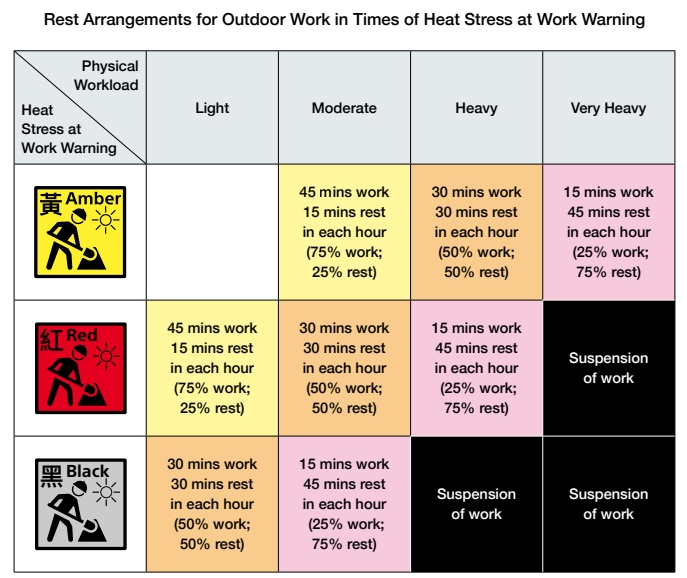
An amber alert is activated when the Hong Kong Heat Index reads 30, while a red or black warning is issued if the index reaches 32 and 34, respectively.
Besides air temperature, the index also considers other elements that influence perceived heat, such as humidity, wind speed, and solar radiation. The weights assigned to these elements in the index calculation are established using hospital admission data.
The United Nations’ Panel on Climate Change haswarnedthat the severity and occurrence of heatwaves have kept rising since the 1950s as a result of climate change caused by human activities. The increase in greenhouse gases such as carbon dioxide—which retain heat in the atmosphere—leads to higher surface temperatures on Earth, with more intense and prolonged heatwaves endangering lives.
See also: Why intense heat has emerged as the most dangerous hidden threat in global weather-related incidents
Hong Kong has already experienced a temperature increase of 1.7 degrees Celsius since the start of the Industrial Revolution, according to research from the non-governmental organization Berkeley Earth.says. By the end of the century, heat and humidity could reach deadly levels for extended periods, according to a 2023 study.study, making it difficult to remain outside in certain areas of the world.



Leave a Reply