
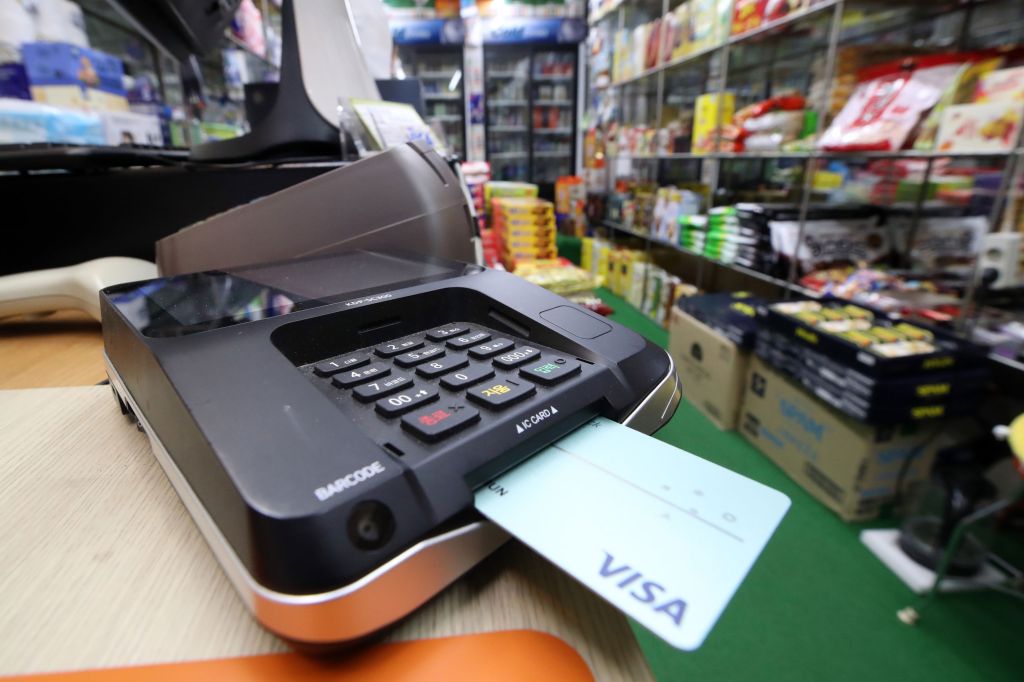

The government’s new tax reform initiative involves cutting value-added tax (VAT) credit advantages for credit card transactions conducted by individual entrepreneurs, beginning next year. Certain self-employed people have raised objections, referring to it as a “practical tax increase,” which has caused debate. The government commented, “The effect on most small business owners with annual sales of 400 million Korean won or below will be minimal.”
As per the tax reform plan announced on the 5th by the Ministry of Finance and Economy, the VAT credit rate for credit card transactions—previously set at 1.3% of sales—will be reduced to 1.2% in the following year. Moreover, the annual credit limit will be cut from 10 million Korean won to 5 million Korean won. These advantages are exclusively available to individual business owners with annual sales of 1 billion Korean won or below, a group that includes about 2.3 million people as of 2024.
Nevertheless, certain self-employed people have expressed their dissatisfaction, claiming that the lowered credit limit will raise their tax obligations. Online forums for self-employed individuals, such as ‘Because It Hurts, I Am the Boss,’ have included messages like, “The government is carelessly giving out taxes and then reclaiming them,” and “It’s getting harder to operate a business in South Korea.” Kwak Dae-jung, who uses the pen name Bong Dal-ho, a former convenience store owner and assistant to the Reform Party leader, posted on his Facebook page, “This tax credit is essential for self-employed people, particularly those running convenience stores, with almost 90% of stores across the country benefiting. For a convenience store with annual sales of 990 million Korean won, after considering income and expenses, the current VAT payment is approximately 17 million Korean won, but with the reduced credit limit next year, it will go up to 22 million Korean won—a rise of 5 million Korean won.” He criticized the present administration, stating, “This is why people say, ‘They give out 150,000 Korean won in living support funds and then take away an extra 5 million Korean won in taxes from self-employed people.’”
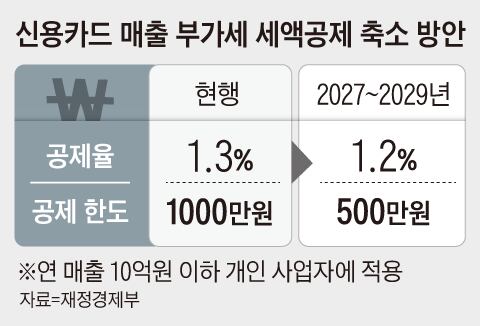
The government admitted that some self-employed people may face higher tax obligations, but it denied any intention to increase their taxes. A representative from the Ministry of Finance and Economy stated, “Lowering the preferential VAT credit rate and the cap on credit card sales is part of returning to standard procedures that were temporarily implemented during emergencies such as the global financial crisis and the COVID-19 pandemic, not an increase in taxes for self-employed individuals.” Initially, the credit system provided a 1% deduction on credit card transactions up to 5 million Korean won per year. To assist self-employed individuals during the global financial crisis, the rate was raised to 1.3% in 2008, and the limit was extended to 10 million Korean won in 2019.
The official stated, “According to historical data, businesses that have annual card sales of 400 million Korean won or less will not surpass the 5 million Korean won credit limit, so their tax obligations will stay the same even after the reduction. These businesses make up roughly 94–95% of all operators.” The government also mentioned that the initial aim of the credit system was to promote transparent sales by encouraging the use of cards instead of cash, and as card transactions are now common, it was deemed reasonable to reduce the benefits.





Leave a Reply