
NAGOYA — The increasing amount of time children are spending online has turned into a societal issue.
Shiori (using a pseudonym), a 14-year-old third-year junior high school student, is undergoing therapy with a child psychiatrist in Nagoya. She received her first smartphone in fourth grade. She had numerous friends and maintained an energetic lifestyle, spending relatively little time focused on screens during her elementary school years.
After she started junior high school, circumstances changed. She had a difficult relationship with her homeroom teacher and became ill before the summer break. According to her mother, in her 40s, Shiori started acting strangely, sometimes speaking in a confused manner or running away suddenly.
As her school absences grew, her smartphone usage rose significantly. She now spends the majority of her day at home, lounging in the living room with her phone during any spare moments. She watches a series of videos on subjects that fascinate her, such as dance and nail art, and participates in online creative projects.
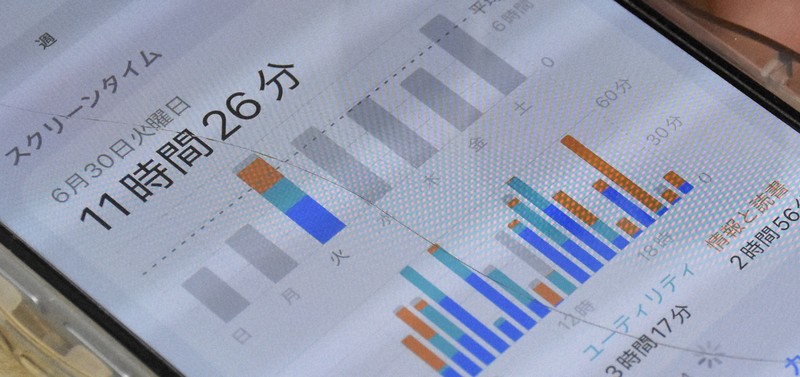
One day, she used her smartphone for a total of 11 hours and 26 minutes. A survey conducted by the Children and Families Agency revealed that middle school students spend an average of five hours and 24 minutes online daily. Shiori’s usage was more than double the average.
“I also use it for studying, but I get bored, so I end up spending hours on my phone without really doing anything,” she says.
Her mother is confused. Shiori’s makeup and textbooks are spread out in the family’s common area, yet when her mother asks her to tidy them up, she continues to be focused on her phone. The household has regulations regarding screen time, but they have not been effective.
The worse she feels, the more time she dedicates to looking at her phone without focus. So, when I notice that things are becoming serious, I speak up to her. When she starts feeling better, she occasionally engages in other activities, so my only option is to keep an eye on her and see her phone usage as a sign of her emotional condition.
Shiori isn’t content with her current circumstances. Occasionally, she deliberately disconnects from her phone, saying, “I’m going to take a bath at 7,” and then actually does so. She also takes medication to manage her sleep pattern. Although there have been ups and downs, she is striving to regain a consistent daily schedule.
Meieki Sako Mental Clinic, where Shiori is receiving treatment, often encounters patients exhibiting symptoms of excessive social media usage. The clinic’s director, child psychiatrist Ryohei Niwa, states, “There are various warning signs, such as the inability to stop despite the desire to do so, or becoming irritable when usage is limited. In recent years, we have observed a rise in issues related to dependency on digital media.” Although there is no official medical diagnosis for social media or smartphone addiction, those affected may demonstrate behaviors similar to addiction, such as becoming deeply engrossed and struggling to disengage.
Since numerous children who come to the clinic exhibit neurodevelopmental characteristics, physicians might recognize a condition like attention-deficit/hyperactivity disorder (ADHD) as the main diagnosis and view excessive internet usage as a related symptom. Shiori was found to display features of ADHD and autism spectrum disorder (ASD).
Due to numerous patients having irregular sleep patterns, they are required to maintain sleep journals and provide their screen usage records to make their schedules more apparent. Healthcare professionals then collaborate with the child and their family to explore ways to modify the child’s environment.
Over-engagement with digital media isn’t just about a lack of self-control. It frequently serves as an alert indicating the challenges children encounter in society or their neurodevelopmental characteristics,” Niwa states. “I advise families to look for external assistance, such as from healthcare facilities, and tackle the problem collaboratively with a long-term approach.
Why do kids get so engrossed in their phones? Ryuta Kawashima, a brain science professor at Tohoku University’s Institute of Development, Aging and Cancer, explains, “Since the frontal lobes, which are crucial for self-control, are not fully matured in children, they struggle to detach from addictive elements like social media.”
He cautioned that “infinite scrolling,” which constantly provides short videos with a single swipe, “exerts a strong addictive influence.”
If individuals continually encounter only attractive ‘hits,’ they may eventually lose interest. The system maintains their engagement by introducing less interesting ‘misses’ prior to presenting another ‘hit.’ The ‘hits’ trigger a pleasant reaction in the brain, which can psychologically heighten the risk of dependence and addiction.
As per studies conducted by Kawashima and colleagues, kids who spent a minimum of one hour daily online over a long time were observed to experience a slight drop in verbal intelligence after three years. The study also revealed negative impacts on the growth of cerebral gray matter and many of the nerve fibers in the cerebellum.
“I see social media as an activity that consumes time, and children, whose brains are still maturing, should be cautious about their usage,” Kawashima cautions.
(Japanese original by Ayami Abe, Lifestyle, Science & Environment News Department)






Leave a Reply