
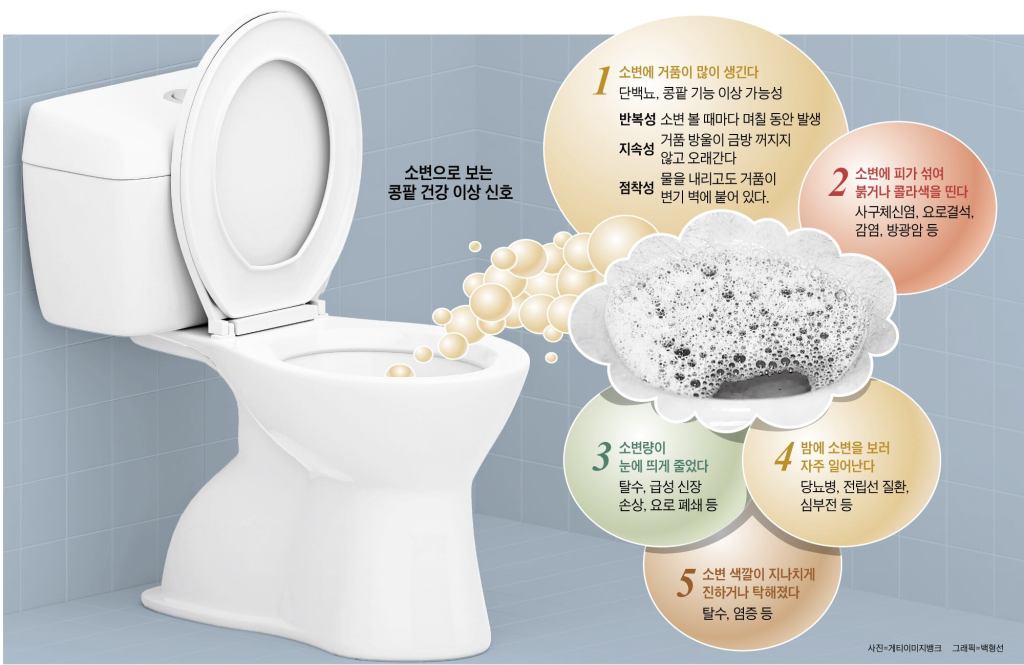
A 58-year-old corporate worker named Kim, who has high blood pressure, observed something strange while urinating one morning. A significant amount of white foam appeared on the top of the toilet water. Initially, he ignored it, assuming, “Perhaps it’s because I urinated too vigorously,” and then flushed the toilet.
However, the same issue happened the following day. As days went by, each time he urinated, small bubbles formed and did not vanish quickly. Even after flushing, some foam appeared to stick to the sides of the toilet. Worried about the repeated presence of foam, he went to see an internal medicine doctor. A urine test showed protein in the urine. Additional tests suggested early kidney damage that might be connected to high blood pressure.
A nationwide survey of 1,500 individuals aged 19 and above, carried out by the non-profit group “Practice Less Salt Eating Research Association” and funded by Korea Gallup, revealed that 25.9%—or one in four people—had encountered foamy urine. The percentage was 29.6% among men and 22.2% among women. Significantly, the occurrence rose with age: 9.7% in those in their 30s, 18% in their 40s, 28.5% in their 50s, and 42.8% for those 60 years or older. The association attributed this pattern to the growing incidence of chronic illnesses such as hypertension and diabetes, along with kidney issues, which tend to increase with age.
Cloudy urine is not always a sign of kidney issues. Bubbles may appear when urine is expelled forcefully or is highly concentrated, or it may be temporary due to vigorous physical activity, a fever, or an infection in the urinary tract. For men, urinating while standing and creating a strong flow into the toilet water can cause bubbles from the impact, but this type of foam typically disappears quickly.
A problem occurs when foam is consistently present during urination. If white foam bubbles remain for an extended period and stick to the sides of the toilet bowl after flushing, it may indicate proteinuria. Proteins have the ability to form and sustain foam at the boundary between water and air—much like how egg whites produce foam when beaten.
Professor Kim Seong-gwon, a retired nephrology professor from the College of Medicine at Seoul National University and leader of the “Practice Less Salt Eating Research Association,” said, “This study showed that people who had foamy urine were 17.6 times more likely to be diagnosed with proteinuria compared to those who didn’t. As foamy urine may indicate proteinuria, it is advised to undergo a urine test.”
What causes proteinuria? The kidneys have “glomeruli,” complex filters that stop essential blood proteins from entering urine. If these filters are harmed by conditions such as diabetes, high blood pressure, or glomerular disorders, proteins start to leak into the urine. Therefore, proteinuria acts as an indicator of issues with kidney filtration.
Professor Kim stated, “In individuals with hypertension or diabetes, proteinuria serves as an initial indicator of the advancement of chronic kidney disease. Consistently foamy urine is a noticeable sign of possible proteinuria.”
The look, amount, and frequency of urine can indicate not only the presence of proteinuria but also hints regarding hydration levels, urinary tract issues, and bleeding. Basically, health-related information generated by the body several times a day ends up in the toilet. Hence, it is recommended to examine the appearance of urine for three seconds before flushing. Public health initiatives in the UK and Australia promote checking the color and variations in urine.
Professor Kim suggested, “Verify whether the urine’s color matches your usual pattern, if it looks dark as though mixed with blood, or if there is an abnormal level of foam. A few seconds of daily monitoring is an easy method to identify the ‘silent signal’ from the kidneys at an early stage.”






Leave a Reply