
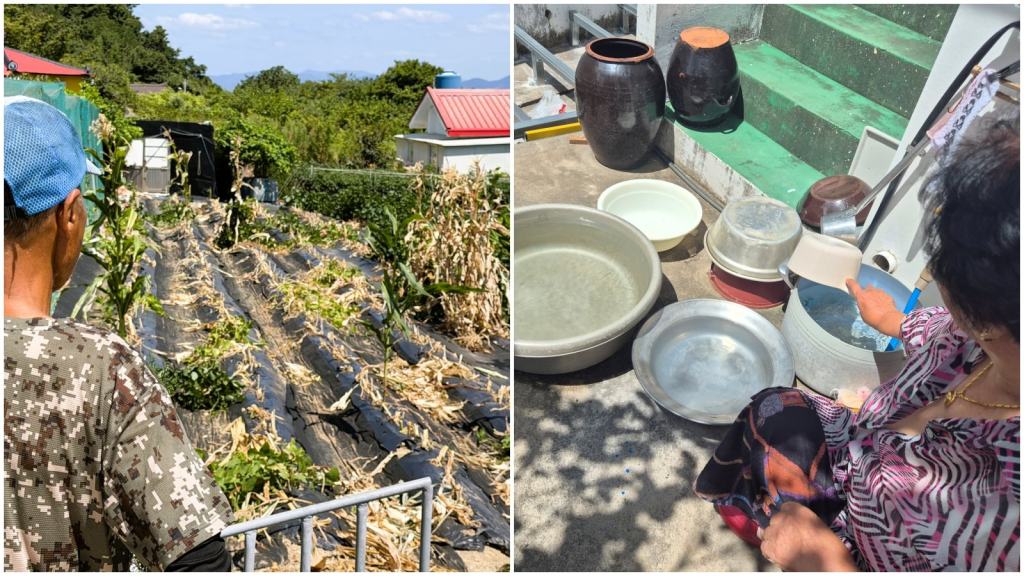
On the morning of the 12th, Chudo Island is located in Sanyang Township, Tongyeong City, Gyeongnam Province. Situated 20 kilometers from the mainland, the island covers an area of 1.6 square kilometers. It has a population of approximately 150 people. As there is no public water supply system, residents depend on groundwater and stream water. The villagers mentioned, “Due to the drought, we are reusing water two or three times just to get by as the groundwater is drying up.” Chudo has been practicing water rationing since spring. Villages with better groundwater conditions receive water for three hours daily, while others get it once every three days, for a maximum of two hours. Residents stated, “When water is available, we fill every container we have—rubber basins, PET bottles, kettles—without any hesitation. This is our lifeline.” One resident added, “We use water from washing rice for hand laundry,” and stressed, “We repeatedly ask tourists to save water.”
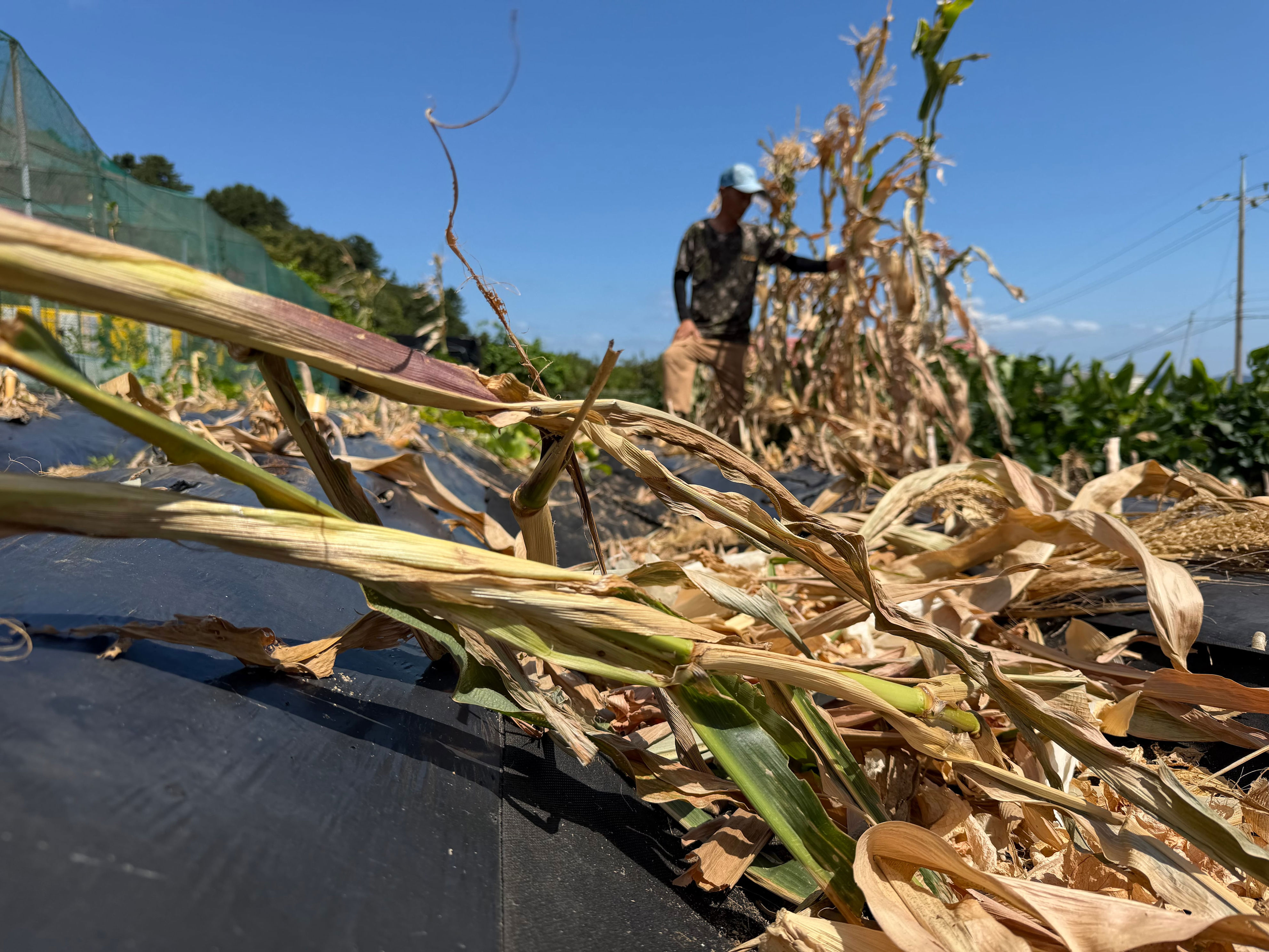
Corn grown in the fields has turned yellow. When touched, it broke apart easily. Perilla plants, which are expected to reach chest height, only reached knee level. Resident Park Seong-geun, 69 years old, stated, “How can we allocate water for the fields when even human consumption is limited?”
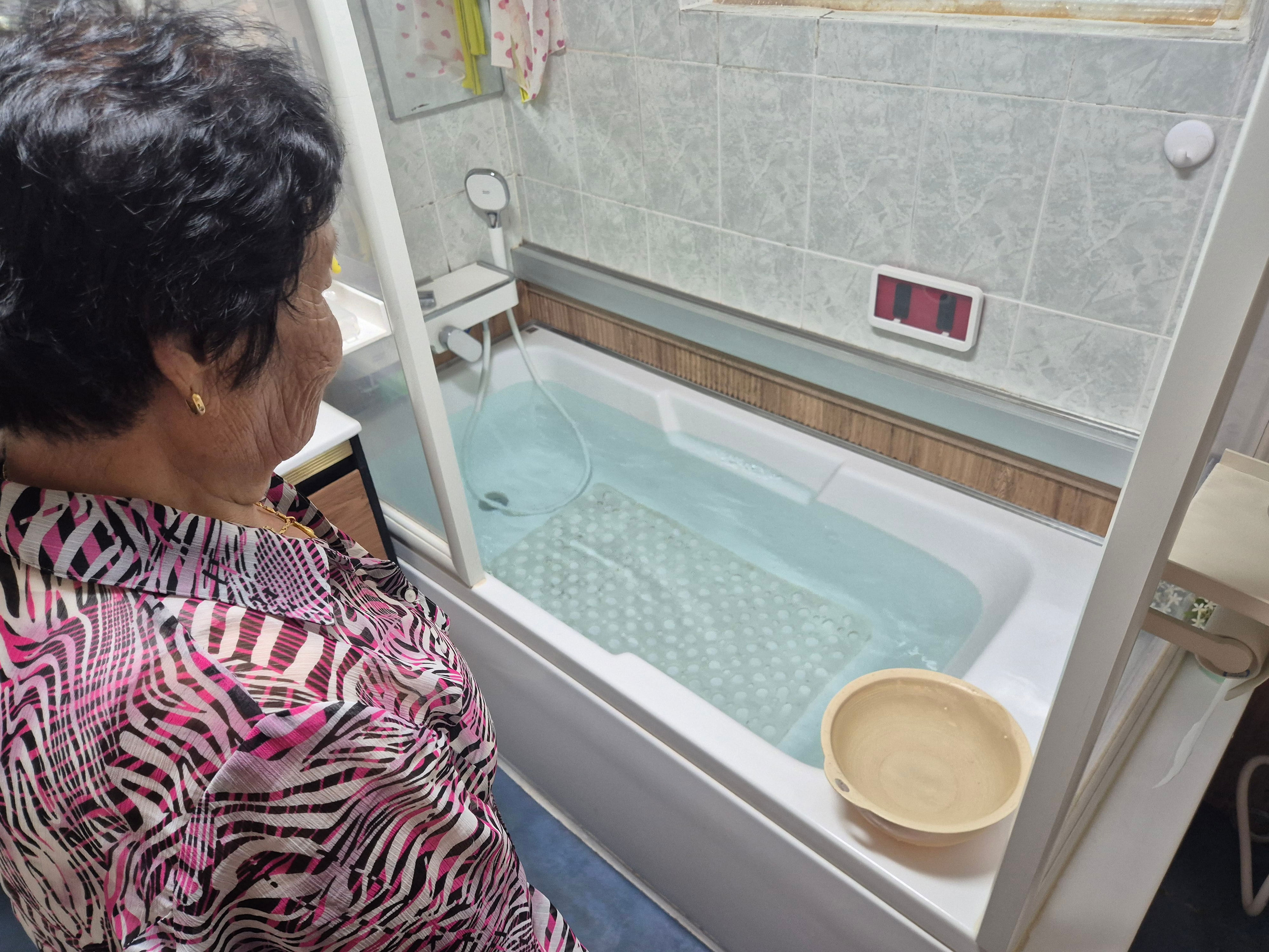
Kim Jong-sik, 72, stated, “Despite the sweat flowing in the heat, I can only take a shower once every two or three days. I wait to flush the toilet until I’ve used it two or three times.” Inside a 50-ton water collection tank that collects rainwater and groundwater, just a thin layer of water was left. Kim noted, “Water shortages on the island are not new, but this year’s drought is so extreme that reservoirs are less than 20% full compared to previous years.” Gyeongnam Province and Tongyeong City have distributed 2,500 bottles of 1.8-liter water to Chudo and plan to send a 130-ton water supply ship on the 14th.
The southern areas are experiencing a severe drought. In particular, island and mountain communities that lack public water supply systems are being affected first.
On the same day, in Namsan Village, Sangnam Township, Miryang City, homes had buckets and pots placed everywhere with no space left. Lee Young-ja, 88 years old, stated, “We need to gather as much water as possible when it is available. Even water used to wash cloths is reused for cleaning.” Lee mentioned, “At my age, I have never encountered a drought this severe.” The village located near Deokdaesan Mountain once had a reservoir, but it has now completely dried up.
Close to the reservoir, persimmon orchards displayed fruits that were shriveled or discolored. Local resident Lee Seong-ho, aged 65, mentioned, “When persimmon trees succumb to drought, it can take three to four years for them to regrow. I am deeply concerned they could perish after being nurtured for decades.”
This summer, southern areas experienced very little rain. Miryang’s total rainfall in July reached 29.4 millimeters, setting a new low for the month. A “dry monsoon season” occurred alongside heatwaves. Daily temperatures climbed close to 40 degrees Celsius, with Miryang and Yangsan experiencing record-breaking highs. Even occasional rains disappeared quickly due to the intense heat.
As per the agricultural drought management system of the Korea Rural Community Corporation, the average reservoir storage rate in Gyeongnam stands at 32.8%, which is less than half of the typical 70.9%. Miryang, Geoje, and Haman in Gyeongnam are under the highest drought alert level, “Severe,” making them the only three areas across the country at this stage. Crop damage affecting persimmons, apples, rice, and other crops is increasing. The affected area totals 2,121 hectares, equivalent to 3,000 soccer fields. On the same day, the I Tongjang Council in Bubuk Township of Miryang conducted a rain-invoking ceremony at Unjuam Hermitage on Hwagaksan Mountain.
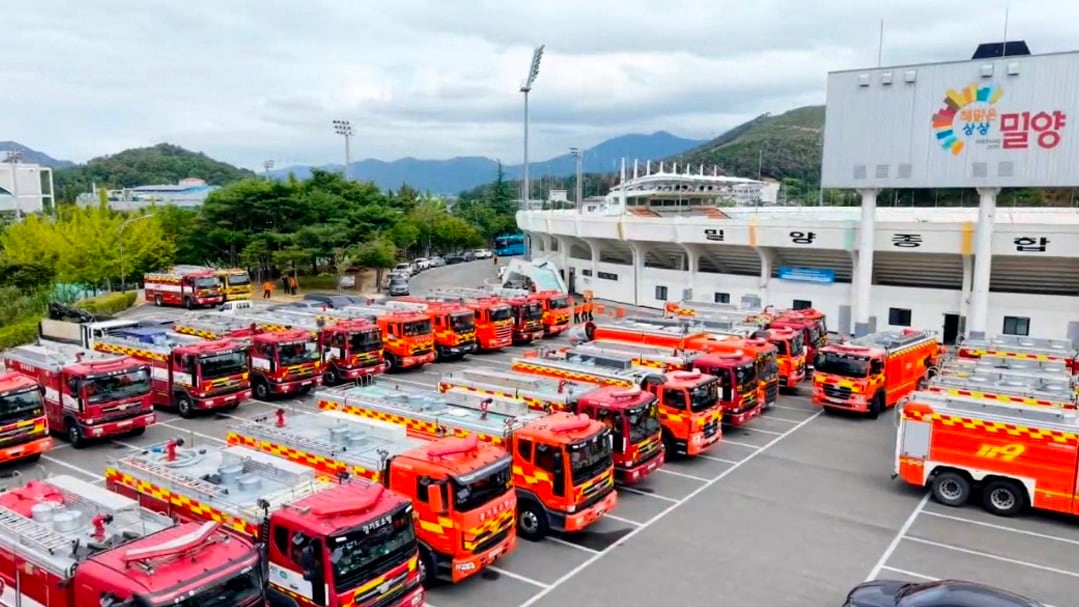
On the same day, 200 fire trucks from different parts of the country were sent to Gyeongnam. They used water from rivers to water the fields. The government issued a nationwide firefighting mobilization order the day before, which enables the complete deployment of national firefighting resources. This marks the second instance such an order has been issued because of a drought, after the August 2025 drought in Gangneung, Gangwon Province.
The conditions in the Honam region are comparable. The average water storage levels in Gwangju (35.9%), North Jeolla (36.1%), and South Jeolla (41.7%) continue to stay within the 30–40% range. Jangseongho Reservoir, located in Jangseong County, Jeonnam-Gwangju, has a storage level of 28.2%, which is the lowest ever recorded—less than half of the typical 59.8%. The reservoir has already transformed into dry land. A representative from the Korea Rural Community Corporation stated, “If there is no rainfall by the end of this month, the storage level could fall below 10% for the first time in history.”
The Okjeongho Reservoir in Imsil County, North Jeolla, has dropped to 18.6% capacity. Decreased water flow and sluggish currents have led to increased algae growth. Locals stated, “Even the water that is left is not suitable for use because of the algae.”
A representative from North Jeolla Province said, “The only answer is rain. If there isn’t substantial rain by the end of the month, both agricultural water and drinking water will become an issue.”



Leave a Reply