
President Lee Jae Myung’s popularity has dropped, and in certain polls, it has gone under the approval rating of the Democratic Party of Korea, turning the presidential approval rating into a major subject at the party’s national convention. Although all candidates for party leadership promised to bring back the presidential approval rating, their analyses varied. Kim Min-seok and Song Young-gil pointed to real estate and stock market problems, along with conflicts between the party and the government, as reasons for the drop, whereas former party leader Jung Chung-rae blamed the loss of reformist identity for the departure of core supporters. A political insider stated, “It is uncommon for contenders for the ruling party leadership to openly discuss the decline in the president’s approval rating just as the Lee Jae Myung administration begins its second year in power.”
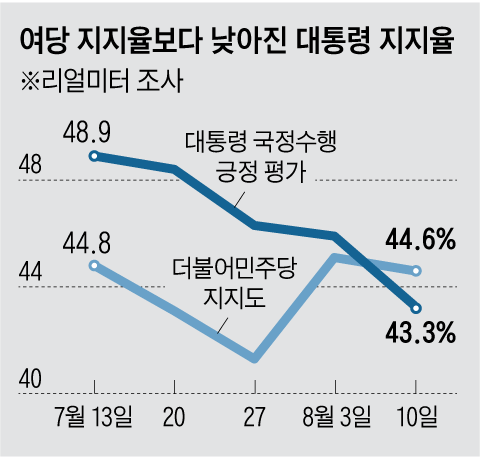
According to an automated response system (ARS) survey released on the 12th by pollster JoWon C&I, President Lee’s approval rating decreased by 4.5 percentage points to 42.9%, compared to two weeks earlier, while the Democratic Party’s approval rating increased by 0.1 percentage point to 46.4%. A Real Meter ARS survey published on the 10th also indicated the president’s approval rating at 43.3%, the lowest since his inauguration, falling behind the Democratic Party’s 44.6%. In wireless telephone interview surveys carried out by Gallup Korea and four polling organizations (Embrain Public, Kstat Research, Korea Research International, and Hankook Research), the president’s approval rating stayed in the early 50s, surpassing that of the party. However, although the president’s approval rating showed a declining trend in July, the Democratic Party’s rating slightly recovered during the same time, showing a divergence between the two (for more detailed survey information, see the National Election Commission’s public opinion survey review committee website).
Jung Chung-rae, during a appearance on Kim Ou-joon’s YouTube channel on the 11th, remarked, “It seems that core supporters have started to distance themselves,” and mentioned, “The president’s approval rating is expected to increase by more than 10 percentage points once I take on the role of party leader.” On the 12th, he held a press briefing at the National Assembly, stating, “A reform-oriented leadership—Jung Chung-rae—is necessary to enhance the president’s approval rating,” and promised, “We will restore the party’s reformist identity using the strength of its members and bring the presidential approval rating back above 60%.”
In reply, Song Young-gil labeled Jung’s analysis as “unprofessional” during a KBS Radio broadcast on the 12th. Song stated, “The drop in approval was due to moderate voters stepping back, not because loyal supporters left. The main problem lies in the mismanagement of real estate policies and the fall in stock prices caused by single-stock leveraged ETFs,” and noted, “We must avoid interfering with real estate taxes.”
Kim Min-seok, who also appeared on Kim Ou-joon’s YouTube channel on the same day, attributed the drop in approval ratings to “a weakening of the moderate voter base, as supporters withdrew due to intense internal disputes during the national convention.” He noted, “After the June 3 local elections, conservative momentum increased, and problems with leveraged ETFs and real estate arose at the same time,” and asserted, “If elected, the tension between the party and government would vanish, stopping the decline in approval ratings, leading to a 10-point recovery within three months.”
Inside the Democratic Party, opinions and predictions vary. A senior party member stated, “The drop in approval ratings is due to a mix of real estate and stock-related tax changes, single-stock ETFs, and the disorganized national convention,” and added, “Since the candidates understand the seriousness of the situation, the next leader is expected to bring together the message and take steps to restore stability.” Another party insider argued, “Although the president’s and the party’s approval ratings might have declined simultaneously because of the removal of prosecutors’ additional investigation powers and the ‘bus house’ scandal, the party’s rating seems steady only because convention supporters have come together. Once a new leader is chosen and time goes by, the party’s approval rating could also decrease.”
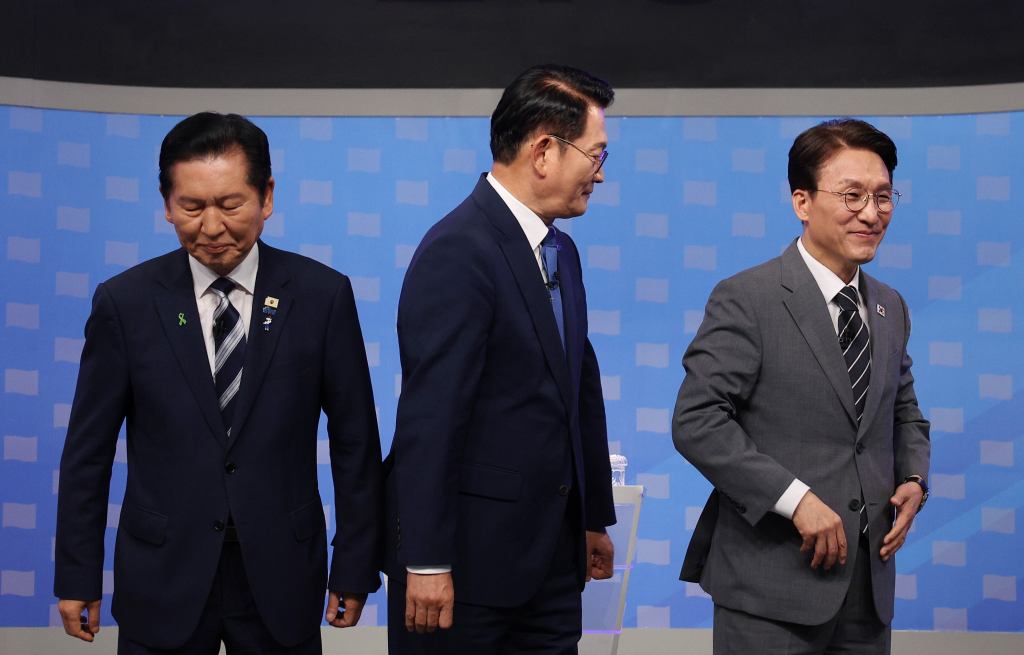
During the final televised debate held that afternoon, the party leadership candidates had a vigorous discussion. Jung Chung-rae remarked, “Many regular investors have been harmed by single-stock ETFs,” and accused Kim Min-seok, the former prime minister, of introducing the related bill and leading the Cabinet meeting that approved the launch of single-stock leveraged ETFs. Kim Min-seok responded, “Our narrow defeat in the 2022 presidential election was caused by Jung Chung-rae’s ‘Bongi Kim Sun-dal’ comment, which created tension with the Buddhist community,” and questioned, “Why didn’t you apologize and step down from the party at that time?” Song Young-gil criticized Jung, stating, “During your time as party leader, you failed to grasp the government’s policy direction and reignited rebellious forces by unilaterally declaring an end to the rebellion.”


Leave a Reply