

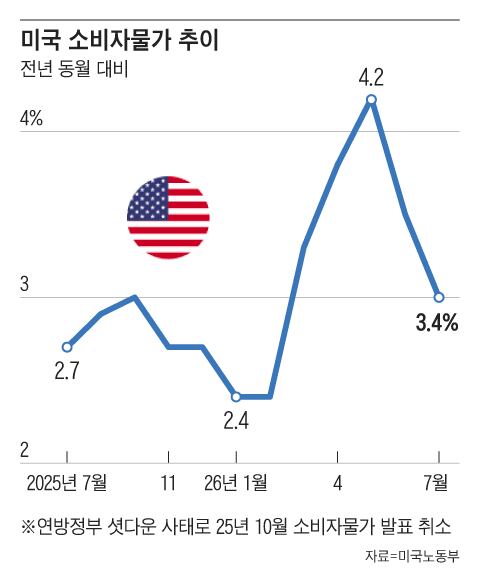
The U.S. consumer price index (CPI) for July increased by 3.4% compared to the previous year, as reported on the 12th (local time), bringing a sense of relief to Wall Street. Although worries had risen that inflation could spike because of the conflict in the Middle East and high oil prices, the CPI growth rate stayed in line with what analysts had predicted. Alongside an unexpected drop in employment last week, the pressure on Federal Reserve Chairman Kevin Warsh to increase interest rates in September has greatly decreased. The Wall Street Journal (WSJ) stated that the inflation data released that day “gave the Fed more time.”
◇Avoided the worst-case scenario
The main emphasis on Wall Street has recently returned to macroeconomic data. As the second-quarter earnings period approaches its conclusion and discussions between the U.S. and Iran regarding the Strait of Hormuz fluctuate between advancement and deadlock, investor focus has shifted back to “interest rates.” The surprising decline in July employment numbers, released on the 7th, added more complexity. Should inflation rise while job market activity slows, the Federal Reserve would encounter a challenging dilemma between maintaining economic stability and managing price levels.
Nevertheless, the most recent data has eased concerns about the worst-case situation. The CPI in July climbed 3.4% compared to the previous year, meeting market predictions and decreasing from June’s 3.5%. On a monthly basis, it went up by 0.1%. The core CPI, which excludes food and energy, also decreased to 2.5% annually from June’s 2.6%. Although prices have not dropped significantly, there is no indication of inflation picking up again despite elevated oil prices.
◇“Warsh has gained time”
Wall Street’s view suggests “the urgency for a rate increase has decreased” rather than “the chance of a rate hike has disappeared.” WSJ Fed expert Nick Timiraos noted that the CPI data “gave the Fed more time to maintain its outlook.” The numbers were not low enough to eliminate the possibility of rate hikes, nor high enough to require an immediate increase in September. Neil Dutta, an economist at Renaissance Macro, said, “It had a greater impact on those favoring hikes than on those who are more cautious.” Dan North, chief North America economist at Allianz Trade, added, “It made the Fed’s task somewhat easier. The pressure for rate hikes that everyone expected has eased, and inflation seems to be stabilizing.”
Interest rate futures responded immediately. As per CME FedWatch, the chance of a September rate pause increased to 59.9%, compared to nearly equal chances of a hold or a 0.25 percentage point increase just a day earlier.
Chairman Powell also found some relief. During the most recent Federal Open Market Committee (FOMC) meeting, three of the 12 voting members supported a rate increase, and recently at least six indicated they would be open to backing a hike based on inflation developments. However, analysts note that with employment unexpectedly declining and inflation remaining within projections, the arguments for a September increase by the more hawkish members have been undermined.
◇”Without the war…”
A more detailed analysis of the data shows another explanation for Wall Street’s satisfaction. The core CPI in July (2.5% year-over-year) has gone back to the level it was at before the U.S.-Israel strike on Iran in February. This has resulted in views that, without the Middle East disruption, U.S. inflation could have been moving closer to the Fed’s 2% goal.
Nevertheless, caution is still necessary. The recent decline in inflation was partially influenced by decreasing energy costs. However, with talks to reopen the Strait of Hormuz not making progress, global oil prices have approached $90 per barrel. Should the recent rise in crude oil prices eventually affect gasoline and transportation expenses, the CPI in August might increase again.
In the end, July’s 3.4% CPI is viewed not as a figure that solves the Fed’s challenge but as one that provides a temporary reprieve to postpone a decision. Investors will now turn their attention to the producer price index (PPI) on the 13th, followed by the August CPI scheduled for September 11—the last inflation data prior to the September 15–16 FOMC meeting. With job market slowing and oil prices increasing again, whether inflation remains stable in August is expected to be the key factor influencing the September interest rate decision.






Leave a Reply