
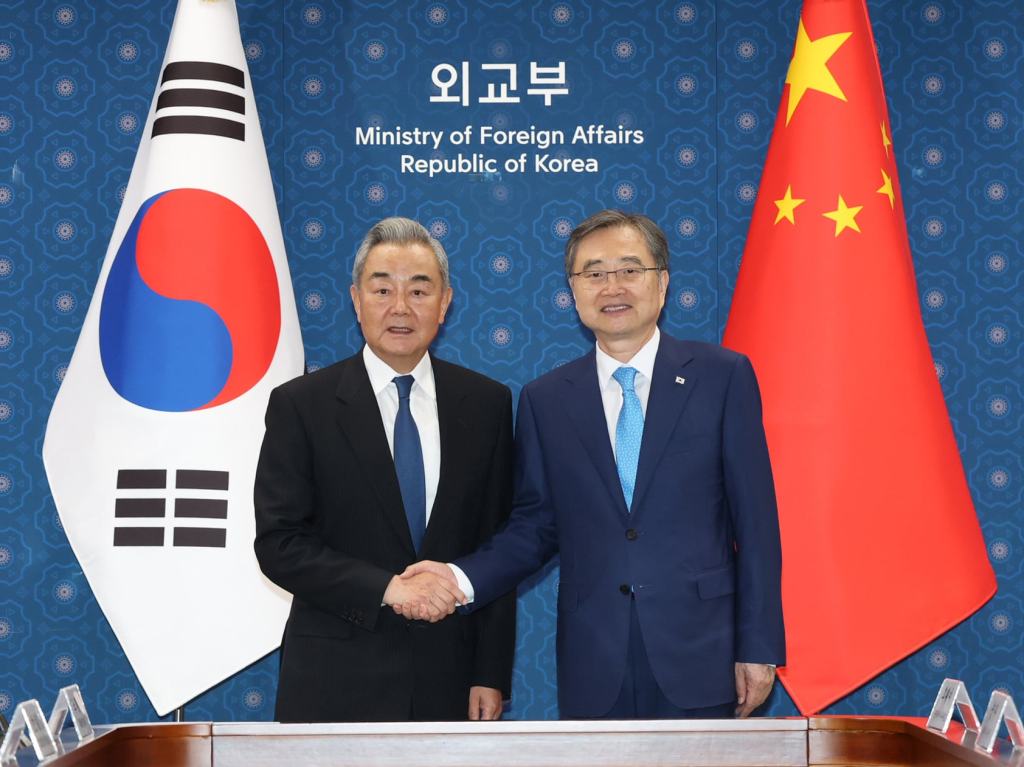
Issues have arisen regarding whether the Chinese Ministry of Foreign Affairs’ mention of the two Koreas as “the two countries of South Korea and Chosun (North Korea)” in a press statement concerning the South Korea-China foreign ministers’ meeting indicates approval of North Korea’s antagonistic two-state concept.
The Chinese Ministry of Foreign Affairs, in a statement published on its website after 11 p.m. local time on the 19th, outlined comments made by South Korean Foreign Minister Cho Hyun and Chinese Foreign Minister Wang Yi during their meeting in Seoul. It mentioned that Wang Yi “hopes that South Korea and North Korea can gradually move toward peace or coexistence, and sincerely hopes for the continued stability and development of the Korean Peninsula.”
◆”South Korea-Chosun Two Countries” Labeling by the Chinese Ministry of Foreign Affairs… “Implies Endorsement of North Korea’s Hostile Two-State Concept”
The Chinese Ministry of Foreign Affairs stated, “Foreign Minister Wang Yi shared his perspectives on the situation on the Korean Peninsula in response to inquiries and outlined China’s consistent and principled position.” According to the ministry, Wang Yi mentioned, “As a responsible major power, China ensures continuity and stability in its foreign policy and aims to contribute positively to achieving peace and stability on the peninsula. We are hopeful that South Korea and Chosun will gradually move toward peaceful coexistence and ultimately attain long-term and sustained stability on the peninsula.” In its press release, South Korea’s Ministry of Foreign Affairs referred to Wang Yi’s comments as addressing “North and South.” China did not include references to the denuclearization of the Korean Peninsula that were present in Foreign Minister Cho Hyun’s statements.
Professor Joo Jae-woo from the Department of Chinese Studies at Kyung Hee University posted on Facebook on the 20th, stating that Wang Yi “implied acceptance of North Korea’s hostile two-state theory,” and mentioned, “As North Korea officially introduced this theory in 2024, China has remained quiet.” Joo pointed out, “This is the first time I remember China using the phrase ‘two separate states of South and North Korea’,” and in reference to Wang Yi’s comment about “gradually moving toward peaceful coexistence,” he added, “This indicates tacit approval of the ultimate goal of the hostile two-state theory.”
Article 5 of the 1992 South Korea-China joint statement regarding the establishment of diplomatic ties clearly mentions, “The Chinese side supports the peaceful unification of the Korean Peninsula by the people of Korea.” This highlights the view that South and North Korea are not distinct entities but are progressing toward “peaceful unification.” North Korean leader Kim Jong-un, during a December 2023 party conference and a January 2024 speech to the Supreme People’s Assembly, described inter-Korean relations as “hostile wartime relations” and prohibited terms like “unification,” “Korean people,” and “three-thousand-ri golden nation.”
◆ “China’s Reference to ‘South Korea and North Korea’ Should Not Be Ignored”
Kim Gunn, a People Power Party lawmaker and former diplomat, wrote on Facebook the same day, “Foreign Minister Wang Yi’s public use of the term ‘the two countries of South Korea and North Korea (韩朝两个国家)’ is not an expression to be taken lightly. In past South Korea-China summits or foreign ministers’ meetings, China primarily used terms like ‘both sides of the South and North’ or ‘inter-Korean relations’ when mentioning the Korean Peninsula issue.” Kim added, “This remained the case even after Kim Jong-un defined inter-Korean relations as ‘hostile two-state relations’ in late 2023. During Foreign Minister Cho Tae-yul’s visit to China in 2024, Wang Yi also mentioned the ‘Korean Peninsula issue’ but did not refer to South and North Korea as ‘two countries.’”
Kim stated, “This episode serves as a glimpse into what occurs when we refer to North Korea as ‘Chosun.’ South and North Korea will start being viewed as distinct entities, and South Korea’s historical claims over the North will diminish. If the global community starts reinforcing the idea that South and North Korea are entirely separate states, it could jeopardize not only the constitutional principle of peaceful unification but also South Korea’s constitutional and historical connections and position in its relationship with North Korea.” Kim emphasized, “It has become clear that the government is sending incorrect messages to neighboring countries by bringing up these issues too quickly without proper internal coordination or public agreement. The government needs to understand that it might face significant consequences by providing neighboring countries with reasons to approach inter-Korean relations and the Korean Peninsula issue in ways that go against South Korea’s goals.”
Unification Minister Chung Dong-young has previously supported the idea of a “peaceful two-state relationship” between South and North Korea, frequently using the official name of North Korea, the “Democratic People’s Republic of Korea,” or its abbreviation, “Chosun.” During a briefing on the Ministry of Unification’s work plan at the Cheong Wa Dae state guest house on the 5th, President Lee Jae Myung warned Chung, stating, “The use of the official names of South and North Korea is a topic of discussion,” and advised taking a careful stance.
◆North Korea and China Harmonizing Following Summit
After Chinese President Xi Jinping’s visit to North Korea in June, the two nations committed to offering strategic support regarding the situation on the Korean Peninsula and their fundamental national security interests. Since then, they have synchronized their foreign policies, particularly concerning the United States. The day prior, Wang Yi outlined a boundary for mediating a U.S.-North Korea summit, stating, “This is a decision that must be made between North Korea and the U.S.,” and emphasized, “In particular, the U.S. needs to alter its long-standing hostile approach toward North Korea.” At a similar time, Kim Yo-jong, a high-ranking official in the Workers’ Party, also urged the U.S. to abandon its adversarial stance toward North Korea in a statement issued by the Korean Central News Agency, noting, “The U.S.’s hostile policy toward Chosun has remained unchanged.”
In the meantime, Foreign Minister Cho Hyun shared on Facebook on the 20th, “After yesterday’s discussions and dinner, this morning I had a casual meeting with Chinese Foreign Minister Wang Yi in a more relaxed setting,” and shared an image of them walking together along the Namsan fortress wall. Cho mentioned, “Next year will celebrate the 35th anniversary of South Korea-China diplomatic ties. I will actively collaborate with Foreign Minister Wang to maintain the momentum of bilateral relations that have been strengthened through the state visits of our leaders.”





Leave a Reply