
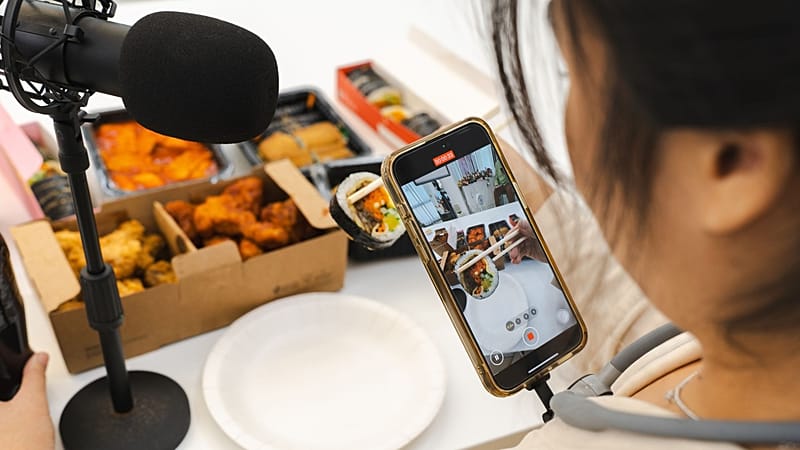
TikTok is emerging as a mixed bag of nutritional guidance for teens: the app can provide recipes, culinary inspiration, and more balanced food options, yet it also introduces young individuals to diet trends, unattainable body standards, and possibly inaccurate health information. This results in a challenging setting for teenagers who are still forming their views on food, wellness, and self-image.
A recent study A study involving teenagers between the ages of 15 and 16 revealed that food-related content on TikTok can spark hunger, motivate young individuals to experiment with new dishes, and in certain instances, affect their eating habits as they strive to copy influencers.
Teenagers characterized TikTok as a very interactive space where food-related videos can swiftly grab their focus and trigger a craving to eat or experiment with something new,said the study’s author, Adrianna N. Bell.
The results emerge as officials and judicial bodies examine more closely the effects of social media on children and teenagers.
Currently in the US, Meta is encountering a legal disputeamid claims that it intentionally created Facebook and Instagram to be habit-forming for younger users. Meanwhile, in Europe, TikTok faced similar accusations.violation of the European Union’s online content regulations, exposing kids to online bullying or communication from abusers, as certain national governments are considering restrictions on social media apps, such as TikTok, for minors.
The TikTok study introduces a new aspect to the discussion: what occurs when social media doesn’t merely affect teenagers’ emotions, but also their food preferences?
It makes me want to give it a try
The research explored how teenagers viewed TikTok’s impact on their dietary habits and the extent of their parents’ involvement.
Teenagers outlined a food landscape where trends, advertisements, recipes, dining critiques, and content from influencers could rapidly transform interest into hunger.
Popular cuisine was especially influential because it was novel — and because everyone else seemed to be giving it a try.
“The reason I want to [try the popular dish] is because I think, ‘why do so many people want to do it, what’s so special about it?’ which makes me want to give it a try,” said one of the teenagers involved in the study.
Appearance was also important. Delicious food, well-made videos, and favorable comments could spark desire. Teenagers mentioned they considered comments when determining whether to trust a suggestion.
Influencers played a significant role in the mix as well.
A participant mentioned altering their eating habits following the viewing of an influencer who had a well-defined body:
Sometimes, I alter my eating habits. Because I’ve seen some guys who are really muscular and have great physiques, and I think wow. So I check out their account to see what they’re eating. Then I sometimes adjust my diet to try to match theirs.
As a result, the influencer doesn’t always have to directly promote a food item. The message might instead focus on a way of life — with food shown as a component in achieving a specific physique or look.
When fast food begins to seem ordinary
The research also emphasizes the significance of TikTok’s algorithm.
Teenagers mentioned that their food selections might be influenced by what was shown on their customized For You page. Continuous exposure could also influence how they viewed specific foods.
“I notice a lot of fast food, and it’s like I don’t view it as unhealthy even though it’s actually quite unhealthy,” another person remarked.
This highlights wider worries regarding the promotion of food on social media platforms. Studies have shown that teenagers often encounter food advertisements online and may be more drawn to social media ads compared to conventional television commercials.
A new comprehensive review and meta-analysis also discovered that when celebrities and influencers endorse foods rich in fat, sugar, and salt, it can lead to higher intake of these items among teenagers.
Nevertheless, on TikTok, it can be more challenging to distinguish advertising from entertainment.
Food content may serve as a brand advertisement, an influencer’s suggestion, a dining critique, a trending recipe, or a creator participating in a popular challenge. The promotional message could be hidden inside a video that appears to be regular user-generated material.
Then there are the parents
Perhaps the most remarkable discovery relates to what occurs beyond the screen.
Most teenagers indicated that their parents had minimal or no involvement in their daily TikTok activities. However, when parents did get involved, “they also mentioned instances where parents made a significant difference by stopping exposure to food-related content and promoting thoughtful discussions about it,” Bell said.
Occasionally, the intervention had nothing to do with TikTok. Shared family dinners, time spent with brothers and sisters, or merely having parents present could break extended sessions of scrolling and decrease exposure to food-related material.
Other adolescents mentioned a more straightforward type of parental impact: developing the ability to challenge what they encounter on the internet.
One individual mentioned that their mother had clarified that influencers possess varied body types and ways of living, indicating that emulating their diet might not yield identical outcomes, as she experienced after trying a diet featured on TikTok.
“… because TikTok told me when I was young that, ‘do this [diet] and you’ll be slim in 22 days’ and I took that seriously,” a participant said.
This suggests a type of parental engagement that focuses less on monitoring and more on understanding media.
Although the research is limited and preliminary, with only 25 adolescents involved, the conclusion is evident: TikTok is not merely displaying how food appears. It has the power to influence what is considered appealing, trendy, and standard.
And occasionally, as one young person expressed, that is enough to make them consider: “I really want to give it a try.”





Leave a Reply