
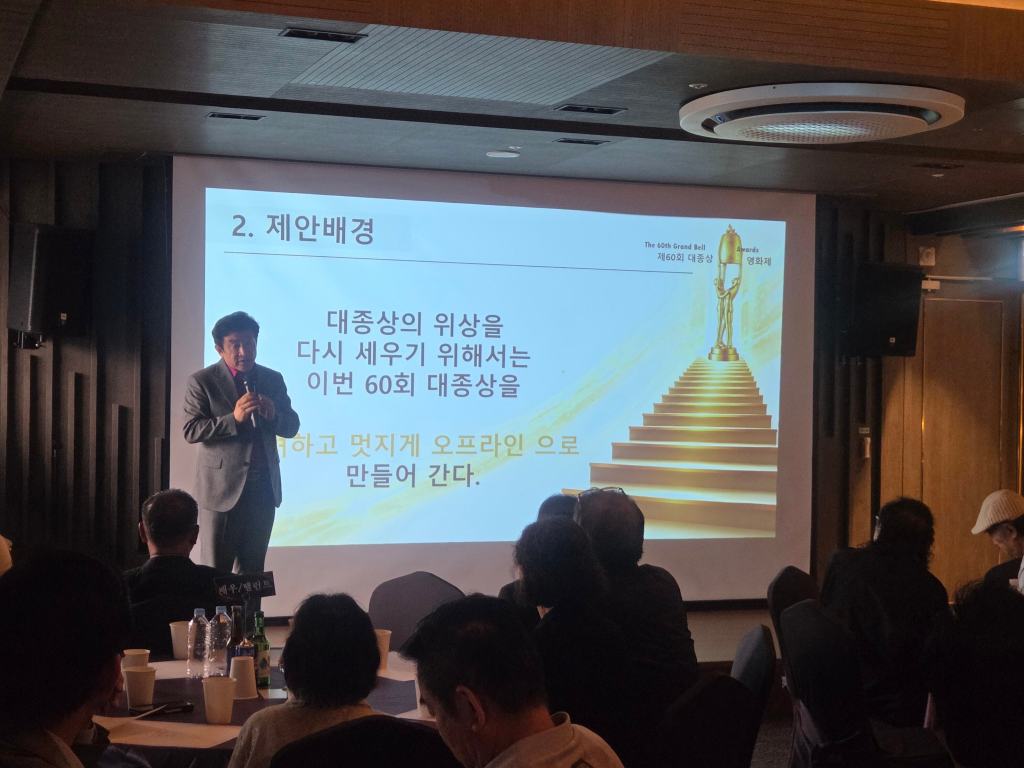
The 60th Daejong Film Awards, set to take place next March, has faced controversy since its inception. The Korea Film Planning Producers Association (Planning Association), which obtained the hosting rights via a court auction, revealed intentions to collaborate with Netflix on the event. Nevertheless, Netflix confirmed that no previous conversations had occurred. Additionally, some industry organizations have voiced concerns regarding the selection of a former executive, who was previously found guilty of fraud and received a prison sentence, as the leader of the new awards’ management.
At a press conference held at the Staylack Hotel in Jung-gu, Seoul, on the 20th, Chairman Seo Jeong-min of the Planning Association stated, “We have finally resumed the Daejong Awards, which had been suspended,” and added, “We are designating today as the ‘Day of the Daejong Awards,’ marking a historic step towards transforming into a global film festival.” The ‘Day of the Daejong Awards’ will be observed annually to mark November 20, the date of the first Daejong Film Awards. President Jo Geun-woo of the Daejong Film Awards Headquarters, in charge of organizing the event, mentioned during the briefing, “We plan to hold an annual ‘Night of Filmmakers’ to foster unity among filmmakers and celebrate and recognize the contributions of veteran filmmakers through events and awards.”
President Jo was found guilty of fraud in 2015 while leading the business division of the Daejong Film Awards. He was convicted for tricking someone into donating 500 million won by promising them a committee chair position. His recent return to manage the upcoming awards has caused debate within the film industry even before the meeting. One participant at the meeting asked, “I have never heard the title ‘president’ used for the Daejong Awards—was this position elected?”
Speaking about the controversy surrounding his return, Jo said during the press conference, “I endured a lot because of the Daejong Awards,” and stated, “I was investigated for seven months by the prosecution’s special task force and was exonerated, but after just one hour of questioning, I received a three-year sentence.” He added, “Although I was treated unfairly and stepped away from the Daejong Awards, no one was there to save them, so I took responsibility. I heard that I needed to restore the Daejong Awards to regain my dignity, so I decided to give it my all until the end.”
He further mentioned, “Certain resistance to my return stems from individual motives. I urge critics to view the film festival I have established before making their judgments.”
Concerning the awards’ activities, Jo mentioned, “With a budget of 2 billion South Korean won, we intend to co-host the Daejong Awards with Netflix to establish an opulent film festival. Similar to the Cannes Film Festival, we will organize South Korea’s top film event over three days in a grand manner.” He also shared intentions to broaden the awards into four categories, such as theatrical releases, Netflix, dramas, and documentaries. However, in response to questions from this newspaper, Netflix stated, “No previous discussions have occurred.”
Jo stated, “I will make sure that recipients of major awards such as Best Film and Best Actor get cash rewards to demonstrate that the Daejong Awards have made a comeback. Unlike the Blue Dragon and Baeksang Awards, which are broadcast-focused, the Daejong Awards will concentrate on in-person interactions.”
He repeatedly highlighted his backing for experienced filmmakers. “The area I will focus on the most is the red carpet,” Jo said, receiving applause. “I will provide chances for veteran filmmakers to walk the red carpet, not only for celebrities.” He further mentioned, “Experienced filmmakers struggle to make ends meet. We will assist them so they can restart their work and address their financial challenges.”
Members of the Korea Film Actors’ Association, which organized the Daejong Awards until the 59th ceremony, have been operating under the Korea Film Association since the prior organization went bankrupt. Prior to the meeting, the association issued a statement condemning the judiciary for selling the hosting rights. In the statement, they stated, “The judiciary’s strict and inconsiderate decision has led the Daejong Awards into a tragic situation. Their one-sided sale of a cultural heritage is a serious blemish on Korean film history and a rejection of cultural publicness.” They further mentioned, “Efforts to privatize the awards’ authority while excluding filmmakers cannot be accepted. We will hold them legally and morally responsible and continue our struggle.”




Leave a Reply