
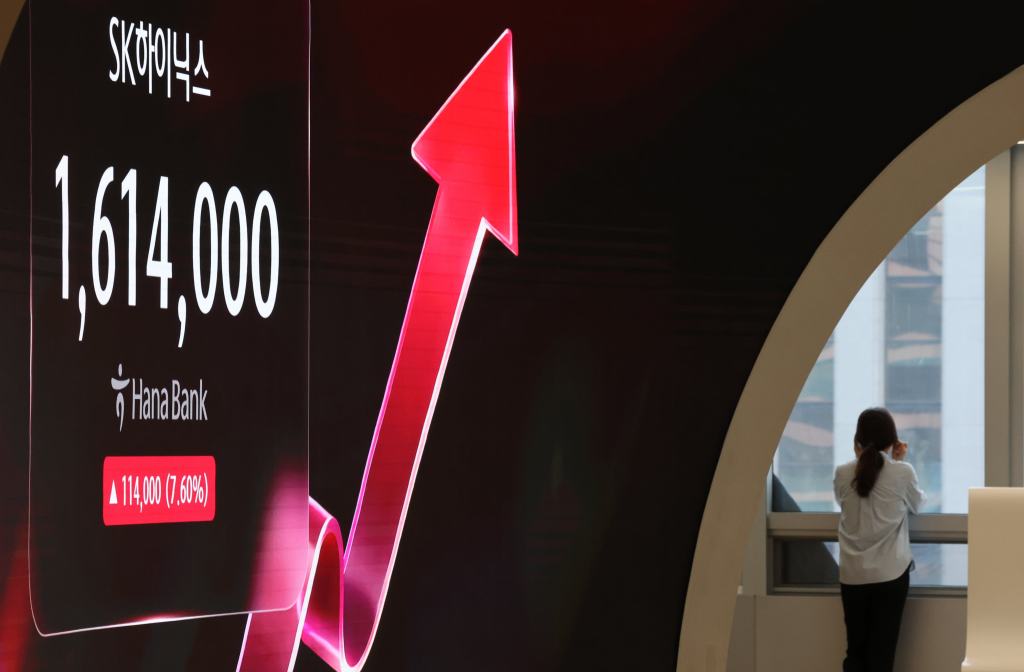
SK Hynix may distribute at least an extra 180 trillion Korean won to investors by 2027, in addition to the 40 trillion Korean won share repurchase and cancellation program announced on the 19th, as per JP Morgan’s analysis. Major investment banks Barclays and Nomura also noted that SK Hynix’s stock is undervalued, highlighting the company’s robust ability to generate cash, which allows for continued facility investments even after managing significant shareholder returns.
As reported by Bloomberg on the 20th, Jay Kwon, an analyst from JP Morgan, projected in a report published right after SK Hynix’s share repurchase announcement that *SK Hynix might allocate at least another 180 trillion South Korean won, roughly 130 billion dollars, for returning value to shareholders by 2027*. This figure does not include the previously announced 40 trillion South Korean won share repurchase and cancellation initiative, which represents about 16% of SK Hynix’s present market value.
What JP Morgan emphasized was not just the size of the stock repurchase program, but also the removal of the shareholder return cap. SK Hynix had initially intended to use up to *50%* of its total free cash flow (FCF) from 2025 to 2027 for returning value to shareholders, but this time it increased that to *more than 50%*. Free cash flow refers to the money left over after deducting the funds invested in facilities from the cash generated by business operations.
JP Morgan’s 180 trillion Korean won figure is not an officially confirmed and disclosed amount by SK Hynix, but rather a projection derived from updated return standards and anticipated future cash flow. Analyst Kwon noted, *“We believe the worst period has ended,”* and *“We suggest investors to purchase shares, as we anticipate a gradual improvement in stock market sentiment over the medium term.”* The early announcement of the share repurchase program was also viewed favorably.
Barclays viewed this stock repurchase as a *‘strong message’* to investors. Simon Coles, a researcher at Barclays, predicted in a report released on the 19th that the amount of shareholder returns between 2025 and 2027 would be around 15% of the current market value. Barclays kept its *‘overweight’* rating and a *300-dollar* price target for SK Hynix’s American Depositary Receipts (ADR).
Barclays concluded that SK Hynix doesn’t have to cut back on investments needed to boost production capacity while still enhancing returns for shareholders. Although substantial dividends or stock repurchases usually limit a company’s ability to invest in facilities, Barclays noted that SK Hynix can manage both because of its robust cash flow.
Coles stated, *“Despite returning roughly 15% of the market capitalization to shareholders, the company will still be able to significantly increase production capacity and invest in new business opportunities over the next few years.”* Barclays increased its quarterly dividend forecast for 2027 to *2,500 Korean won per share* and its year-end dividend projection to *10,000 Korean won*. With an estimated share buyback amount of *200 trillion Korean won* in 2027, about *51%* of the total free cash flow from 2025 to 2027 would be distributed to shareholders by the end of 2027.
The equilibrium between dividends and stock repurchases continued to be flexible. Raising dividends might indicate the company’s belief in upcoming cash flows. Nevertheless, Barclays believed that repurchasing shares when the stock price is low is more sensible than increasing fixed dividend obligations, given the semiconductor sector’s significant earnings fluctuations.
Nomura also assessed SK Hynix’s current stock price as *‘significantly undervalued,’* keeping its *‘buy’* recommendation and setting a target price of *4.7 million Korean won.* As per Nomura, SK Hynix’s stock is currently being traded at price-to-earnings ratios (PER) of *3.8x* and *2.8x* considering projected earnings for 2026 and 2027, respectively.
Nomura outlined three factors that could lead to a reevaluation of stock prices: earnings growth fueled by demand for AI, lower business risks due to long-term supply agreements, and significant shareholder returns. SK Hynix’s free cash flow is projected to rise from *156 trillion Korean won* this year to *318 trillion Korean won* by 2027. Estimated shareholder return amounts are *78 trillion Korean won* and *159 trillion Korean won*, with total shareholder return ratios compared to market capitalization at *7%* and *15%,* respectively.
The future of the memory sector remains optimistic. Barclays has noted that although certain major technology firms may decrease the amount of memory included in their products due to supply constraints, these shortages are not expected to be resolved quickly. As a result, average selling prices for memory are anticipated to stay elevated, and SK Hynix is expected to continue its dominant role in the high-bandwidth memory (HBM) market.
Factors under consideration include whether major U.S. technology firms will maintain their investments in AI facilities, whether these investments will yield adequate returns, and how the advancements by Chinese semiconductor companies will influence the market. Specific figures for dividends and additional stock repurchase amounts are anticipated to be outlined in SK Hynix’s shareholder return information, which will be released during its third-quarter earnings report.
SK Hynix intends to repurchase 24.07 million common shares from the market within the next roughly three months and then eliminate them. The proposed buyback is valued at *40 trillion Korean won*, representing about *3.3%* of the total outstanding shares. On the 20th, the day following the announcement, SK Hynix’s stock closed at *1.691 million Korean won*, reflecting an increase of *12.73%* compared to the previous day.




Leave a Reply