
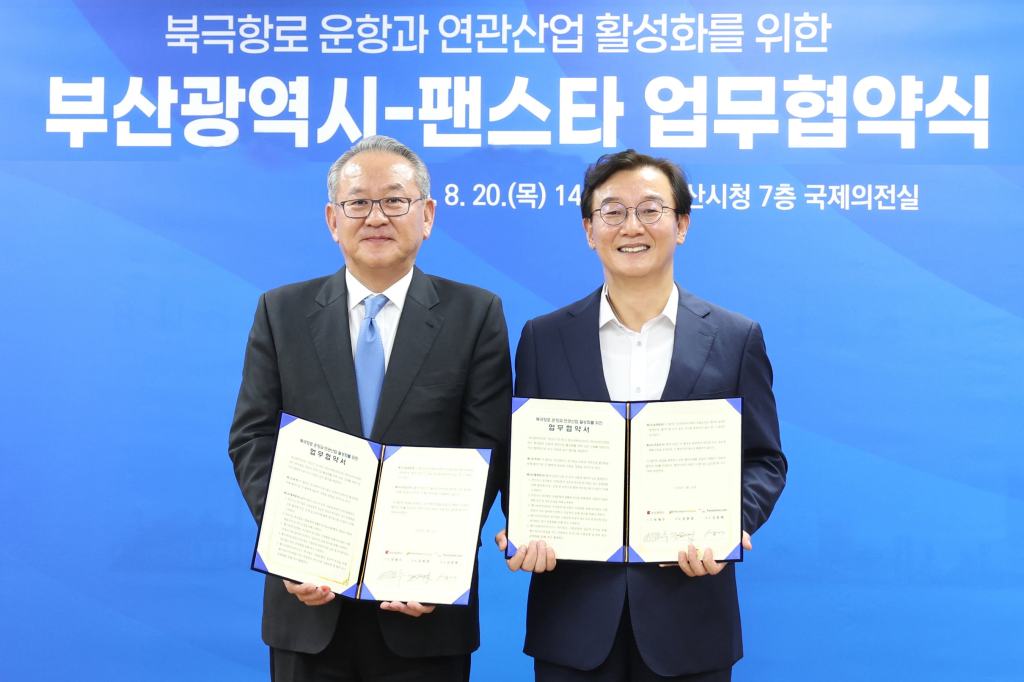
Western media, including Reuters, reported on the 20th that South Korea’s government-backed trial voyage through the Arctic has faced criticism from Western nations due to possible breaches of sanctions against Russia. The Fanstarr Acro, a container ship with a capacity of 2,800 TEU operated by Fanstarr Line.com, is set to leave Busan Port on the 22nd, making stops at the UK’s Felixstowe on September 9, the Netherlands’ Rotterdam on the 11th, and Poland’s Gdańsk on the 15th, before returning to Busan via the Northern Sea Route on October 5. This initiative, led by the Ministry of Oceans and Fisheries and coordinated by the Korea Ocean Business Corporation and the Korea Shipowners’ Association, represents South Korea’s first-ever trial voyage of a container ship along the Arctic route.
Reuters reported, “If this journey is successful, South Korea will become part of a select group of countries, such as China and Russia, that utilize the Arctic passage,” and noted, “This endeavor depends on Russian collaboration, which may cause tensions with Western partners.” Traveling through the Arctic route naturally requires up-to-date information about ice conditions in the Arctic, which means relying on Russian assistance, potentially resulting in breaches of sanctions.
Reuters also mentioned, “Western diplomats have shown dissatisfaction with the plan, as South Korea needs to seek and secure navigation permissions from Russia.” A European diplomat, speaking about the Russia-Ukraine conflict, said to Reuters, “Our goal is to isolate Russia and we do not want to interact with it. We have shared these concerns with South Korea.” Experts on the Arctic route caution, “If South Korea seeks Russian help because of problems such as getting stuck in ice during the journey, it might be considered a breach of sanctions.”
Norwegian media outlet High North News reported on the 11th that Fanstarr Line.com had already secured navigation authorization from Russia. The journey received prior approval from Rosatomflot, a Russian state-owned company responsible for the Arctic route and its permit system. High North News noted, “Rosatomflot, also referred to as Atomflot, is subject to sanctions from the U.S., UK, and EU.” The European Commission stated in March that asset freezes apply to Rosatomflot, and offering financial support to the company is forbidden.
High North News reported, “Fanstarr Line.com and the South Korean government have not made public any resolutions to these problems.” Reuters also mentioned, “The Ministry of Oceans and Fisheries and Russia’s Foreign Ministry did not provide responses to inquiries.” As global alliances become more defined, the Arctic route has become a significant security issue for the West, with China and Russia increasing their collaboration in the Arctic Ocean. The South Korean government sees the Arctic route as cutting the distance between Busan and Rotterdam, Netherlands, by about 35% compared to the Suez Canal route. With the U.S.-Iran conflict threatening traditional routes such as the Strait of Hormuz, the necessity of creating new energy distribution channels has also been highlighted.
Promoting the Arctic route is a major focus of President Lee Jae Myung. During the inauguration of the temporary office of the Ministry of Oceans and Fisheries in Busan on December 23 last year, the president remarked, “The Arctic route is a crucial corridor that will significantly reshape the global industrial structure, logistics network, and the dynamics of energy and security. We aim to develop Busan Port into the world’s largest port and promptly advance the construction of the new airport on Gadeok Island, making Busan the central figure in the era of the Arctic route.”
Lee Soo-ho, head of the Arctic Route Promotion Headquarters within the Ministry of Oceans and Fisheries, stated during a meeting at the ministry’s Busan office, “Given that this route spans several countries, we have outlined the objectives, importance, and plans for the Northern Sea Route trial expedition to relevant nations and concluded necessary discussions to adhere to international standards.”




Leave a Reply