
Wildfires in Europe are expected to devastate nearly three times the current area by the year 2100, according to a concerning study.
Experts caution that an increase in temperature and reduced moisture levels could lead to more frequent and extensive wildfires in the coming years.
In a “high emissions scenario,” in which nations fail to implement measures to reduce pollution, temperatures might rise by 3.6C (6.5F) compared to the pre-industrial norm.
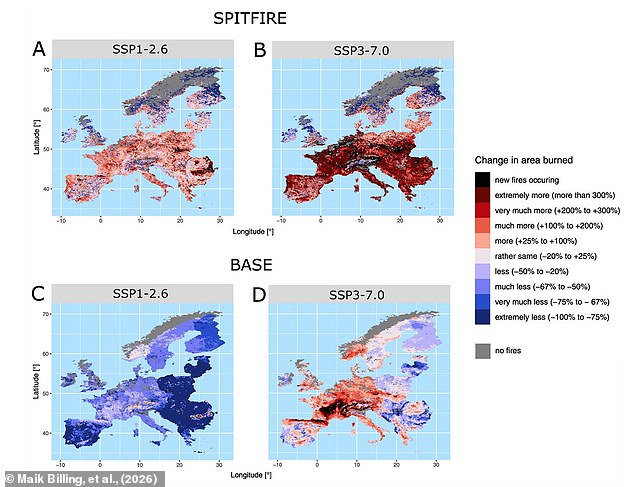
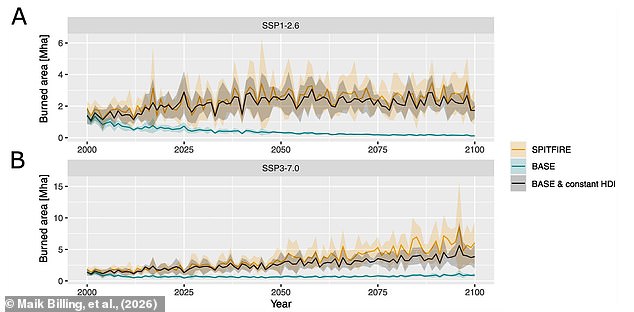
Through computer simulations, scientists forecast that this will lead to a 193 percent rise in the area of Europe impacted by wildfires, amounting to 20,463 square miles (53,000 square km) annually.
That rise would affect a large portion of western and Central Europe along with the Mediterranean, whereA historic fire season has already been ongoing.
However, the scientists also anticipate that human-inducedclimate changewould witness flames starting in areas of Europe that had not experienced major fires before.
Co-author Dr. Kirsten Thonicke, from the Potsdam Institute for Climate Impact Research, states: ‘The fires in France, Spain, and Greece demonstrate how swiftly hot, dry, and windy conditions can challenge firefighters and their resources.’
Due to climate change, circumstances might escalate to the point where we can no longer effectively prevent or combat fires once they reach a specific scale.
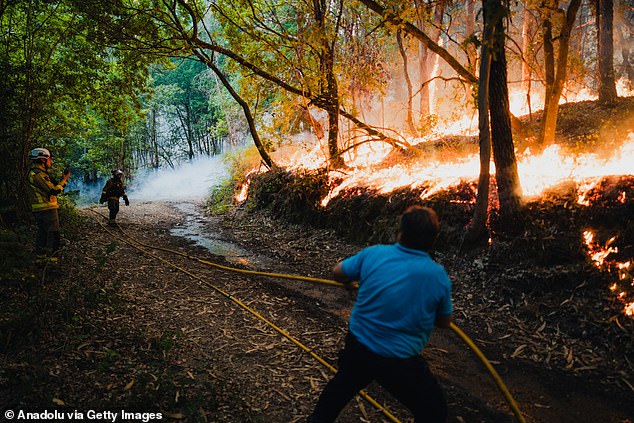
The rise in greenhouse gas emissions is causing the global average temperature to climb, leading to more frequent and intense periods of hot and dry weather.
Co-author Professor Thomas Hickler from the Senckenberg Society for Nature Research states that ‘almost all’ of the rise in wildfires over the past few decades can be attributed to human activities.
Similarly, Professor Hickler states that every rise in the future will be solely due to human-generated greenhouse gas emissions.
Scientists employed a collection of computer simulations to forecast the impact of global warming on the extent of forest fires in the coming years.
These models demonstrate how alterations in climate and weather patterns affect plant development, moisture levels, air movement, and also elements such as the frequency of lightning occurrences.
These elements are then integrated with forecasts of evolving land use, including deforestation for farming purposes, and changes in population distribution to determine the region impacted by wildfires.
If no actions are taken to reduce emissions, the models forecast significant rises in the area affected by fires throughout Europe.
This is largely because of the rise in ‘extreme fire weather’, fueled by extended and more severe summer dry spells.
Nevertheless, the scientists also found that the region impacted by fires will expand even if immediate actions are taken to reduce emissions.
In a “low emissions scenario” where temperature rise is limited to 1.8C (3.2F), 39 percent more land will be burned annually by the end of the century.
Professor Hickler explains that this is a result of an phenomenon referred to as ‘warming in the pipeline’.
“the climate system responds gradually,” professor hickler explains.
A significant portion of the additional heat retained in the atmosphere due to increased greenhouse gases is absorbed by the ocean, and it requires a considerable amount of time for the combined ocean-atmosphere system to reach a new state of equilibrium with the greenhouse gas influence.
Additionally, we have initiated other processes that generate positive feedbacks, such as the rising thawing of permafrost, which releases carbon dioxide into the atmosphere.
Effective policies aimed at reducing emissions can assist Europe in mitigating the most severe impacts of rising wildfires, although an increasing danger is now unavoidable.
This will serve as a foreboding signal for numerous European countries that are currently facing one of the most severe fire seasons in history.
In the EU, 2,340 square miles (6,060 square km) of land has already been affected by fires – more than two and a half times the 20-year average for this period.
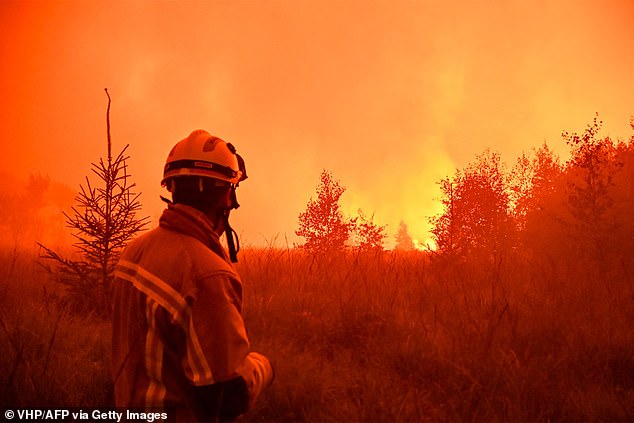
Greece, France, Spain, Belgium, Portugal, and Croatia have all experienceda fresh surge of wildfireswhich have forced thousands of individuals to leave their homes.
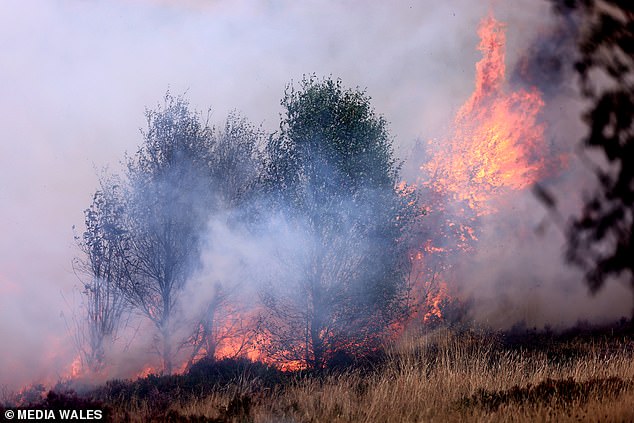
Last week,A fire spread quickly throughout the Hautes Fagnes natural parkin eastern Belgium, close to the German border.
It is the largest fire ever recorded for the country, exceeding a fire in 2011 that consumed almost 1,400 hectares, according to information from the European Forest Fire Information System.
In the meantime, hundreds were relocated from a seaside resort in northern Greece and from a village in south-western France.
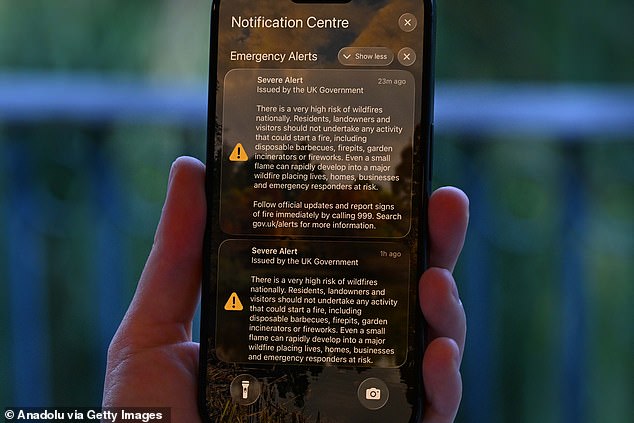
Similarly, the UK has experienced its most severe fire season in history, with firefighters dealing with more than 1,132 fires throughout the country.
It exceeded last year’s annual total of 1,017 wildfires, with four months remaining in 2026.
The scientists discovered that thorough preparation could significantly reduce the possible harm.
Ongoing advancements in fire control could lead to a 92 per cent decrease in the area affected by fires in a 1.8C scenario and a 72 per cent reduction at 3.6C.
Nevertheless, they also warn that these forecasts might turn out to be excessively hopeful in the most severe situation.
Professor Hickler states: ‘If Europe boosts its funding for wildfire control, our models indicate that this could lead to a substantial impact.’
But if fires turn out to be extremely severe, our capacity to control them could fail, and we haven’t determined where that threshold lies yet.





Leave a Reply