
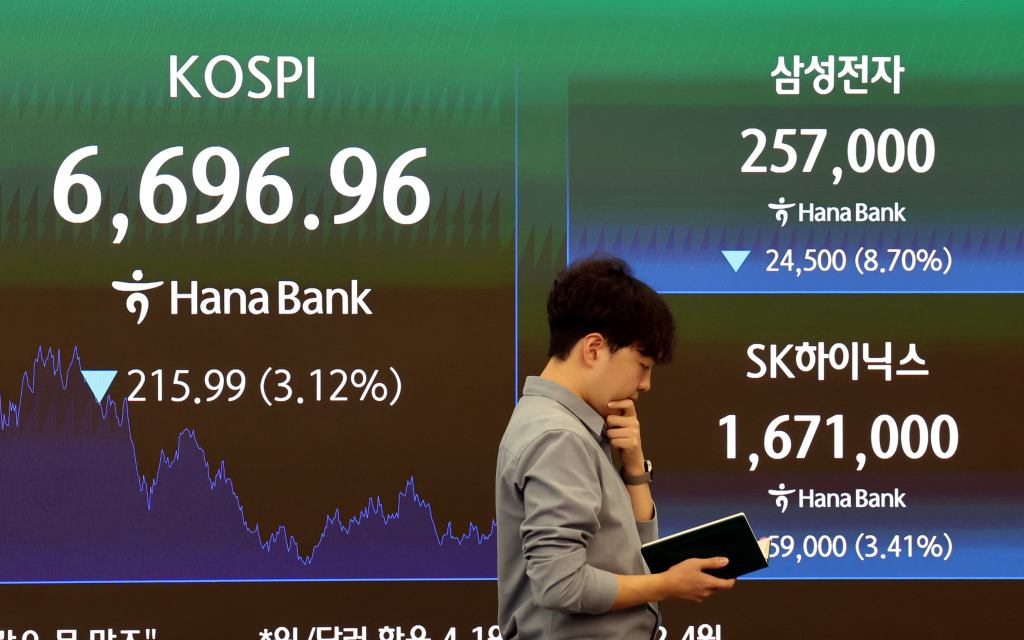
Consumer confidence has dropped for the first time in four months after the stock market crash. According to the Bank of Korea’s “Consumer Trend Survey” released on the 25th, the Composite Consumer Sentiment Index (CCSI) for August decreased by 2.3 points to 104.5 from the previous month. The CCSI, which had increased for three straight months since May, has now started to decline.
The CCSI is a numerical indicator that combines six major consumer sentiment indices (CSI), capturing people’s views on the present economic conditions and their future predictions. An increase suggests greater “optimism” or the expectation of “rising prices,” whereas a decrease points to increased “pessimism” or the belief in “falling prices.” The survey took place from August 3 to August 14.
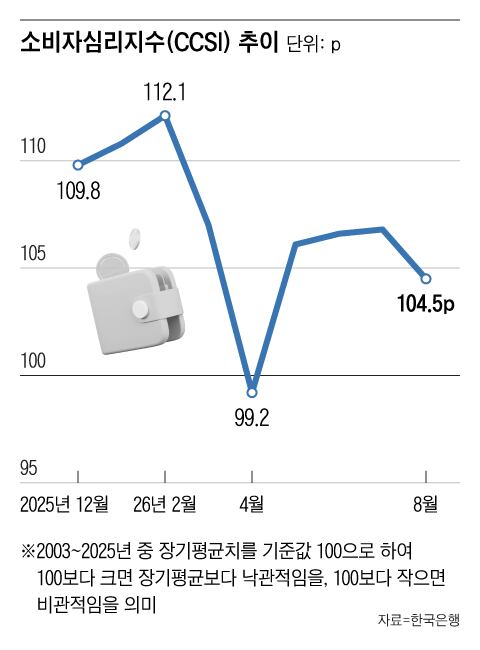
A representative from the Bank of Korea said, “Although the real economy remains stable, the downturn in stock markets and built-up inflation have deteriorated the perceived economic environment, resulting in a decrease in consumer confidence.” All six indices that make up the CCSI declined. The Current Economic Conditions CSI experienced the biggest drop, falling by 5 points to 79—the lowest point since April, at the beginning of the Middle East conflict.
The Future Economic Outlook CSI dropped by 3 points to 89, representing the largest fall since April. The Household Income Outlook, Current Living Standards, Living Standards Outlook, and Consumer Spending Outlook CSIs all fell by 1 point each.
Shaped by the government’s real estate tax changes and housing supply policies, the Housing Price Outlook CSI dropped by 2 points compared to the prior month. Nevertheless, with a reading of 125, it is still much higher than the baseline of 100, suggesting that more participants anticipate an increase in property prices rather than a decrease. The Housing Price Outlook CSI has been above 100 for five straight months starting from April.
The projected inflation rate for the upcoming year stayed steady at 2.7%, continuing to exceed the Bank of Korea’s objective of 2%.





Leave a Reply