
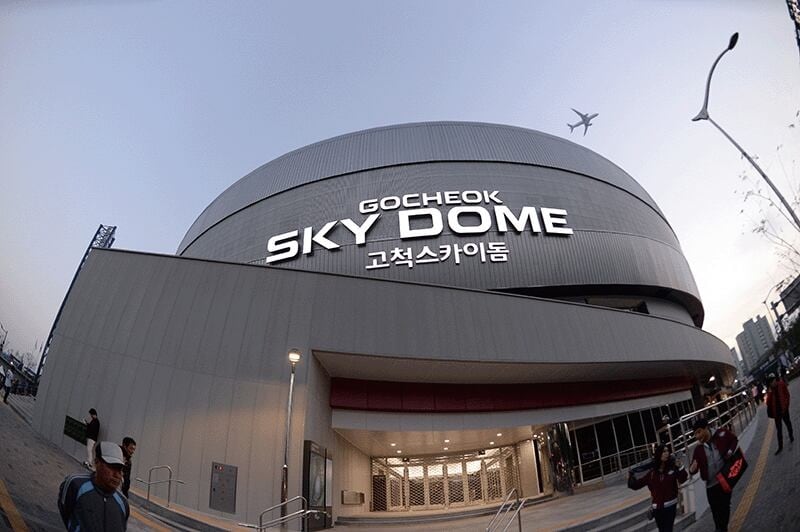
“Cheongju, North Chungcheong Province, is the optimal location for building a dome stadium,” said Shin Yong-han, governor of North Chungcheong Province.
“We will build a sports and performance complex-type dome stadium in the Cheonan-Asan area to establish it as a cultural and sports hub for the central region,” said Park Soo-hyun, governor of South Chungcheong Province.
On August 19, when Chae Hwi-young, the Minister of Culture, Sports and Tourism, visited the North Chungcheong Provincial Government Office, Governor Shin first discussed the issue of building a dome stadium. The previous day, Governor Park, who met with Minister Chae, also discussed the dome stadium issue. It is not limited to the Chungcheong region. On August 10, Chun Jae-soo, the mayor of Busan, met with Minister Chae to request support for the construction of an open-close dome stadium (multi-purpose dome arena).
The competition among local governments nationwide to attract a dome stadium is heating up. In addition to Chungcheong and Busan, Seoul’s Gangseo District, and Gyeonggi Province’s Gwangmyeong, Paju, and Goyang City have also joined the race. A dome stadium is a large facility designed to cover the entire stadium with a roof, allowing sports events or performances to be held indoors regardless of weather or season. From the perspective of local governments, not only does it create a landmark representing the region, but it also expects significant ripple effects across the local economy, such as accommodation, dining, and shopping, as tens of thousands of people flock in for each event. If large-scale sports events and performances by famous domestic and international singers are continuously hosted, it can also boost the region’s visibility.
The Ministry of Culture, Sports and Tourism announced on August 5 during the ‘2026 Second Half Business Report’ held at Cheong Wa Dae that it would expand the number of dome stadiums, which can be used for both sports and performances, to two locations nationwide. In a pre-briefing the day before the business report, Lee Sun-young, the ministry’s sports director, stated, “We are currently conducting research projects after budget deliberations for two regions” and added, “As soon as the discussions on the public competition criteria are finalized, we will gather on-site opinions, hold briefing sessions, and proceed with the public competition process.”
Currently, there is only one dome stadium in South Korea, the 20,000-seat Seoul Gocheok Dome, and another dome stadium is scheduled to be built in Incheon’s Cheongna area by the end of 2027. A new dome stadium is planned to be constructed in 2032 at the site of Jamsil Baseball Stadium, which will be demolished at the end of this season.
The need for large-scale dome stadiums has been consistently raised. As professional baseball has become increasingly popular, breaking annual attendance records, frequent game cancellations due to recent drastic climate changes, such as fine dust, heatwaves, and heavy rains, have become common. Earlier this month, the KBO (Korean Baseball Organization) declared a ‘heatwave break’ for the first time in its history.
Dome stadiums, which can accommodate up to 40,000 to 50,000 people regardless of weather or season, have long been a desire for the entertainment industry. Despite being the birthplace of K-pop, South Korea has struggled with planning large-scale performances due to the lack of proper performance infrastructure. In 2024, global pop stars like Taylor Swift and Ed Sheeran did not include South Korea in their Asian tours, which highlighted the issue of insufficient infrastructure. Chung Tae-young, vice chairman of Hyundai Card, who has been involved in attracting large concerts by famous pop stars to the country, posted on his SNS, “We couldn’t even mention the idea of booking Taylor Swift because we don’t have a large enough venue.”
At the time, Taylor Swift performed at the Tokyo Dome, which can accommodate 55,000 people, and Ed Sheeran also performed at the Tokyo Dome and the Kyocera Dome in Osaka. In Japan, major cities outside Tokyo, such as Osaka, Nagoya, and Fukuoka, have large dome stadiums capable of accommodating more than 40,000 people. Large arena-level performance venues, including the Saitama Super Arena (a multi-purpose indoor sports and performance venue) in the Tokyo metropolitan area, which can hold more than 20,000 people, are located throughout the country.
However, there are voices calling for a cautious approach, as dome stadiums require construction costs in the hundreds of billions of won and entail significant maintenance expenses even after completion. Particularly, the feasibility of the project will depend on whether the stadiums can maintain high annual utilization rates by consistently attracting concerts and various sports and cultural events even during off-seasons for professional baseball. It is also necessary to assess whether the surrounding infrastructure, such as transportation networks and accommodation facilities, can handle up to 50,000 spectators at once. A source from the entertainment industry stated, “While large dome stadiums are undoubtedly necessary, the construction itself should not be the end goal. It is essential to thoroughly evaluate regional sports and performance demands, accessibility, and the potential for year-round operation.”





Leave a Reply