

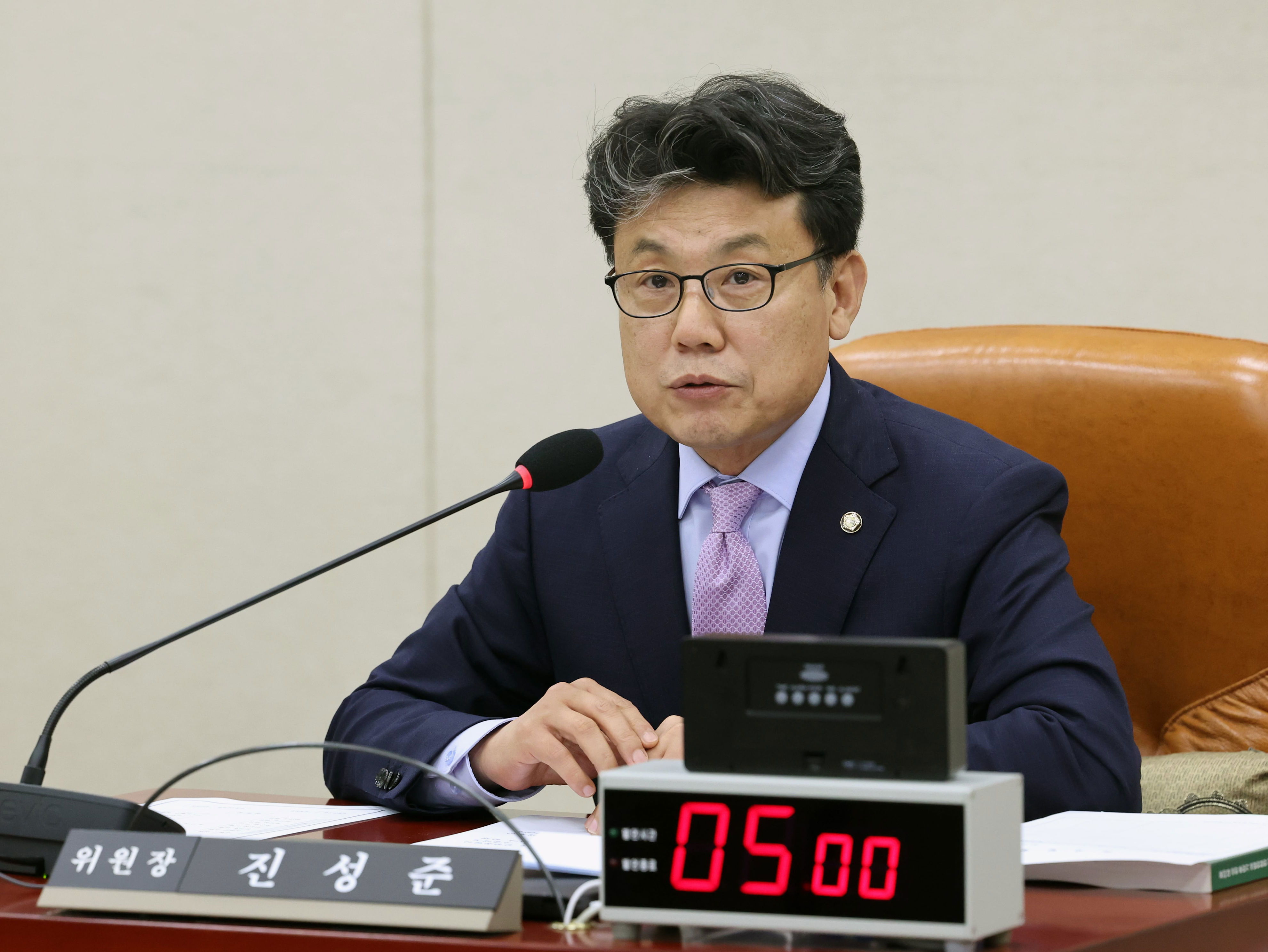
Jin Sung-joon, a member of the National Assembly and chairman of the Defense Committee in the 22nd National Assembly’s second half session, was previously sentenced to prison for violating the National Security Act. The violation occurred in 1989, during his mandatory military service as a short-term enlisted soldier after graduating from university. The ruling by the 35th Division Ordinary Military Court documented his thoughts and actions at the time.
Jin viewed U.S. troops stationed in South Korea immediately after liberation on August 15 as an “occupying force that advanced into the southern part of the Korean Peninsula.” He reportedly considered the South Korean military to be imperialist mercenaries deprived of operational command by U.S. forces, and the U.S. Forces Korea as an obstacle to unification by posing a military threat to North Korea. The court ruling noted that he advocated for a “nationwide armed revolution” and argued that support from North Korea was necessary to achieve this.
His conviction stemmed from his leading role in forming an organization called “Uibyeonghoe” (Righteous Army Association) to spread these ideas within the military. At the group’s founding assembly, he stated, “Since our military is subordinate to U.S. forces, the withdrawal of U.S. troops from the Korean Peninsula is essential to build a self-reliant national military.” He assessed that while North Korea had established a “self-reliant socialist system,” South Korea’s progress had been stifled by U.S. influence. Based on these remarks, the 35th Division Ordinary Military Court sentenced him to six years in prison. Jin is commonly reported to have received a three-year sentence, as the Army High Military Court later reduced the term.
Despite this history, Jin became the Defense Committee chairman in June. The Democratic Party unilaterally appointed him without consulting opposition parties. Immediately after his election, he stated at the National Assembly plenary session, “I will do my best to safeguard self-reliant national defense and peace on the Korean Peninsula.” There is no record of him renouncing or reflecting on his past anti-U.S. and pro-North Korea sentiments. He maintains that his National Security Act violation was part of the “anti-dictatorship democratization struggle” and was recognized as a democratization movement in 2003. The specifics of how his case came to be classified under democratization efforts remain unclear.
The Defense Committee chairman is a position akin to a “senior overseer” of national security in the legislature. The exact reason for Jin’s appointment remains undisclosed. However, given his past actions and his inaugural remarks, it appears the Lee Jae Myung government may have considered factors such as the transition of wartime operational control and efforts to improve relations with North Korea. Given the recent deterioration in South Korea–U.S. relations, appointing a figure with pronounced anti-U.S. tendencies seems perplexing.
The government’s awkward personnel decisions are particularly evident in defense matters. Ahn Gyu-back, the Defense Minister who drew public anticipation as a civilian appointee, faced allegations of desertion during his short-term enlisted service. Ahn delayed addressing the issue, which could have been resolved by disclosing his military service records. Amid growing tensions—including communication breakdowns with the U.S. and controversies over integrating military academies—President Lee nominated a four-star general as the new Defense Minister on the 30th.
It is hoped that the allegations against Ahn are unfounded. If proven true and the appointment proceeded despite knowledge of them, it would suggest the government regards the military with contempt, viewing it as an easy target. While some military elements were wrongfully involved in martial law, this does not justify disrespecting the armed forces responsible for national security.
The current security situation is dire. South Korea–U.S. joint training exercises have been scaled back, while North Korea continues to gain modern warfare experience in Ukraine. Expanding South Korea–U.S. cooperation and conducting realistic training are urgently needed, yet the country is moving in the opposite direction. President Lee claims, “Our security capabilities are overflowing,” but it is unclear what exactly is overflowing. The nonchalant appointment of a National Security Act violator as Defense Committee chairman is likely connected to this disconnect.




Leave a Reply