
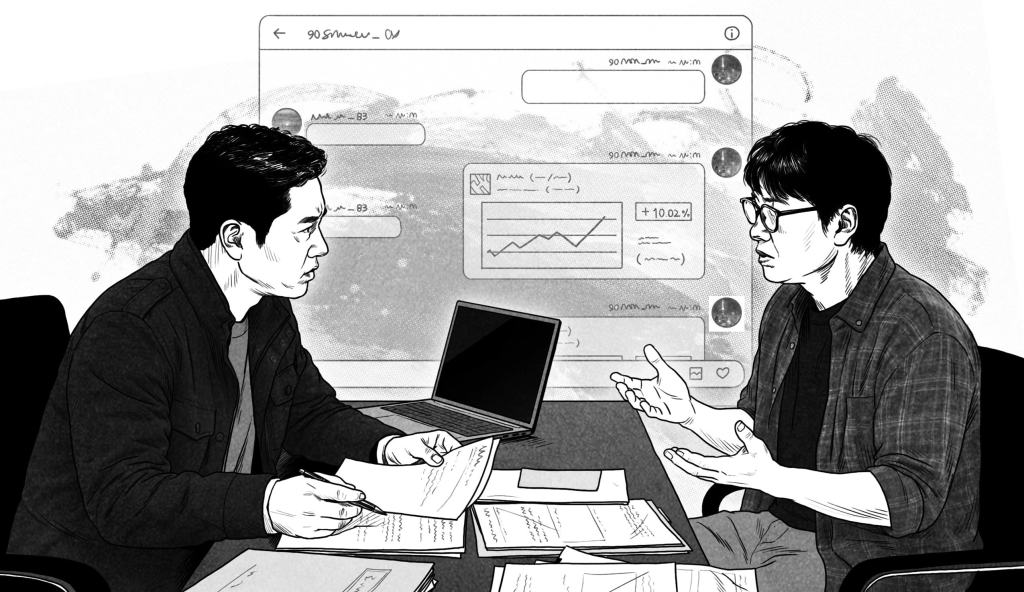
I swear it started as a joke. The domestic stock market has been really hot lately, hasn’t it? I do invest in stocks, but only in U.S. markets. I automatically buy shares monthly, so honestly, I didn’t care much whether prices went up or down. Still, I’d occasionally check stock communities to stay informed, and what I saw was hilarious.
“Selling stocks secondhand. I’ll sell them at a 20% discount from what I paid.” “Can I get a refund on stocks if I contact customer service?” “I was so pissed I ordered takeout. Whether it’s a loss of 100 million Korean won or 100.03 million Korean won, it’s the same, right?” “Why do foreigners keep selling? If I see a foreigner on the street, I’ll beat them up.”
These funny posts flood the boards during downturns. Of course, there are serious rants too. Especially the so-called experts who shared investment ideas on the forum get cursed out during slumps. “You made me lose money!” It’s absurd—everyone is responsible for their own investments. But then, out of mischief, I sent a message to a netizen who’d posted about losing a lot of money: “I’m sharing this because I feel sorry you lost so much. Hainecs will rise tomorrow.” Unsurprisingly, I got a stream of curses in reply. My goal was to mock them: if Hainecs went up, I’d say, “See? I told you.” But to my shock, Hainecs actually rose by 10% the next day. At market close, I sent another message: “I’m sharing again. Hainecs will fall tomorrow.” Again, curses flew back. Yet, Hainecs dropped the next day.
You can guess what happened next. Right. The stock kept moving as I “predicted” for four days straight. If I’d known, I’d have invested myself. On the fifth day, I messaged, “Hainecs will rise on Monday. No doubt.” The reply changed—no curses. Instead, they earnestly asked where I got my information. On Monday, Hainecs surged 17%. After five accurate predictions, they bombarded me with messages:
“Should I sell today?” “Will it rise tomorrow? It’s gone up so much today—should I sell?” “What about tomorrow? Please tell me.” I replied at market close: “It’ll drop tomorrow. Sell.” “Thank you, Teacher!” They now called me “Teacher.” The next day, Hainecs fell, and I imagined how much I’d have made if I’d invested. Their messages exploded again: “Thanks to you, I’m recovering some losses. You’re my savior. What about tomorrow?”
That’s why I did it. It began as a joke, but after six “accurate” predictions, things spiraled. Think about it—how unfair is it? I predicted six times correctly but made no money, while they recovered millions thanks to me. Without me, they’d have lost everything, and yet I’m broke while they profit! So, without thinking, I sent: “Deposit 5 million Korean won, and I’ll tell you.”
Anyone in that situation would’ve made such a demand, right? If I’d been right the next day, there’d have been no issue. They’d recover their losses, I’d get 5 million Korean won—everyone happy. So, to clarify, it was a spontaneous prank. I never approached them with malicious intent.
“Okay, Mr. Kim Chulsoo. Let’s ask one thing,” the detective said, slamming a stack of printed online community posts on the desk. “How do you play the same prank on 256 people at once? You sent half the group a ‘rise’ prediction and the other half a ‘fall.’ The next day, you repeated the process with the 128 who got it right. Keep halving the group, and you’re guaranteed believers. If you’d kept ‘predicting’ correctly, you could’ve asked for more. How ‘spontaneous’ is that? You scammer.”
※This is a work of fiction.






Leave a Reply