
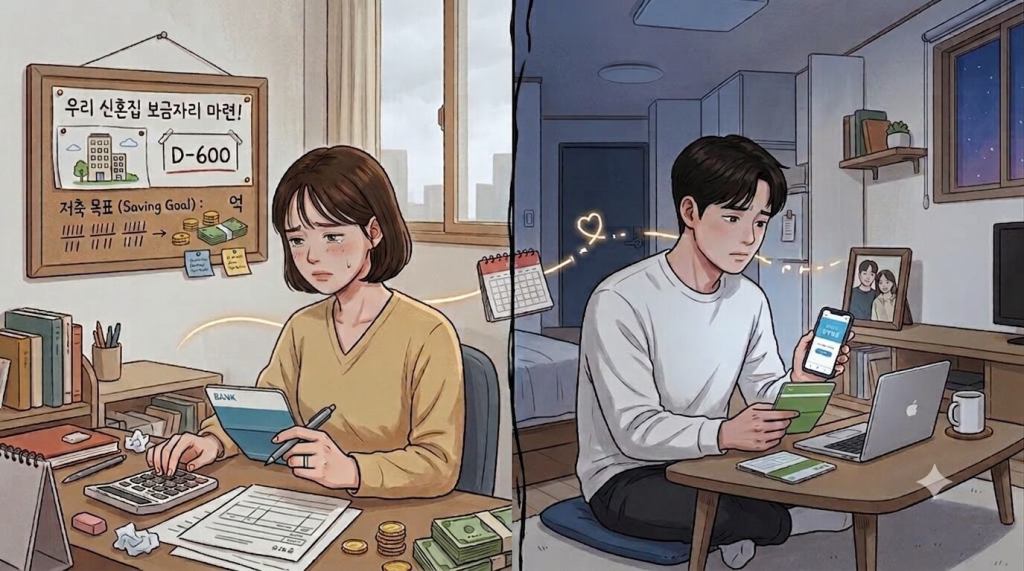
“I miss you, but I live alone.”
Park Seong-jun, 31 years old, an office worker living in Suwon, Gyeonggi Province. Although he married his girlfriend of three years in early August, they have not yet moved in together. Park continues to live in his Suwon studio apartment, while his wife resides in an officetel in Dongdaemun-gu, Seoul. They are part of a growing trend of so-called “non-cohabiting newlyweds” who maintain separate households after marriage.
The couple could not merge their households on their wedding date due to the jeonse (lease deposit) crisis. When they began searching for a new home earlier this year, the scarcity of jeonse properties in Seoul and the metropolitan area made it difficult to find a suitable home. Park said, “As housing prices rose this year, we struggled to decide between buying and leasing, and ultimately failed to secure a new home.”
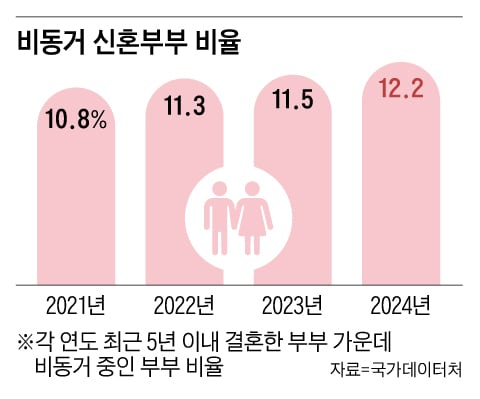
Recently, more than one in eight newlywed couples have chosen to live separately, like Park and his wife. According to the Ministry of Data and Statistics, in 2024, 115,979 out of 952,026 newlywed couples (12.2 percent) lived apart. In 2021, 118,984 out of 1,101,455 newlywed couples (10.8 percent) lived separately. Over three years, the total number of newlywed couples decreased by 13.6 percent, while the number of non-cohabiting couples fell by only 2.5 percent. Consequently, the proportion of non-cohabiting newlyweds rose from 10.8 percent to 12.2 percent.
In the past, “weekend couples” who lived apart due to work or studies were common. However, recently, many couples delay merging households to save money for housing amid soaring prices. According to KB Real Estate statistics, the average sale price of medium-sized apartments (60–85 square meters) in Seoul rose from 1.1623 billion Korean won in December 2021 to 1.5652 billion Korean won in August 2026, an increase of nearly 400 million Korean won. Meanwhile, data from Duo’s “Marriage Cost Report” shows that couples married within the past two years spent 192.71 million Korean won on housing in 2021, rising to 322.01 million Korean won in 2026—an increase of about 130 million Korean won.
Loan requirements have also tightened. Under the government’s June 27 mortgage regulations announced last year, the maximum loan limit for housing purchases in the capital region or regulated areas was capped at 600 million Korean won. The loan-to-value (LTV) ratio for first-time homebuyers, including young adults and newlyweds, was reduced from 80 percent to 70 percent in these regions.
Given these circumstances, more couples are choosing to postpone establishing a shared home and instead save money by living separately in their existing studios or with their parents. Ahn, 28, who lives alone in Eunpyeong-gu, Seoul, is set to marry in January but has not secured a new home. After marriage, Ahn plans to continue living in Seoul while her fiancé, who works in Gangneung, Gangwon Province, will remain in his studio apartment there. Ahn said, “Even with our savings and maximum loans, buying a home is still out of reach. Paying monthly rent feels wasteful, so we decided to live apart and save money first.”
Some newlyweds become “kangaroo tribe” couples, staying with their parents to reduce housing costs. Kim, 29, an office worker, married in September last year but still lives with her parents in Gangseo-gu, Seoul. Her husband, who frequently travels for work, rents a 550,000 Korean won monthly studio apartment in Cheongju, North Chungcheong Province. Kim said, “We thought it better to minimize housing expenses and save money rather than immediately setting up a new home.”
Housing costs are also delaying marriages. In a report released by the Korea Institute for Health and Social Affairs in April, 20 percent of respondents who expressed a desire to marry cited “inability to secure housing costs” as the reason for postponing marriage. Professor Kim Joong-baek from Kyung Hee University’s Department of Sociology said, “Non-cohabiting marriages are an inevitable choice for young people struggling to afford their own homes.”




Leave a Reply