
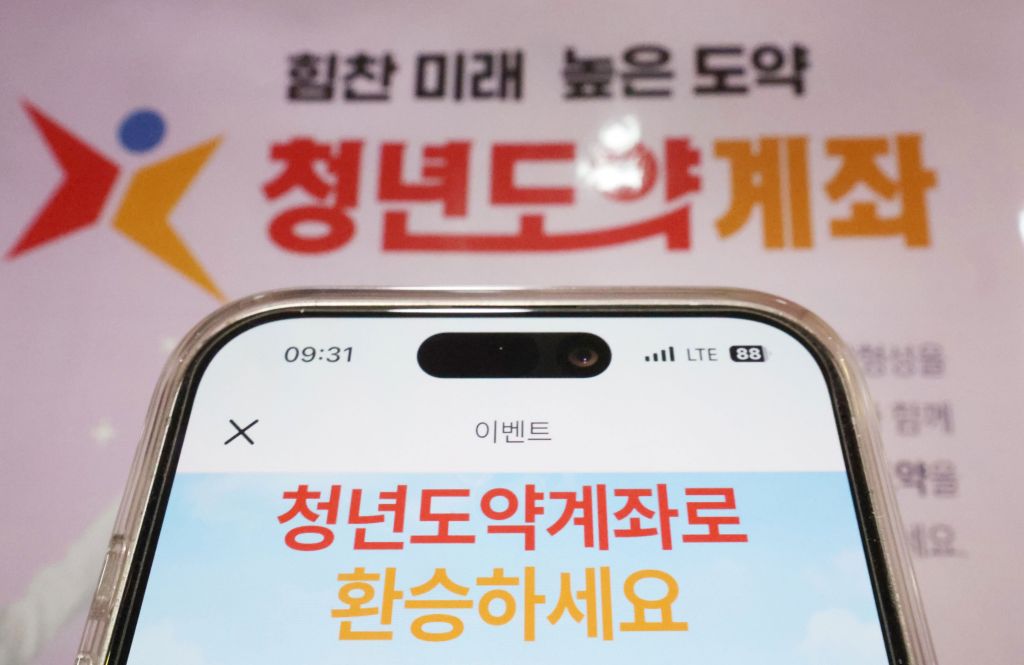
A freelancer in their 20s, identified as A, recently closed their Youth Leap Account. A said, “I joined thinking I could save tens of millions of won over five years, but my income has been irregular, and I often couldn’t even pay 100,000 Korean won monthly. I judged that it would be better to rejoin when I have more capacity later.”
Approximately four out of 10 subscribers to the government’s Youth Leap Account—a program aimed at helping young people build savings—have terminated their accounts before maturity. Dropout rates are particularly high among low-income youths, prompting criticism that the asset-building policy exacerbates “the rich get richer, the poor get poorer.”
◇2.55 million joined, but 940,000 canceled
According to data submitted by the Korea Inclusive Finance Agency to Song Eon-seog, a People Power Party lawmaker, as of August 25, 938,000 people had canceled their Youth Leap Accounts midway. This represents 36.7% of the 2.554 million people who joined between the product’s launch in 2023 and the end of last year.
The Youth Leap Account allows youths aged 19–34 to deposit up to 700,000 Korean won monthly for five years. The government adds contributions based on income level and provides tax-free interest income.
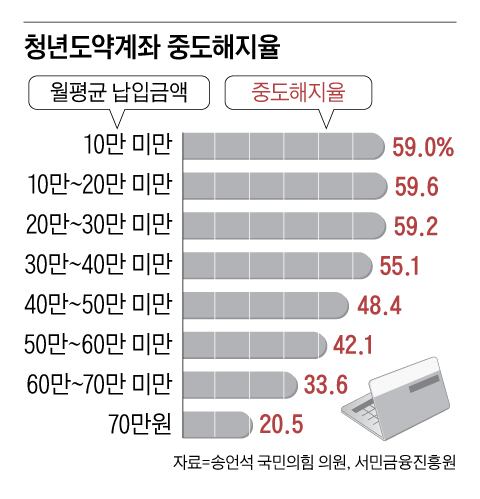
Cancellation rates varied sharply by monthly deposit amount. Those who deposited the maximum 700,000 Korean won had a cancellation rate of 20.5%. However, cancellation rates exceeded 50% for those depositing less than 400,000 Korean won monthly. Breakdowns were: 300,000–400,000 Korean won, 55.1%; 200,000–300,000 Korean won, 59.2%; 100,000–200,000 Korean won, 59.6%; and under 100,000 Korean won, 59.0%.
The account requires a minimum three-year commitment to receive government support. Early termination before three years forfeits government contributions and tax-free interest benefits, except in special cases such as retirement, business closure, or illness.
The issue lies in the difficulty for youths with irregular income or urgent financial needs—such as jeonse or monthly rent contracts—to maintain the account until maturity. According to the Korea Inclusive Finance Agency’s Youth Financial Status Survey, 39.0% of cancellations were due to “unemployment/income reduction,” followed by “urgent need for funds” at 33.3%.
Some youths cannot even join. Government asset-building programs, including the Youth Leap Account, require verified income for enrollment. The Ministry of Data and Statistics’ May 2026 Economic Activity Population Survey reported a 65.6% employment rate for youths (19–34), meaning one in three youths is currently jobless. Experts argue such financial support policies may deepen inequality.
Last year, the average net assets of the top 20% and bottom 20% youth households were 930.22 million Korean won and 23.01 million Korean won, respectively—a gap exceeding 40 times. Surgeong Jeong, a professor of business administration at Sangmyung University, said, “Uniform support criteria need adjustment for youths with irregular income, such as platform workers and freelancers.”
◇“Resources should focus on low-income youths”
Critics also note that similar youth asset-building products reappear with renamed structures under each new administration. Moon Jae-in’s government introduced the Youth Hope Savings, followed by Yoon Suk-yeol’s Youth Leap Account and Lee Jae Myung’s Youth Future Savings.
The government allowed existing Youth Leap Account subscribers to switch to the Youth Future Savings upon its launch. Of the 1.385 million people who applied for the Youth Future Savings (applications closed last month), 262,000 (18.9%) were existing Youth Leap Account holders. New subscribers totaled 1.123 million, just 35% of the government’s expected 3.2 million. Song Eon-seog criticized, “The Youth Future Savings, promoted to erase the previous administration’s policies, fell short of half the government’s expected subscriptions.”
Starting next year, the government plans to lower eligibility thresholds for the Youth Future Savings and expand support. Income requirements for the general product will be removed, and government support for the preferential product targeting low-income youths will increase from 12% to 15%.
Yang Jun-mo, a professor at Yonsei University, said, “Rather than continuously introducing similar financial products, increasing good jobs to strengthen youths’ income base and focusing limited resources on low-income youths who need support is essential.”





Leave a Reply