
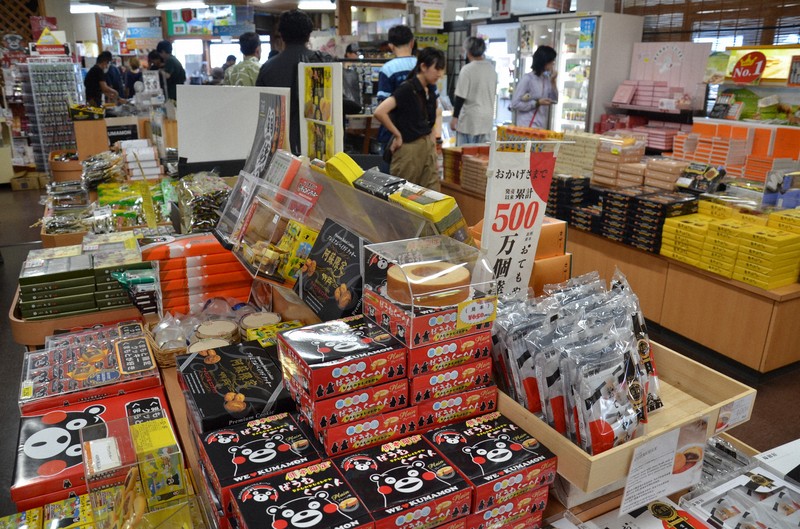
While recovery efforts are gradually moving forward across Kumamoto Prefecture after the region was struck by a strong temblor on July 28, the local tourism industry continues to struggle, and traveler numbers have even declined in other parts of southwestern Japan’s Kyushu region that suffered no damage.
Although there are hopes for the central government’s tourism support measures, there is still no clear sign of a full recovery in inbound foreign sightseers, which had been an important source of tourism spending in Kyushu.
The Aso region of Kumamoto Prefecture is home to one of the world’s largest calderas. The Daikanbo overlook, sitting at an elevation of about 936 meters, offers a panoramic view of the surrounding mountains and is a standard tourist stop for visitors traveling around Kumamoto, Oita and Miyazaki prefectures. August is normally the peak season, but there are no crowds at the restaurants and tourist facilities in the area.
“Summer is usually so crowded with cars that there are massive traffic jams. … We have no idea when things will recover,” said Kimiaki Ono, president of Daikanbo Kanko, a company operating the Daikanbo Chaten teahouse in the area.
Tourist numbers in August fell to about half the usual level. In particular, the number of foreign visitors, who often arrive by large tour buses and spend heavily on souvenirs, fell to about one-third of the normal level. August sales were down 10% from a typical year, according to the company.
In addition to concerns about aftershocks, the way people travel around the Kyushu region is affecting the entire region. Traveling across multiple prefectures is common in Kyushu. Following the July 28 earthquake, some Kyushu Shinkansen bullet train services remained suspended, while traffic restrictions continued on parts of the Kyushu Expressway. As a result, cancellations extended to areas far from the disaster zone.
At Kagoshima City Aquarium in neighboring Kagoshima Prefecture, the number of visitors from July 28 through Aug. 16 fell 23.5% from the same period the previous year to about 60,000, reducing admission revenue by about 8 million yen (approx. $50,000).
Hotel reservation cancellations have also become a serious problem.
“Our inn didn’t suffer any earthquake damage, and we’ve been able to operate normally. Even so, about 90% of our reservations for August were canceled,” Hidetomo Hirai, president of Yamaga Onsen Seiryuso, a hot spring inn in Yamaga, Kumamoto Prefecture, said with a sigh.
Since the earthquake, reservations for about 700 guests have been canceled, resulting in about 24 million yen (around $150,000) in lost sales. Some 70% of the cancellations are for August and September, but many have also called off their reservations for October and November.
According to a survey covering all seven prefectures in the Kyushu region and other areas, at least 408,500 person-nights of hotel reservations were canceled across Kyushu. A guest-night is calculated by multiplying the number of guests by the number of nights they stayed. The canceled bookings are equivalent to about 2.4 days of the total number of person-nights in Kyushu, which averaged about 170,000 per day in 2025, but the actual number of cancellations is believed to be higher.
In Kumamoto Prefecture, the Aso region has seen the most cancellations, followed by the Amakusa area and the city of Kumamoto, which are closer to the disaster area. In Kagoshima Prefecture, the city of Kagoshima has been affected the most. This is because the Kyushu Shinkansen service between Kumamoto and Shin-Minamata stations has been suspended, making it impossible for people to travel directly from Fukuoka or western Japan’s Kansai region to Kagoshima Prefecture by bullet train.
A string of cancellations has also been seen in Miyazaki Prefecture, particularly in the city of Miyazaki. The Kyushu Expressway was temporarily closed, and the effects of the disruption continue to make travel to and from areas including Fukuoka, Kumamoto, Nagasaki and Saga prefectures difficult.
As the increase in reservation cancellations pressures businesses, some hotels have begun lowering fees for new reservations. According to a tourism official in the Oita Prefectural Government, some inns have started offering discounts, an unusual move during the height of summer, after cancellations left them with noticeable numbers of vacant rooms.
As recovery efforts continue, those involved in the tourism industry in various areas are placing their hopes on the central government’s “Kyushu support discount,” a tourism assistance program scheduled to begin this fall. The government will cover part of the cost of accommodations and tour packages with public funds.
However, some in the industry say that “the program alone won’t be enough.”
One reason is that foreign tourists have become increasingly important to tourism spending in the Kyushu region as rising prices have made Japanese consumers more cautious about spending.
According to statistics from the Kyushu Tourism Organization, the total number of person-nights by foreign visitors in the region in 2025 was 13.15 million, accounting for about 21% of all guest-nights.
Daikanbo Kanko president Ono told the Mainichi Shimbun, “Things won’t return to normal unless we can get inbound tourists to come back. We need to communicate overseas that ‘you can travel safely in Kyushu.’”
(Japanese original by Yuichi Utsunomiya and Atsuji Nakazono, Kyushu Business News Department, and Azusa Yamazaki, Kyushu News Department)





Leave a Reply