
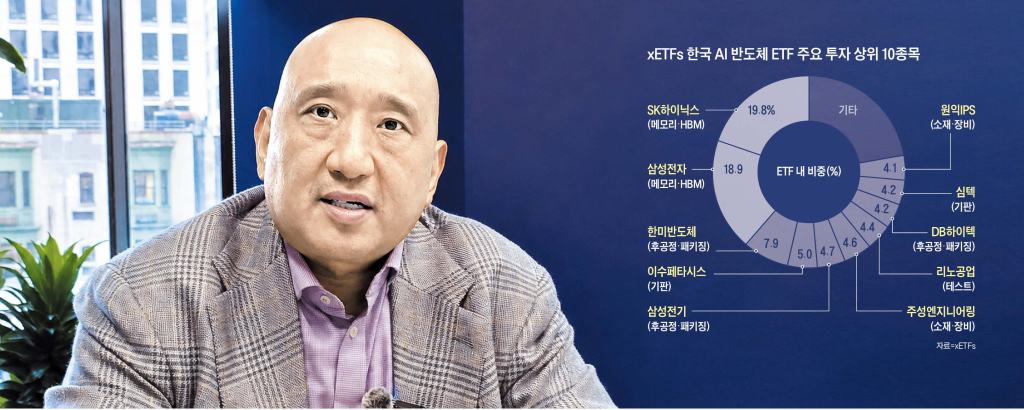
“The best time to plant a tree was 20 years ago,” goes an old saying. “South Korea planted that tree a long time ago. The moat built by companies such as SK Hynix and Samsung Electronics is incredibly deep,” said Johnny Wu, founder and CEO of xETFs. “I believe the Korean economy is entering a golden age, and that it could last for more than a decade.”
Wu made the remarks in an interview with WEEKLY BIZ last month at his office in Midtown Manhattan. He has worked on Wall Street for more than 20 years, including at British investment bank Barclays, where he led businesses involving derivatives and structured products. He later founded a hedge fund and a financial consulting firm before co-founding the exchange-traded fund provider xETFs last year.
—Some believe AI will transform the global economy, while others warn that excessive investment could create a bubble. Which view do you take?
“Both can be true. I believe the AI revolution is real. Steam power, railroads, electricity and the internet fundamentally changed how economies functioned and how civilization advanced. AI is the fourth industrial revolution.”
“At the same time, every technological revolution produces overinvestment in certain areas, and there will inevitably be winners and losers. Capital expenditure by hyperscalers such as Amazon, Microsoft, Meta and Google to build data centers could reach between $600 billion and $1 trillion over the next few years. For them, it is an arms race. They need the best technology and the fastest computing capacity to remain competitive, so they have little choice but to keep investing. There will certainly be losers, but the companies that win will benefit tremendously.”
—Which companies will actually make money from this investment boom?
“The ‘picks and shovels’ companies. If $1 trillion is invested, Nvidia will benefit on the GPU side, while SK Hynix and Samsung Electronics will benefit from demand for high-bandwidth memory and DRAM.”
“But it goes far beyond chips. There is an enormous supply chain encompassing power and energy, liquid cooling, data center real estate, semiconductor equipment, components and materials. As AI investment expands, companies across this ecosystem will benefit from that spending.”
—Will those gains spread throughout South Korea’s semiconductor ecosystem?
“Jensen Huang, CEO of Nvidia, understands that global demand for AI will be enormous and that Nvidia must work with the best companies to supply AI accelerators. SK Hynix and Samsung Electronics will play critical roles in that process.”
“But it is not just those two companies. There are many Korean firms across the HBM supply chain that develop technologies and supply components alongside Samsung and SK Hynix. Their geographic proximity is also an advantage. As more AI data centers are built, the importance of South Korea’s entire semiconductor ecosystem will continue to grow.”
—Could China catch up quickly if it continues pouring money into semiconductors?
“It will be very difficult. A handful of companies dominate essential parts of the data center supply chain. You cannot really build an AI data center without Nvidia’s GPUs or SK Hynix’s HBM. Advanced semiconductor production also depends on TSMC and on ASML’s extreme ultraviolet lithography equipment.”
“These companies have accumulated specialized expertise over many years to reach their current positions. Based on what I have read and heard from industry experts, it could take China five to 10 years to build comparable HBM production capabilities.”
“More importantly, today’s leaders will not stand still during that time. Even if China catches up to where those companies are today, the technology will already have moved forward. That makes closing the gap extremely difficult.”
—Semiconductors have historically gone through repeated boom-and-bust cycles. Could today’s optimism unravel?
“There will certainly be cycles. The semiconductor industry has a history of overbuilding and oversupply, followed by falling prices, earnings cuts and sharp declines in share prices. If Meta or Amazon suddenly announced that it was dramatically cutting capital expenditure, the entire semiconductor industry would be hurt because fewer chips would be needed.”
“What is different this time is that demand created by the AI revolution is likely to last much longer. Before AI, humans were the primary users of computing resources. Now AI agents also require computing power. That could multiply demand for memory, chips, data centers and AI computing infrastructure.”
“I do not think the hyperscalers have much ability to slow down. They must continue investing to maintain the best technology and keep users on their platforms. Companies with dominant positions in areas such as HBM will therefore continue to benefit, even though their share prices may remain volatile.”
—Why do you believe South Korea’s “golden age” could last more than 10 years?
“South Korea planted the seeds 20 years ago. Companies such as Samsung Electronics and SK Hynix continued to make massive investments, building capabilities that other countries cannot replicate in a short period of time.”
“South Korea has government support, outstanding companies, an extraordinary workforce and a technological head start. That combination is very difficult for other countries to catch up with.”
“Of course, unexpected shocks can occur at any time, whether from wars, interest-rate changes or disruptions in financial markets. After more than 25 years as an investor, I have learned that it is impossible to predict every surprise.”
“But if you ask whether South Korean companies are structurally well positioned to benefit from the enormous amount of money being invested in AI around the world, my answer is absolutely yes. The world needs South Korea to supply the technologies and components required for the AI buildout.”
—You recently listed an ETF focused on Korean semiconductor companies in the United States.
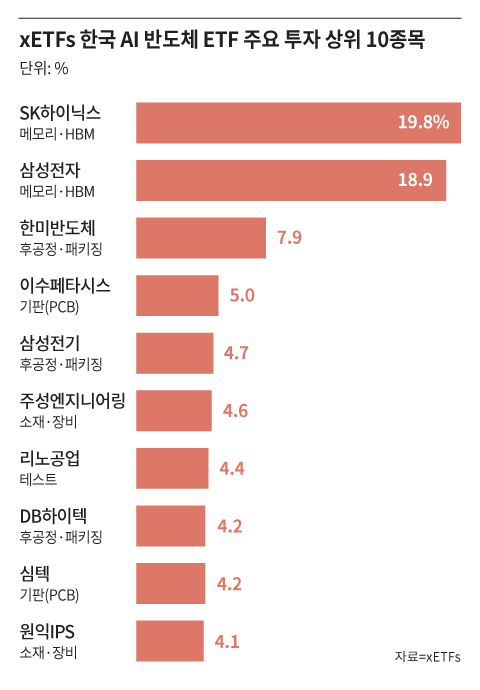
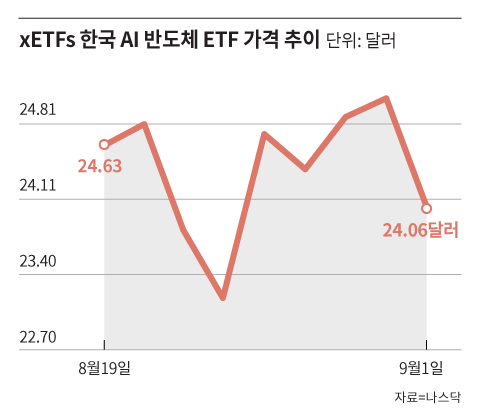
“We launched the xETFs Korea AI Semiconductor ETF, or KSMH, on Aug. 19. SK Hynix and Samsung Electronics each account for about 20% of the portfolio. The ETF also holds 18 other Korean companies that are critical to the semiconductor supply chain, including Hanmi Semiconductor and Samsung Electro-Mechanics.”
“Hanmi Semiconductor plays an important role in advanced packaging, while Samsung Electro-Mechanics supplies substrates. Other companies in the portfolio are involved in testing, materials and various stages of the packaging process.”
“Existing semiconductor ETFs in the United States are generally dominated by American and Taiwanese companies such as Nvidia, AMD, Intel and TSMC. They often provide little or no exposure to Korean companies. Broader Korea ETFs, meanwhile, also include healthcare, financial services and other industries, so they are not pure semiconductor investments.”
“We saw a gap in the market. KSMH allows investors to gain exposure to the Korean AI semiconductor industry through a single ticker.”
—The Korean stock market has recently been highly volatile. Were you concerned about launching the fund at such a time?
“I think it is almost impossible to time the market in the short term. No one can know with certainty what will happen over one day, one week or one month.”
“South Korea’s market can be particularly volatile because it is heavily weighted toward semiconductors. Leveraged products can amplify that volatility and become very dangerous for investors who try to time the market.”
“But over the long term, there is history, consistency and a basis for confidence. Given South Korea’s strength and position in memory chips and semiconductors, I believe its economy and leading companies are well positioned to perform strongly.”
“The real question for investors is whether they can tolerate short-term volatility. Those seeking broader exposure can invest in a basket of semiconductor companies rather than trying to select and time a single stock. Long-term investing is ultimately about doing the research, building conviction and accumulating investments over time.”



 jasdooit
Leave a comment