
CHEORWON/GOSEONG, South Korea – Residents of Cheorwon, one of South Korea’s border towns, have an inside joke about what they would do if war broke out with North Korea: Keep a spare North Korean flag at home, and wave whichever one matches the army that shows up.
“Wave the North Korean flag when their soldiers come, wave the South Korean flag when ours arrive,” said Kim Hee Jun, 63, with a chuckle. Kim is a taxi driver who has lived his entire life in Cheorwon, a county sitting directly on the heavily fortified border with the North.
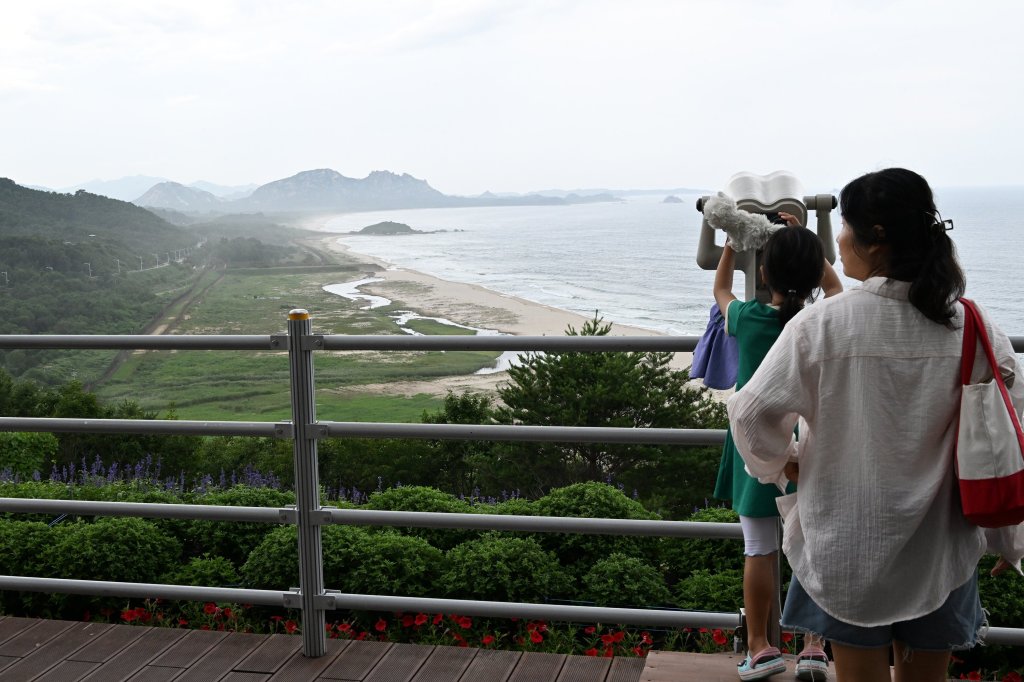
Cheorwon, in central South Korea, and Goseong, on the northeast coast, are among the country’s most prominent border communities, places where nearly eight decades of division and the destruction wrought by the 1950-53 Korean War remain etched into the landscape.
The relationship between the two Koreas has deteriorated sharply in recent years, with North Korean leader Kim Jong Un designating the South as his country’s “primary hostile state,” formally abandoning reunification as a goal and ordering the demolition of road links connecting the two sides on both the eastern and western corridors in October 2024.
In Goseong, a villa where North Korean founder Kim Il Sung spent summers with his family before the Korean War is located on the shore of Hwajinpo Lake, with the seaside retreat of South Korea’s first President Rhee Syngman standing on a hill across the water.
The county became a symbol of inter-Korean reconciliation when overland tours to North Korea’s Mount Kumgang launched in 2003, but the program was suspended indefinitely after a North Korean soldier fatally shot a South Korean tourist who had strayed beyond a designated boundary in July 2008.
“When the tours were running, people were euphoric. It felt like reunification was just around the corner,” said Kim Gang Yeol, a Goseong taxi driver whose father fled North Korea during the war and never returned.
Kim, 65, said his family was one of thousands separated by the war, many of whom settled along the northeast coast, including in nearby Sokcho’s Abai Village.
In Cheorwon, the ruins of a three-story building constructed by the North Korean Workers’ Party in 1946 stand at the center of town, its walls pockmarked by bullets and its entrance crushed by tanks that rolled through it during the war.
“Cheorwon’s residents went from living in the most prosperous center of the region to the very front line (of the border),” said Kim Il Nam, 66, a guide at the site, noting that Cheorwon was then the largest urban center in Gangwon Province.
The building, constructed using a Russian technique that relied on bricks rather than steel reinforcement, served as a base for North Korean authorities to detain and torture dissidents and civic leaders during the North’s five-year occupation of the area, Kim said. “Most died, and those who survived came out looking like corpses.”
The building survived largely by accident because it contained no steel reinforcement worth salvaging, and was eventually designated a registered cultural heritage site.
Cheorwon also sits above the second of four infiltration tunnels North Korea dug beneath the border, discovered in 1975 at the cost of eight South Korean soldiers’ lives, just three years after Pyongyang signed the July 4 Joint Communique with Seoul in 1972 pledging peaceful dialogue. The locals cite the discovery as proof that the North’s promises have never been trustworthy.
Living next to one of the world’s most heavily armed borders has shaped residents’ daily lives in ways unfamiliar to most outsiders.
Lee Ho Myeong, 50, a lifelong Cheorwon resident, recalled growing up under “blackout protocols” in villages along the civilian control line near the border, where families hung opaque curtains to keep house lights invisible to North Korean observers. Their movements after dark were also restricted.
Though many of those controls have eased over the years, the heavy military presence still weighs on the local economy, with periodic troop mobilizations and access restrictions disrupting businesses, Lee said.
Neither diplomatic breakthroughs nor rising hostility have much bearing on a community long accustomed to the turbulent history of inter-Korean relations.
The 63-year-old taxi driver said wartime scars run deep in Cheorwon, where many residents were conscripted into the North Korean army after the area fell north of the 38th parallel at the end of World War II.
Many either escaped from the North Korean army or later switched sides and served in the South Korean military, spending decades concealing their past service under Pyongyang’s flag.
“Whether something good happens or something bad, people here just think, ‘this will pass too,’” Lee said, adding that he has never truly expected reunification in his lifetime because the cultural and economic gap between the two Koreas has grown too wide.
Kim said wartime scars run deep in Cheorwon, where many residents were conscripted into the North Korean army after the area fell north of the 38th parallel at the end of World War II.
Many of them either escaped from the North Korean army or switched sides later, serving for the South Korean military, and ended up spending decades concealing their past service under Pyongyang’s flag.
Lee, the lifelong Cheorwon resident, said North Korean defectors now live and run businesses in Cheorwon and that their presence attracts little notice.
“They’re Korean, so people just accept them. It’s that simple,” the driver said, adding that whatever Pyongyang’s leaders declare, ordinary people on both sides of the border remain fundamentally the same.
He recalled how he once asked both North Korean defectors and ethnic Korean immigrants from China whom they would cheer for in a soccer match between South Korea and China.
The defectors chose South Korea without hesitation, while those from China picked China.
“The North Korean people,” the driver said, “they just think of themselves as Korean.”



Leave a Reply