

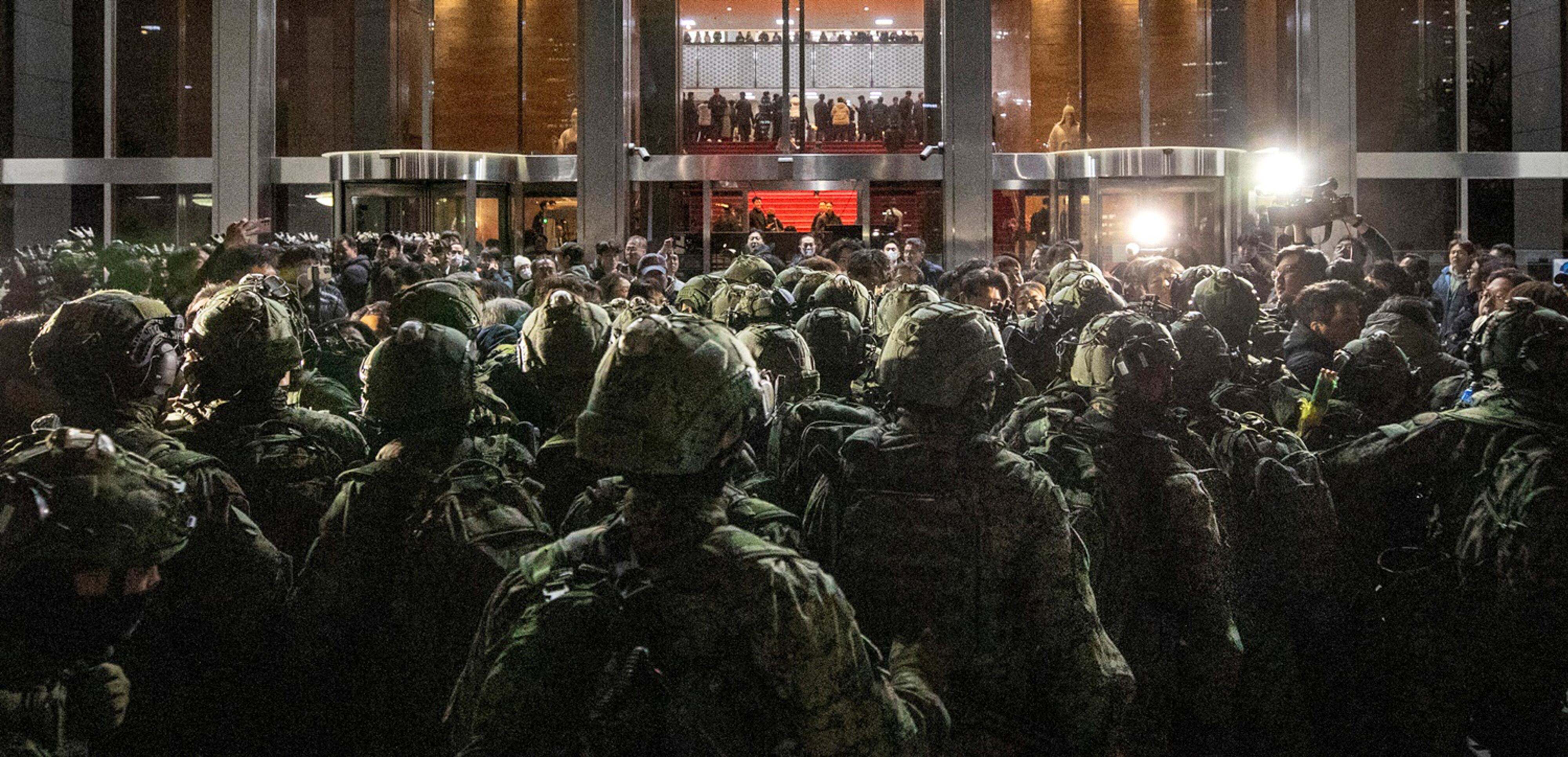
They say there can be a democratic military, but no military democracy. During the December 3 emergency martial law, many military commanders fell into deep anguish over the duties of soldiers and citizens, likely because of this. Martial law was declared, and they received orders to deploy, but the duties of soldiers and citizens, military law, and the constitution clashed.
Obedience to orders is a matter of life and death for soldiers. Article 25 of the Military Service Basic Act stipulates the “duty of obedience to orders,” stating, “Soldiers must obey the lawful orders of their superiors when performing their duties.” Although the clause “in the course of duty” is attached, the Ministry of National Defense’s legal commentary views “orders from superiors” as naturally “lawful” orders. Meanwhile, Article 44 of the Military Criminal Act defines “resisting or failing to obey a superior’s legitimate order” as a crime of disobedience. No matter how unjust an order may be, the path to refusal is narrow and arduous. Hence, when an order is given, soldiers charge even into battlefields where bullets rain down.
Yet, on the night of the December 3 emergency martial law, many military commanders recognized the illegitimacy of orders at a certain moment. Kim Moon-sang, then Capital Defense Command operations chief, delayed the 707th Special Missions Group’s helicopter entry into Seoul airspace three times because the flight’s purpose was unclear. As the Special Warfare Command’s elite unit tasked with counterterrorism, 707th Special Mission Unit members were deployed to the National Assembly. However, they fell into great confusion upon seeing the surging crowds of citizens. Kwak Jong-geun, former Special Warfare Command commander, claimed he judged the order from then-Defense Minister Kim Yong-hyun to evict lawmakers from the National Assembly chamber as a “clear violation of the law.”
What should soldiers do in such cases? Soldiers in a democratic state are “citizens in uniform.” They must remain loyal to the constitution above their superiors’ orders. Article 5, Clause 2 of the constitution stipulates, “The military’s sacred duty is to safeguard national security and defend the homeland, and its political neutrality must be upheld.” Even the president, as the military’s supreme commander, is bound by the constitution. However, during the December 3 emergency martial law, few soldiers successfully navigated the narrow gap between the constitution and military law. The Ministry of National Defense investigated 108 soldiers, and 50 faced disciplinary action. The Army Chief of Staff, Navy Chief of Staff, and Joint Chiefs of Staff Operations Chief—who commanded 70% of army forces and guarded the front lines—were also dismissed. In the first trial, courts sentenced the Defense Counterintelligence Command commander, Capital Defense Command chief, Army Chief of Staff, and Special Warfare Command commander to prison terms of 9–18 years. The military’s core collapsed.
The court’s judgment was as sharp as frost. It did not acknowledge any conflict between the constitution and military law. This is likely tied to the military’s unfortunate history. South Korea’s military defended liberal democracy by fighting against North Korea’s aggression. Economic growth was fundamentally its achievement—a rare case in world history. However, coups and military dictatorships inflicted deep wounds on democracy. After democratization in 1987, the military returned to barracks. Yet, the December 3 emergency martial law summoned it back to the political arena. It had not fully withdrawn to the barracks.
Kim Yong-hyun, former defense minister, and Noh Sang-won, former Intelligence Command commander, actively participated in the martial law. However, most involved parties appear to have hesitated due to personal reasons like school ties, regional connections, or promotions. The Yoon Suk-yeol administration retired all three service chiefs in late 2023 and replaced them with lieutenant generals promoted after his inauguration—an unprecedented personnel move in military history. During the Park Chung-hee, Chun Doo-hwan, and Roh Tae-woo administrations, members of the private military faction “Hana” held supreme power. The military became privatized. Left-wing governments also focused on partisan appointments. Although civilian control was restored after democratization, the ills of privatization persisted.
The public was shocked by the fearful and pathetic appearance of generals after the December 3 emergency martial law. The military’s status, once dominant in society, plummeted to the lowest level after democratization. The military became like grass swaying with the winds of political power. During left-wing governments focused on “sunshine” and “peace,” absurd arguments like “dialogue defends the nation” emerged. This is the current reality of our military.
Our military is critically ill. The December 3 emergency martial law made it impossible to discern how low it could fall. Is this acceptable for a nation living under the world’s most severe security threats? Without normalizing civil-military relations, even a top-five global military is an illusion. Politics must guarantee the military’s independence to uphold political neutrality. To build a military loyal to the constitution, expanding legal officers is more critical than punishment. The military must now become a “thinking” force to survive. Strength alone is not enough. It must deeply contemplate how to act when the constitution and military law clash and what the military’s role should be in a democratic state. Only then can it be reborn as a truly strong military.


Leave a Reply