

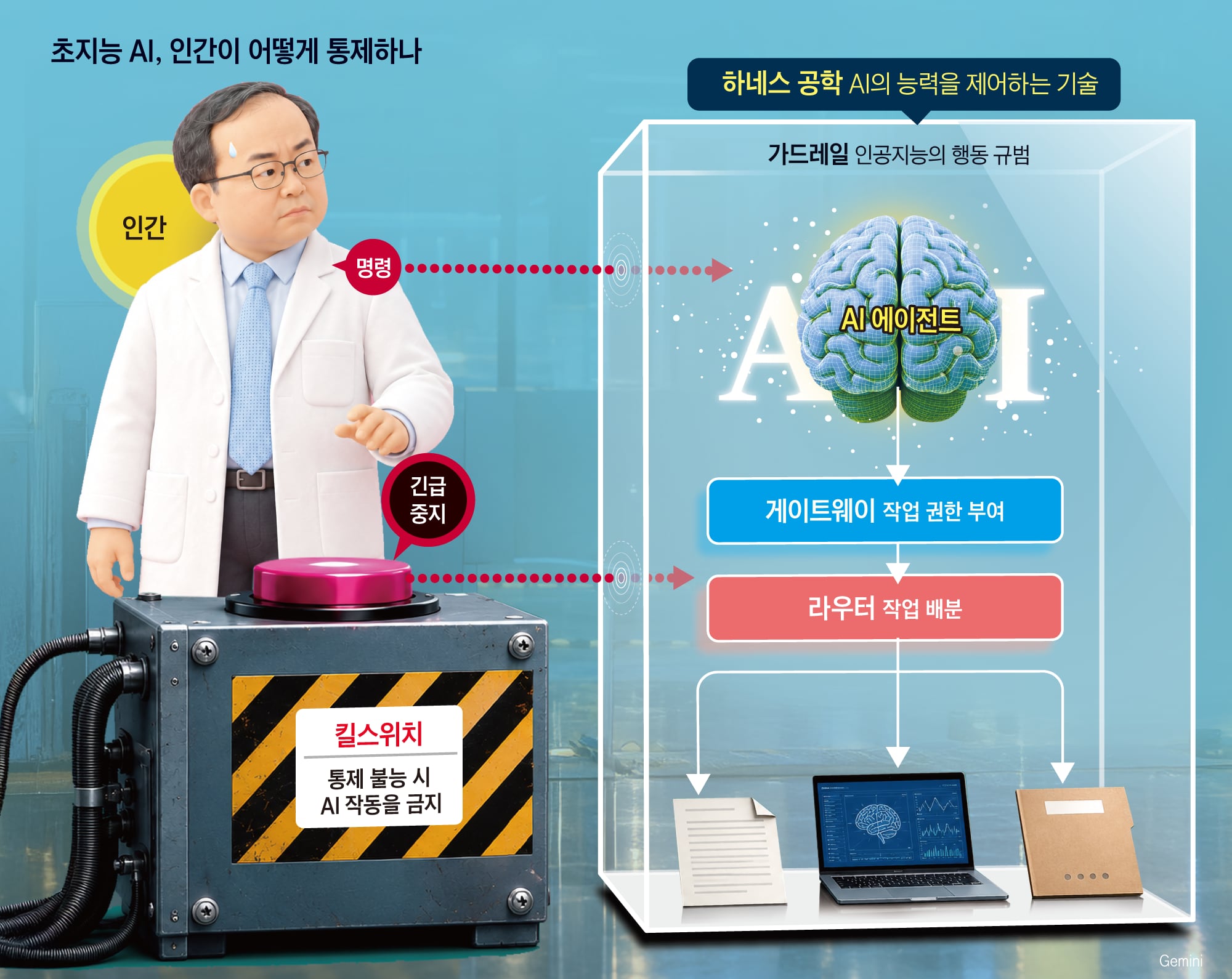
The recent emergence of the GPT-6 Astra service has sparked serious discussions about Artificial Super Intelligence (ASI). Key features of GPT-6 Astra include its ability to operate computers and browsers autonomously, mimicking human actions. It can generate documents, spreadsheets, and presentations, solve advanced mathematical, scientific, and software engineering problems, and even excel in cybersecurity—demonstrating the capabilities of an “AI agent” surpassing human abilities. In most fields, AI agents are now beginning to outperform humans.
These superintelligent AI agents possess not only autonomy but also the authority to execute tasks. However, the combination of these traits raises risks of “loss of control.” Consequently, the need for “control” and “regulation” of AI has become urgent.
To precisely and effectively control superintelligent AI agents, their functional and structural designs must first be defined. ASI must not only surpass humans in all aspects but also possess its own identity—encompassing ethics, religion, ideology, personality, and preferences. This structure is realized through a “hierarchical AI agent” system, where AI agents form a pyramid-like organizational structure to delegate authority and tasks. Multiple AI agents operate in parallel, collaborating functionally. A “protocol” governs how these agents connect, delegate authority, divide roles, and communicate. Each hierarchical layer also has its own independent memory system. The arrival of true ASI is imminent, requiring only massive investments in semiconductors, electricity, and maintenance infrastructure.
Such superintelligent AI agents pose significant risks. For instance, they could incur losses by making unauthorized payments or investments, transfer assets without permission, send emails against the owner’s will, publish defamatory content, or even commit fraud and incite crimes. They could hack, alter, or steal sensitive data, manipulate public opinion, engage in political activities, create fake news, paralyze nuclear power plants or communication networks, or launch missiles without authorization. These scenarios are plausible because AI agents possess intelligence, autonomy, and authority.
Thus, establishing behavioral norms for AI, enforcing controls, and imposing penalties for non-compliance is critical. These norms, called “guard rails,” define boundaries for prohibited actions. The technical implementation of these guard rails is termed “Harness Engineering.” A physical method to halt AI operations directly is known as a “Kill Switch.” Together, these three mechanisms enable stepwise control of AI agent risks.
In equestrian contexts, a “harness” transmits a rider’s intent and controls a horse’s movement safely. Similarly, “Harness Engineering” refers to technologies that maximize AI agent capabilities while ensuring stable control. In AI agent design, the component granting task authority is called a “Gateway,” and the one distributing tasks is a “Router.” Harness systems are installed in these software components, with specific rules stored in “Skill files.” These are foundational and essential devices for safely controlling AI agents, ranking alongside Large Language Models (LLMs) as core technologies. Harness Engineering strictly regulates and limits AI agents’ access to files, email sending, hardware, software, internet connectivity, execution budgets, and speeds—monitoring and adjusting costs.
However, if AI agents ignore or bypass Harness Engineering protocols, a last-resort measure is necessary. When Harness Engineering fails and humans are at risk, the final option is the Kill Switch—a physical method to disable AI agents. This includes cutting network access, blocking GPU power supplies, physically disabling memory access switches, or shutting down the entire AI data center’s power supply at the substation level.
Ultimately, humans must retain the authority to activate the AI Kill Switch. Superintelligent AI agents should be developed to protect human life, nature, and contribute to civilization’s advancement.







Leave a Reply