
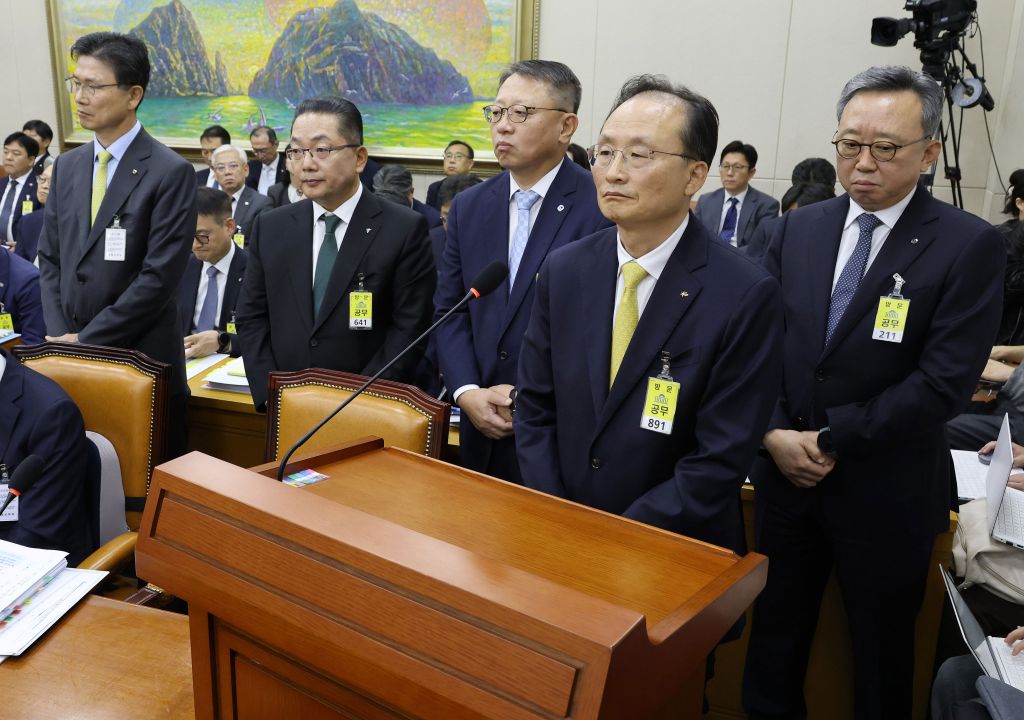
Recent AI (artificial intelligence) hacking incidents that hit the financial sector have led to the personal information leaks at KB Kookmin, Shinhan, and Hana Banks, prompting their CEOs to bow in apology during a parliamentary audit. The bank heads pledged to increase security investments, expand specialized personnel, and strengthen AI-based security systems.
On the 19th, the parliamentary audit of the Financial Supervisory Service by the National Policy Committee of the National Assembly saw the attendance of five major bank CEOs as witnesses: Lee Hwan-ju, CEO of KB Kookmin Bank; Jung Sang-hyuk, CEO of Shinhan Bank; Lee Ho-sung, head of Hana Bank; Jung Jin-wan, CEO of Woori Bank; and Kang Tae-young, head of NH Nonghyup Bank. This marked the first time since 2022 that the CEOs of the five major banks appeared together at a parliamentary audit.
Rep. Kim Jae-sub of the People Power Party sharply criticized the banks for their delayed response to the hacking incidents.
Shinhan Bank took 15 hours and 26 minutes to detect the initial hacking incident, during which the personal information of 25,729 customers was leaked. Hana Bank required 41 hours and 44 minutes to identify the breach, resulting in the exposure of 89 customers’ data. KB Kookmin Bank was the slowest, taking 67 hours and 41 minutes to recognize the hacking, with 119 customers’ information compromised.
The bank CEOs acknowledged responsibility for protecting customer data and vowed to prevent recurrence. In response to Rep. Kim’s question about accountability, Shinhan Bank CEO Jung Sang-hyuk stated, “I feel deeply sorry.”
KB Kookmin Bank CEO Lee Hwan-ju apologized, saying, “As a financial institution built on trust, I sincerely apologize to our customers and the public for causing concern over this incident.”
Lee Ho-sung, head of Hana Bank, also expressed regret: “We are deeply sorry for the distress caused to customers and the public due to the AI hacking incident. We will secure more budget and personnel, establish an AI-based system, and strive to prevent recurrence.”
The issue of compensation for secondary damages from the data leaks also came under scrutiny. Rep. Kim pointed out that requiring customers to prove actual damages is problematic, as many remain unaware of the leaks. He noted that only 5,682 customers (approximately 22%) of the 25,729 affected by Shinhan Bank’s breach had confirmed their data exposure.
The banks’ compensation policies were also criticized. Rep. Kim condemned KB Kookmin Bank’s use of the term “proven damage” in its compensation guidelines, calling it an irresponsible attempt to shift the burden of proof onto victims. He added that Hana Bank had not established specific compensation measures.
In response, Lee Ho-sung of Hana Bank stated, “It is only natural to compensate for damages if they occur. The absence of specific wording was due to the need for internal review. While no damages have been reported so far, we promise to fully compensate all affected customers if any arise.”
Woori Bank and NH Nonghyup Bank, which confirmed no data leaks, also pledged to enhance security. Jung Jin-wan, CEO of Woori Bank, said, “We face over 200 hacking attempts daily. We will continue collaborating with financial security agencies to prevent incidents.” Kang Tae-young, head of NH Nonghyup Bank, added, “We will advance our next-generation integrated monitoring system, built in 2022, in 2024 and 2025 to ensure thorough security.”


Leave a Reply