

Student rallies over ailing high schools are hijacked by looters who rampaged through major cities, angered by rising fuel and living costs
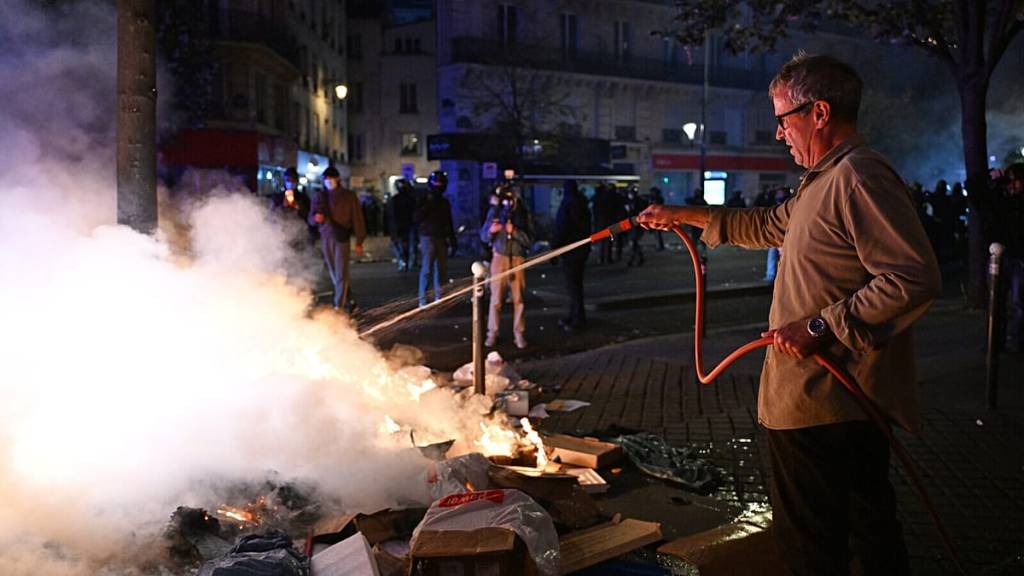
France experienced a weekend of shocks as weeks-long high school student protests for better study environments were hijacked by violent looters across major cities, angered by rising fuel prices and an ongoing cost of living crisis.
While the rallies saw hundreds of thousands protest peacefully, clashes over the weekend led to chaotic scenes: hundreds of shops were pillaged, the historic city hall of Limoges was burned down and multiple public buildings across cities like Paris, Marseilles and Bordeaux were attacked.
In his televised speech to the French people on Sunday evening, French President Emmanuel Macron called for a clear distinction between those who destroyed properties and the peaceful protesters.
Do you have questions about the biggest topics and trends from around the world? Get the answers with SCMP Knowledge, our new platform of curated content with explainers, FAQs, analyses and infographics brought to you by our award-winning team.
“For several weeks, our youth have been expressing a deep anxiety in high schools and universities, worrying for their future, their living and study conditions … the idea that they will not have a desirable future,” Macron said, vowing that their voices “will be heard”.
This grievance behind the protests points to issues with France’s education system that analysts say could threaten the country’s ambition to innovate and catch up with the US and China.
In the Organisation for Economic Co-operation and Development’s (OECD) last Programme for International Student Assessment (PISA) report published last month, France has only 9.8 per cent of top performers – those who reached level 5 or 6 – in science, reading or mathematics, compared to 55.5 per cent for mainland China, covering students from Beijing, Shanghai, Jiangsu and Zhejiang.
“It shows that in terms of people that are top performers, that in theory will have the best jobs will have the capacity to innovate, the proportion is decreasing [for France] every PISA cycle … now action should be taken,” said Eric Charbonnier, an education analyst at the OECD.
The report showed that 9.3 per cent of the Chinese students tested reached level 6 in science, compared to only 0.8 per cent in France. For maths, the gap was even bigger, 30 per cent for China and only 0.7 per cent for France.
On paper, despite rising public debts and recent efforts to bring down government spending, France did not cut its budget for education. For the 2027 budget, the government is planning Euro64 billion (US$71.9 billion) for education, up by Euro1 billion year on year.
But the problem for Charbonnier is not how much money was invested but how well it was spent. A lot of the investment is blocked in paying for social benefits: 32 per cent of the proposed education budget in 2027 will go to pensions, according to the French government.
“It’s not an investment on the quality of education. It’s not an investment on teachers, on improving the working condition,” Charbonnier said.
Meanwhile, the teacher shortage issue is worsening in the country. Some 65 per cent of French schools were missing at least one teacher this year when school started in September, up by 5 per cent compared to 2025, according to the SNPDEN, France’s largest union of secondary school principals.
In a centralised country where Paris dictates a lot of the rules, France has also seen a high level of policy uncertainty in education, according to Charbonnier, adding that France had 12 education ministers in the past 15 years and each one of them attempted to do their own reforms, creating confusion for schools.
A lot of funding was also put into building maintenance, according to Sacha Courtial, co-president of Volt France, a pro-EU party active on the younger generation.
Many French high schools were built many years ago, under the Third Republic, and need a huge amount of investment just for maintenance, he said. During the weeks of protests, many high school students complained about studying in extreme heat without air conditioners or during winter times in classrooms with inadequate heating.
Moreover, compared to China, the US or northern European countries, France also lags in digitalisation efforts and the teaching materials are outdated with no mention of new technologies such as AI, according to Courtial.
“Every politician will say that youth is the future but we have to admit that … the education policies have not been prioritised enough,” he said.
More Articles from SCMP
Hong Kong lift scandal prompts calls to review checks and engineer accreditation
Designer salt and pepper shakers from Anya Hindmarch and more
Spirit of Hong Kong Awards: medical student draws from experience of volunteer work
Face Off: Should Hong Kong universities have a cap on students who did not take the local exam?
This article originally appeared on the South China Morning Post (www.scmp.com), the leading news media reporting on China and Asia.
Copyright (c) 2026. South China Morning Post Publishers Ltd. All rights reserved.




Leave a Reply