
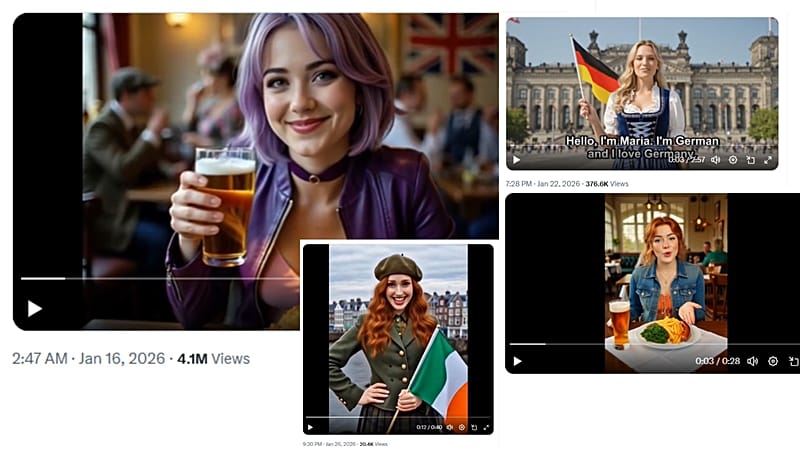
Almost the same AI-created characters have emerged in various parts of X and Facebook throughout Europe, spreading anti-immigration and anti-government content.
Different versions of the same character have been posted online, including the Dutch-speaking “Emma,” the German “Maria,” and the Irish “Amelia.”
Every character has her own national symbols and political allusions. In Germany, Maria is dressed in a traditional Bavarian dirndl and shows her affection for a “cold beer at our local tavern.” She states that her government is no longer safeguarding her and urges “courageous knights” to protect her country from Muslim immigrants.
In the Netherlands, an AI-generated version of Emma claims that Christmas needs to be observed “in the traditional manner”.
In Ireland, a character with red hair refers to the country’s taoiseach, Micheál Martin, as a “spokesperson for Brussels.” She claims that Brussels compels Ireland to maintain “open borders,” even though Ireland is not a member of the Schengen area.
Each of these videos has drawn thousands of views and engagements, especially on X.
These imitators can be traced to the most famous version that originated first in the UK. Here, Amelia, an AI-created schoolgirl with purple hair, has become popular, with her initial viral post receiving over 1.4 million views.
Versions of the character have spread across Facebook, Instagram, X, and Telegram: Amelia is featured in manga comics and alongside Harry Potter and the Royal Family in digitally-created images, urging UK residents to “take their country back” during a time of uncontrolled Muslim immigration and a poorly managed government.
Amelia’s unlikely origins
The group responsible for the character that the viral memes are derived from claims that much of the online discussion about Amelia is inaccurate.
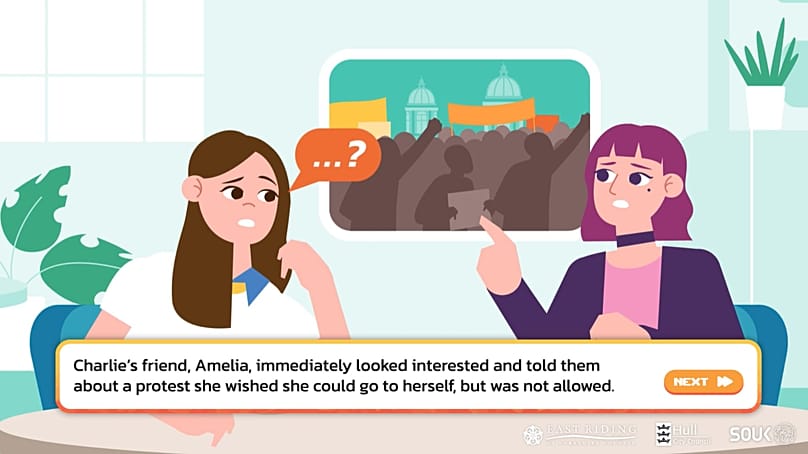
A preliminary version of Amelia was introduced in Pathways, an educational game created by the UK-based social enterprise Shout Out UK in collaboration with local authorities in Hull and East Riding of Yorkshire. The initiative received funding from the UK Home Office as part of a counter-extremism prevention effort.
The game prompts students to select a character who is then involved in different online situations, requiring them to decide how to react to posts, messages, and various types of social pressure.
Matteo Bergamini, the CEO of Shout Out UK, informed Euronews’ fact-checking unit, The Cube, that the game was created behind the scenes in 2023, during a time when local officials in Hull and Yorkshire identified online radicalisation as the most significant threat, particularly for children aged 13 to 18.
“The main danger came from the growing online far-right community,” Bergamini stated, noting that the game was specifically targeted and confined to certain regions in the UK.
The game was not intended to be played alone and was included in a broader educational program aimed at helping teachers encourage in-depth conversations about harmful versus healthy behaviors, he mentioned.
In the game, Amelia is not the main character or an example to follow, but a secondary figure who prompts the central character to participate in unsafe online activities.
Furthermore, the game does not, as some online sources claim, encourage a teacher to direct a child towards Prevent, a UK government initiative, in relation to discussions about mass migration.
It seems the Amelia meme originated among far-right groups as a reaction to what they perceived as a stereotype that criticized their stance on immigration and the “nanny state.”
The Cube contacted several meme creators, but they did not respond in time for the release.
Extreme versions and monetisation
Most Amelia memes, especially on popular platforms like X, are generally innocuous. They would not need to be taken down according to the regulations of the Digital Services Act (DSA).
The DSA mandates that online platforms take down unlawful content, including hate speech, terrorist activities, and material involving child sexual exploitation, along with certain forms of damaging advertisements.
However, researchers who have been tracking Amelia’s swift ascent mention that highly extreme forms of the character can be found in specialized online groups and applications like Telegram.
Siddharth Venkataramakrishnan, an analyst with the London-based research organization the Institute for Strategic Dialogue (ISD), noted that the meme has been adopted by a wide range of online groups, including those who use it in a humorous way and some of the most prominent anti-migrant accounts.
Although not all iterations of the character include offensive language, some versions employ dehumanizing and violent imagery directed at particular groups.
Shout Out UK claims that their persona has been “memefied and sexualized” on the internet by right-wing individuals, with numerous instances linking it to racist and antisemitic remarks, as well as Nazi and far-right symbols.
The organization states that the campaign has extended beyond online platforms and has resulted in threats and harmful messages being directed at its employees.
Amelia has also turned into a means of generating revenue. The ISD has noticed accounts that are pushing Amelia-themed meme coins, which is a typical pattern for popular social media trends.
With this in mind, Venkataramakrishnan states, it remains uncertain which accounts are sharing Amelia memes for political purposes, and which are doing so to boost profit-driven interactions.
“Where does the boundary lie between backing something due to ideology and supporting it because you seek to earn money?” he stated.
Emotionally intense memes are also more prone to gaining popularity on social media once initial engagement begins, Venkataramakrishnan noted, an effect that would have caused Amelia memes to spread quickly.


 jasdooit
Leave a comment