
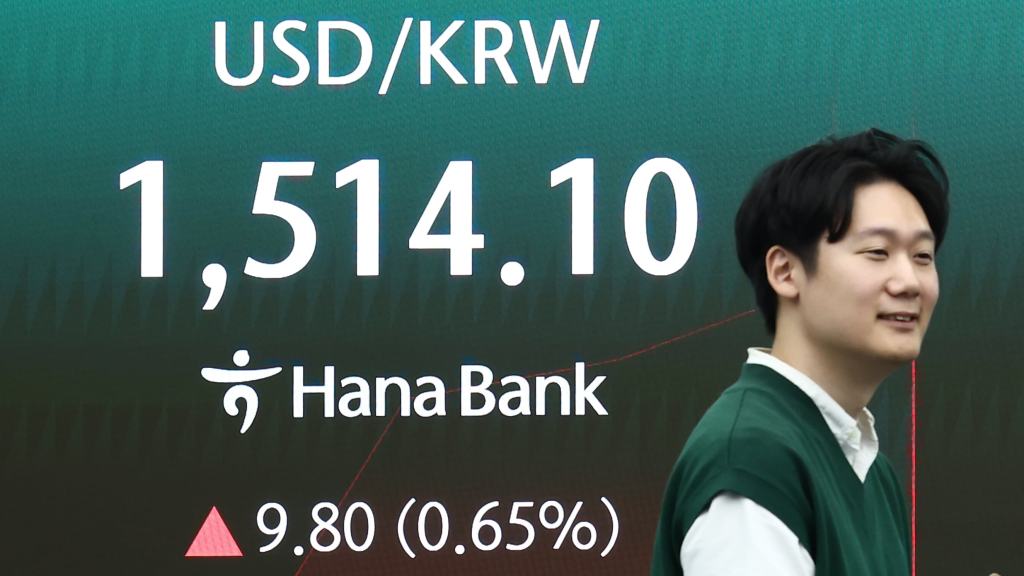
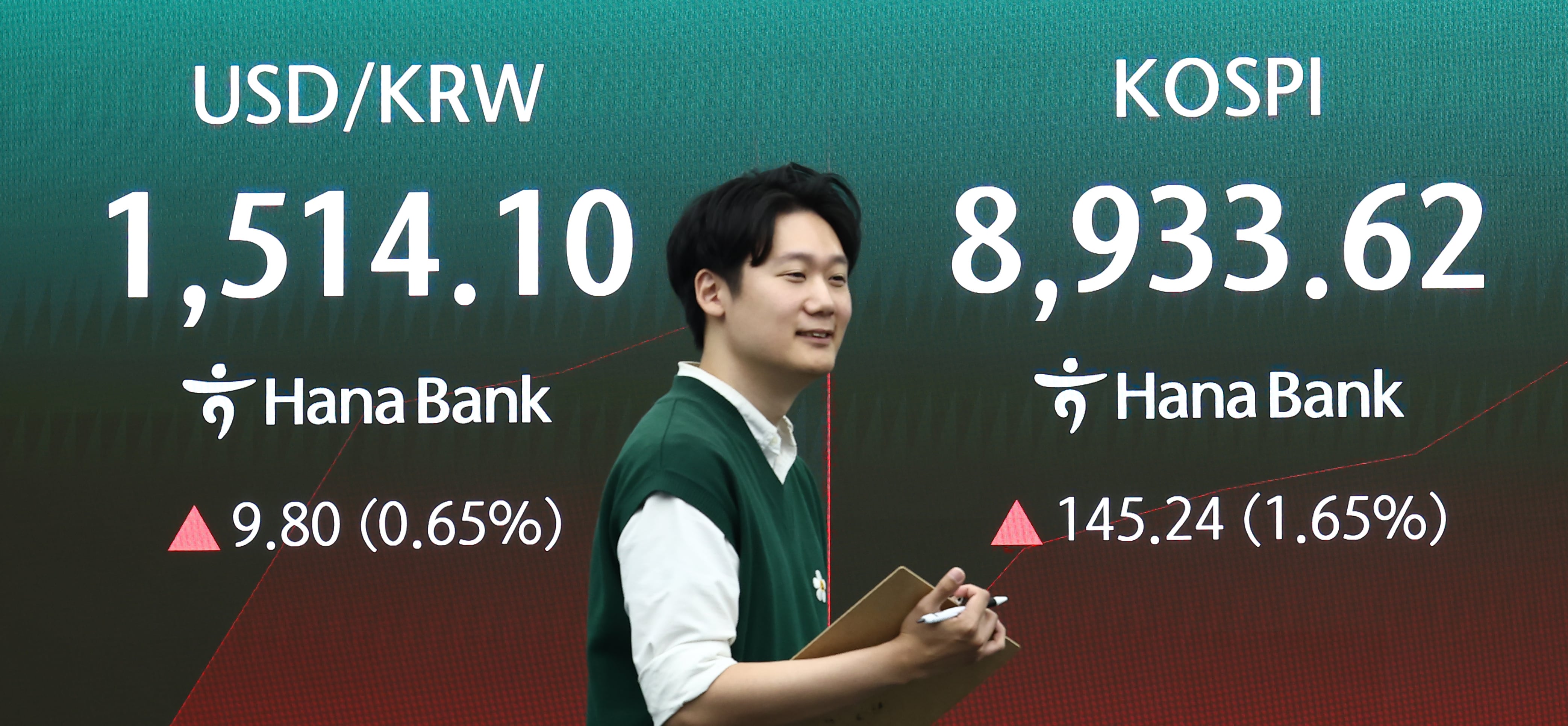
The Korean won’s exchange rate against the dollar has stayed within the 1,500 won range for 11 straight trading days, equaling the record from the 2009 financial crisis. Even though the KOSPI is nearing 9,000, exports are reaching new highs, and higher interest rates are expected, the won’s value has not improved. Analysts believe the high exchange rate in the 1,500 won bracket will continue until the latter part of this year.
◇ The 1,500 Won Exchange Rate Becoming Commonplace
As per the Bank of Korea’s Economic Statistics System on the 2nd, the weekly closing exchange rate for the won against the dollar stood at 1,504.3 Korean won as of 3:30 p.m. on the 1st. It has stayed within the 1,500 Korean won range for 11 straight trading days since the 15th of last month, matching the record set during the global financial crisis (February 24–March 10, 2009). On the 2nd, the exchange rate opened at 1,512 Korean won in the Seoul foreign exchange market. If the closing rate also goes beyond 1,500 Korean won, it will break the record from the crisis period.
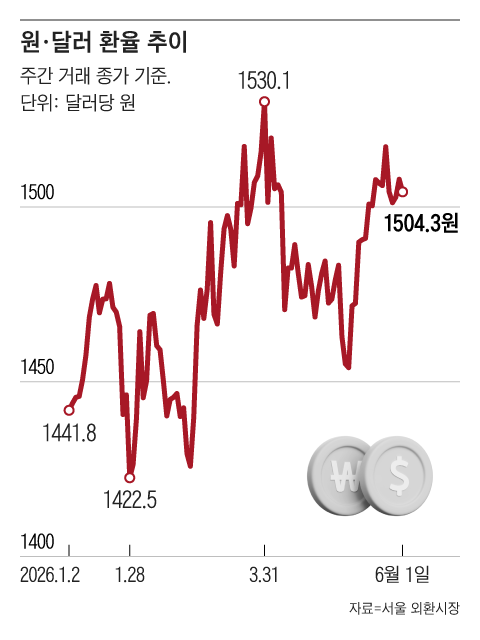
Each year, the count of days where the exchange rate has gone beyond 1,500 South Korean won this year has already exceeded the period during the 2009 crisis. Beginning after the U.S.-Israel-Iran conflict in March, the exchange rate has remained within the 1,500 South Korean won range, ending 23 weeks of trading in that bracket. In the 2009 crisis, the exchange rate surpassed 1,500 South Korean won for 12 days.
◇ In contrast to Theoretical Positive Exchange Rate Expectations, the Result is the Opposite
The current upward movement in the exchange rate goes against economic theories suggesting that robust exports, a thriving stock market, and interest rate increases would cause the exchange rate to decline. In April, exports rose by 48% compared to the previous year, reaching $85.99 billion. This strong export performance could potentially help reduce the exchange rate by boosting the inflow of foreign currency. Moreover, the KOSPI has exceeded the 8,000 mark and is now aiming for the 9,000 level. Even though foreign investors have kept selling, the demand for won to invest in the local stock market is increasing. Additionally, the Bank of Korea has indicated plans to increase the base interest rate this year. An increase in the base interest rate might lead to higher returns on the won, thus strengthening its value. Despite these three favorable factors, the won has had difficulty gaining strength.
◇ The Middle East Conflict Impacting the Currency Exchange Rate
The decline in the won’s value is linked to the increasing separation between South Korea’s domestic capital market and its exchange rate. Since the start of the U.S.-Israel-Iran conflict in March, the dollar, considered a safe-haven currency, has strengthened, while the won has kept depreciating. Moreover, the extended period of inverted interest rates between South Korea and the U.S. has removed the motivation for foreign capital to retain the won.
Experts anticipate that the strong exchange rate will continue as long as the Middle East conflict remains unsettled. Baek Suk-hyun, an economist from Shinhan Bank, remarked, “Factors like increasing oil prices and higher demand for the dollar caused by the Middle East crisis are having a greater impact on the exchange rate market than other elements.” He further noted, “Even if a truce between the U.S. and Iran is quickly reached, oil prices will not become stable unless the blockage of the Strait of Hormuz is fully removed, and the resulting high exchange rate situation will remain for a while.”
Some critics argue that the won’s fundamental attractiveness is decreasing. Kang Sung-jin, a professor in the Department of Economics at Korea University, stated, “South Korea’s present situation features low investment appeal because of slowing growth rates, not being a major currency country, and having few strong companies outside of semiconductors.” He further mentioned, “Without addressing issues like a rigid labor market and excessive dependence on semiconductors, it will continue to be difficult to significantly boost demand for the won.”





Leave a Reply