
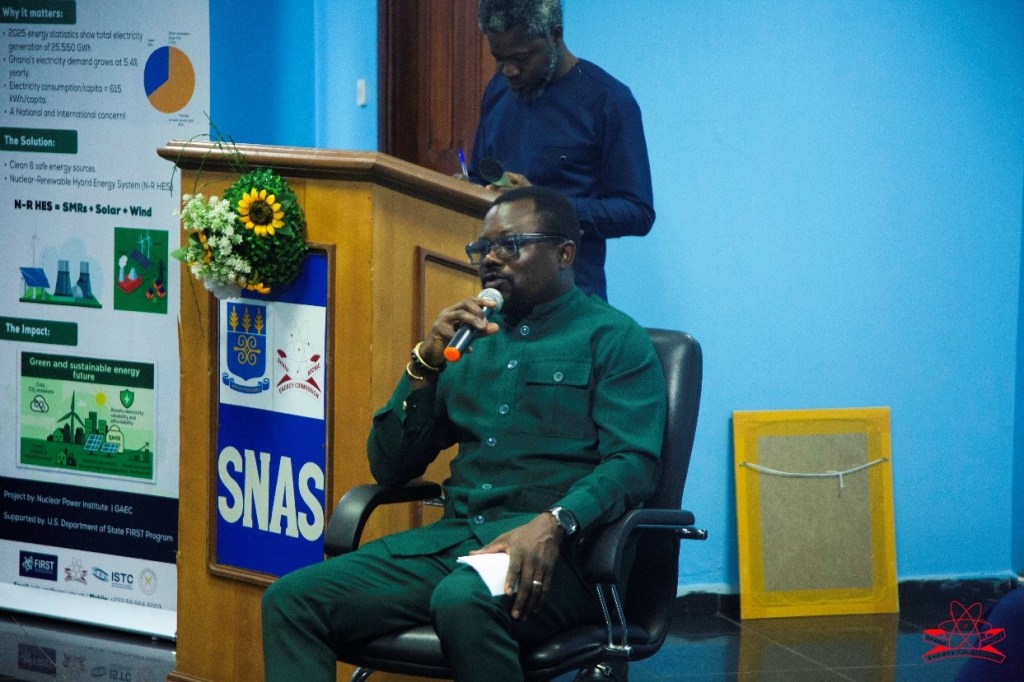
As part of a major step towards ensuring stable and environmentally friendly power, important national representatives met in Accra to push forward initiatives for combining Small Modular Reactors (SMRs) with renewable energy options.
The high-level workshop represented a crucial advancement in transforming Ghana’s nuclear energy goals into a tangible plan for a robust electricity generation framework.
Hosted by the Graduate School of Nuclear and Allied Sciences (SNAS), the gathering united leaders from the Ministry of Energy and Green Transition, Nuclear Power Ghana (NPG), the Volta River Authority (VRA), the Bui Power Authority (BPA), the Energy Commission, and academic institutions.
The seminar, backed by the United States Department of State’s Foundational Infrastructure for Responsible Use of Small Modular Reactor Technology (FIRST) Program and carried out via the International Science and Technology Centre (ISTC), centered on a hybrid energy system in which SMRs supply steady, low-carbon power to support Ghana’s expanding solar and wind energy facilities.
Dr. Eric Glover, speaking on behalf of the Director-General of the Ghana Atomic Energy Commission (GAEC), referred to the discussion as a “strategic milestone” for the country’s energy security.“We are involved in a problem-solving conversation that highlights nuclear energy as a reliable component in a varied energy portfolio,” he said.
On the international front, Mr. Bauyrzhan Almagzhanov from ISTC emphasized ongoing capacity development, such as the delivery of a NuScale SMR simulator to Ghana in January 2025 and advancements in a welding certification program aimed at enhancing local industrial capabilities. He referred to SMRs as a “transformative opportunity” for dependable, adaptable energy that enhances security while fostering national expertise for growth.
The seminar conversations were based on research conducted by Mr. Mark Amoah Nyasapoh,manager of the project, who shared results from a study supported by a FIRST microgrant. Utilizing advanced energy modeling tools, the National Renewable Energy Laboratory’s (NREL) HOMER Pro software for optimizing hybrid systems at a small scale and the International Atomic Energy Agency’s (IAEA) MESSAGE model for analyzing broader energy pathways. Mr. Nyasapoh’s research illustrated how SMR-renewable hybrid energy systems can boost grid stability, reduce emissions, and increase long-term electricity affordability or maintain a more consistent tariff structure.
Mark Amoah Nyasapoh, an Energy Economist and Planner at the Nuclear Power Institute (NPI) under the Ghana Atomic Energy Commission (GAEC), as well as a PhD student at the University of Energy and Natural Resources (UENR) in Sunyani, highlighted that the study focuses on real-world, country-specific solutions.
“The models offer a unified and persuasive basis for policy and investment,” Mr. Nyasapoh stated.He conveyed his sincere appreciation for the significant support and mentorship received from Dr. Archibold Buah-Kwofie, Director of the Nuclear Power Institute (NPI) at GAEC, along with his academic advisors: Prof. Samuel Gyamfi from UENR; Prof. Seth Kofi Debrah of the IAEA in Vienna; Prof. Hossam A. Gaber from Ontario Tech University in Canada; and Prof. Nana Sarfo Agyemang Derkyi from UENR.
Professor Hossam A. Gaber from Ontario Tech University discussed global progress and safety measures, stressing the importance of “defence-in-depth” engineering and meticulous site selection in nuclear projects. He suggested creating a local training simulator and data center to enhance Ghana’s technical capabilities. Prof. Emmanuel Ampomah-Amoako, head of the Nuclear Installations Directorate at the Nuclear Regulatory Authority (NRA), focused on safety, autonomy, and preparedness as Ghana considers advanced technologies.
Dr. Robert M. Sogbadji, Deputy Director of Nuclear and Emerging Green Technologies at the Ministry of Energy and Green Transition, is a panel member who answered a question.
From a policy standpoint, Dr. Robert M. Sogbadji from the Ministry of Energy and Green Transition reiterated Ghana’s dedication to reaching net-zero emissions by 2070, highlighting nuclear energy as a key addition to renewable sources. Dr. Stephen Yamoah, Executive Director of NPG, emphasized the importance of customized funding and active public involvement.
On the renewable energy side, Ing. Maxmillian Kwarteng from the Bui Power Authority (BPA) stated the company’s preparedness to assist with the integration.
Professor Samuel Gyamfi, head of the Regional Centre for Energy and Environmental Sustainability (RCEES) at the University of Energy and Natural Resources (UENR), emphasized the long-standing collaboration between GAEC and UENR.
He particularly praised his PhD student, Mr. Nyasapoh, whose research, funded by a FIRST microgrant, adds considerably to an expanding range of scholarly studies. Professor Gyamfi attributed the project’s achievements to the mentorship of Professors Seth Kofi Debrah, Hossam A. Gaber, and Nana Sarfo Agyemang Derkyi, along with the assistance from Dr. Archibold Buah-Kwofie, the Director of the Nuclear Power Institute at GAEC.
“The message is evident,” “When academic excellence combines with real-world opportunities, Ghana develops the talent pipeline essential for its energy future,” he said.
The workshop ended with a tour of the new NuScale SMR simulator at SNAS’s Energy Exploration (E2) Centre, representing a clear example of the country’s advancing skills. The event comes after a previous initiative, which included a community workshop at Takoradi Technical University (TTU).
A shared agreement was reached on the immediate following steps: utilizing the simulator for employee training, promoting industrial certification initiatives, refining financial models, and incorporating research into national energy strategies. Through these efforts, Ghana seeks to establish a robust, low-emission power supply system that may act as an example for energy growth in West Africa.
Provided by SyndiGate Media Inc.Syndigate.info).





Leave a Reply