
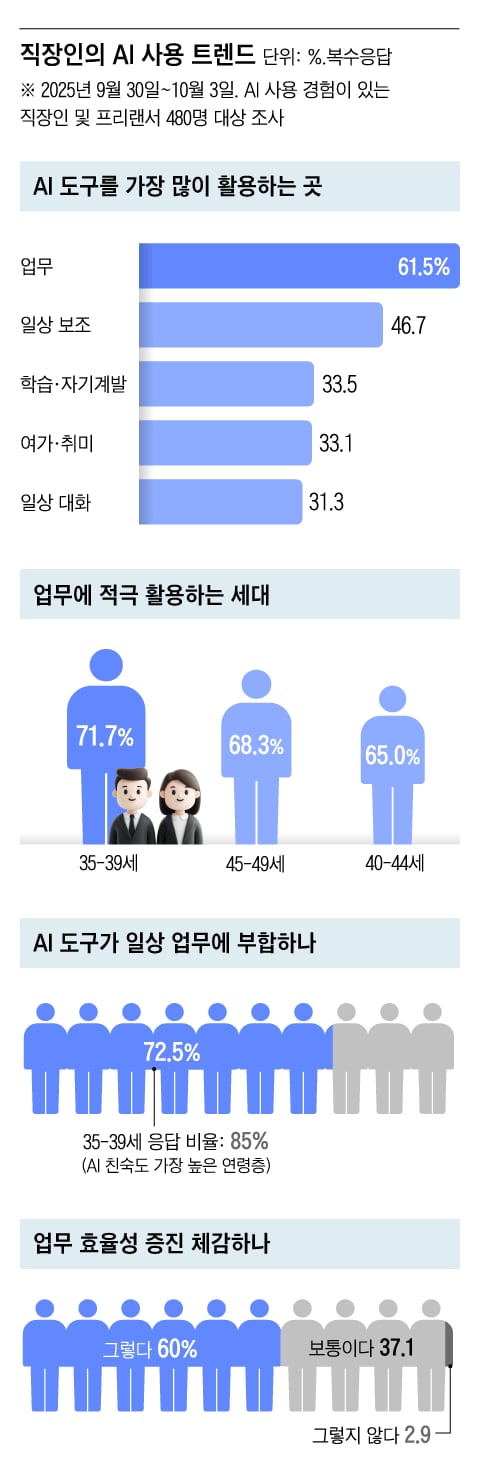
A study has shown that six out of ten office employees in South Korea are employing artificial intelligence (AI) tools in their professional tasks. AI tools were most commonly used in work-related activities as opposed to personal assistance or education.
As per the survey titled *Trends in AI Usage Among South Korean Office Workers*, carried out by the collaboration platform Notion and the Daehak Naeil 20s Research Institute on the 2nd, 61.5% (multiple responses) of participants stated that they “are already using AI tools in their jobs.” This usage rate in the workplace was higher than in other areas like daily assistance (46.7%, multiple responses), learning and personal growth (33.5%), and entertainment or hobbies (33.1%).
Employees who use AI in their jobs mentioned that they get help in areas like data searching (25%, with multiple answers), summarizing information (15.4%), improving wording (13.5%), writing reports or documents (9.8%), and translating texts (9.8%). Over 60% of those surveyed believe that the time spent on routine and repetitive tasks has been reduced, enabling them to concentrate more on creative and strategic activities.
Individuals in their late 30s (ages 35 to 39) showed the highest level of engagement with AI in the workplace. This group had the highest AI work utilization rate at 71.7%, with 85% reporting that AI tools fit well with their daily responsibilities. Additionally, 21.7% of this age group used AI six or more days a week, which is higher than other age groups.
On the other hand, individuals in their late 20s (ages 25 to 29) were the group that extensively integrated AI into both professional and personal routines, demonstrating a notably higher adoption rate in fields like daily support, communication, and mental health or advisory services.
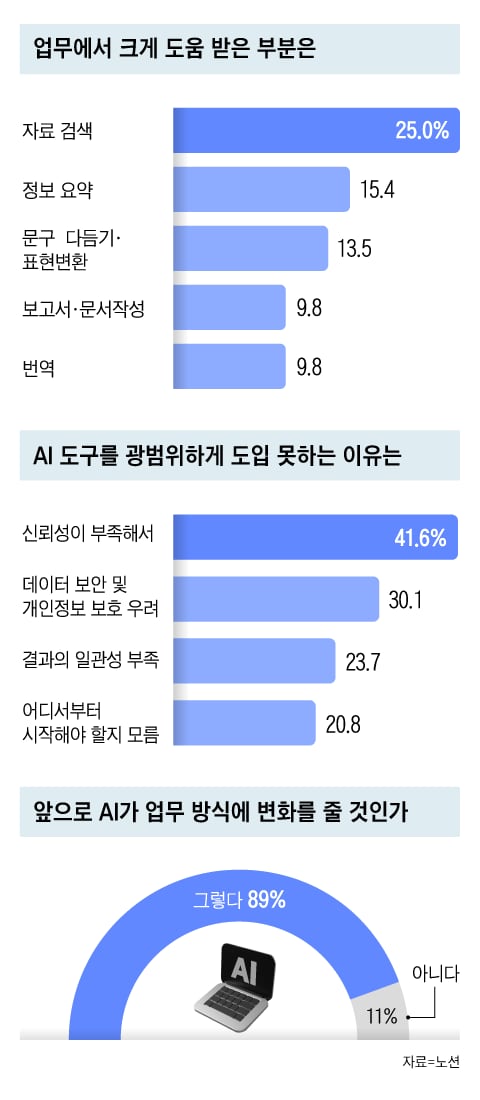
In terms of future work approaches, 89% of participants felt that AI technologies will lead to beneficial transformations in professional practices. Nonetheless, challenges such as insufficient reliability (41.6%), worries about data security and the safeguarding of personal information (30.1%), and variability in outcomes (23.7%) were still recognized. Indeed, 97.5% of respondents stated that they check or revise the outputs generated by AI, showing a cautious approach towards complete automation while embracing AI as a ‘colleague.’






Leave a Reply