
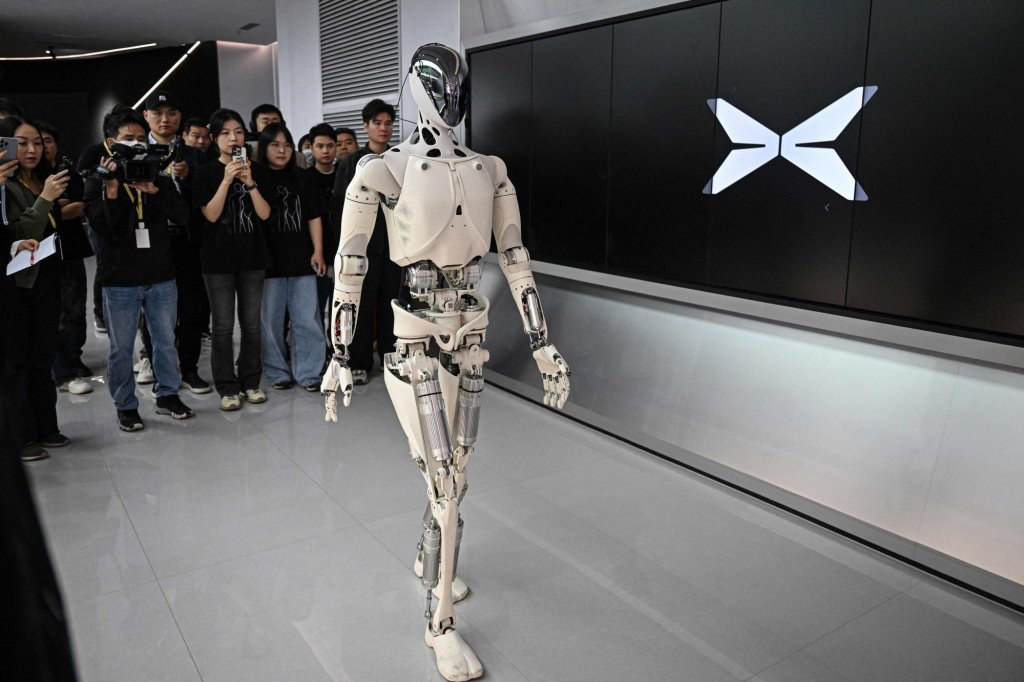
CEO compares the situation to toddlers learning to walk before they run, following Iron’s loss of balance going viral.
Chinese electric vehicle (EV) company Xpeng Motors presented its humanoid robot to hundreds of spectators at a mall in Shenzhen, a southern city, over the weekend. However, a backward fall made headlines, highlighting the challenges that lie ahead for these types of machines.
After smoothly walking to the center of the audience on Saturday, Iron, the 178cm robot known for its human-like movement, lost its balance and toppled backward while standing still on the stage, as seen in several online videos. A staff member caught it mid-fall, resulting in it ending up face-down on the floor.
The staff quickly took it away and brought it back after making modifications to enable interactive performances with kids, including asking trivia questions such as what color a giant panda’s feces would be.
Are you curious about the most significant issues and developments from across the globe? Find the solutions withSCMP Knowledge, our latest platform featuring curated content including explainers, FAQs, analyses, and infographics, presented by our acclaimed team.
On Sunday, the second day of the campaign, the device did not move, but was instead attached to a frame during informative and engaging conversations with the audience.
Although the robot had successfully walked on several occasions during its Saturday event, its fall made headlines. It became the fourth most searched term on Baidu on Monday morning and the top trending subject on Sunday night on ByteDance’s news app Jinri Toutiao, according to data from Entobit.cn, which monitors social media.
It brings to mind how every toddler learns to walk,” said He Xiaopeng, co-founder and CEO of Xpeng, on Sunday via the microblogging platform Weibo. “After falling, they will get back up; the next stage is to start running, and continue running.
Robotic dogs, which are non-humanoid robots, have reached commercial success more quickly than humanoids, according to a report from GF Securities last year. “In comparison to bipedal humanoid robots, quadrupedal robotic dogs offer greater carrying capacity and superior balance, and they are also simpler to control, design, and maintain,” the report stated.
Although AI has achieved significant progress in cognitive tasks—such as defeating humans in chess and translating languages—physical embodiment posed greater difficulties, as there was more data available regarding knowledge and art than about movement, according to Zhang Qiang, head of the academic committee at the Beijing Innovation Centre for Humanoid Robotics, in an educational video from May.
“It is very challenging to obtain thoroughly detailed information about human movement,” Zhang stated.
He mentioned that it was also simpler for a robot to perform certain tasks, such as dancing or flipping, in a controlled setting.
Nevertheless, businesses from China have attempted to extend the limits of robotic technology.
Unitree Robotics recently deployed one of its G1 humanoid robots in the Altay region of Xinjiang, where temperatures dropped to 47.4 degrees Celsius below zero. The 130cm tall bipedal robot took over 130,000 steps in the snow, creating a Winter Olympics symbol and demonstrating resilience in harsh conditions.
Xpeng is not the sole Chinese electric vehicle company adopting a strategy akin to that of US-based Tesla by venturing into robotics. According to a report from LatePost on Friday, Beijing-based Li Auto has reorganized its research team, assigning vice-president Lang Xianpeng to lead a new humanoid robotics department. Meanwhile, Gou Xiaofei, who previously managed smart cockpit design, will head a new team concentrating on software and body development.
Li Auto did not promptly reply to an inquiry for statement.
The organization has published multiple positions within the sector, such as engineers specializing in joints and hands.
More Articles from SCMP
Six fresh coffee shops in Hong Kong to celebrate the Year of the Horse in February 2026
Silver Bullet: New Oriental Shifts Focus to Older Learners as China’s Population Ages
This piece was first published in the South China Morning Post (www.scmp.com), a top news outlet covering China and Asia.
Copyright (c) 2026. South China Morning Post Publishers Ltd. All rights reserved.






Leave a Reply