
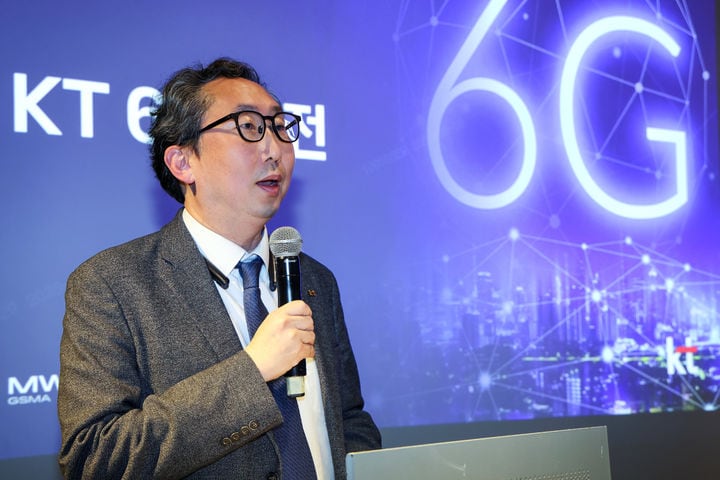
In the face of intense worldwide rivalry to dominate the 6G (sixth-generation) communication industry, KT has introduced its vision for an “intelligent 6G network.”
KT conducted a press briefing led by Lee Jong-sik, director of KT’s Network Research Institute, on the 2nd (local time) at the “MWC (Mobile World Congress), Mobile World Congress, 2026” in Barcelona, Spain, to unveil its 6G strategy and outlook.
The telecommunications sector expects current network frameworks to face challenges in managing the increasing data flow resulting from the rapid growth of artificial intelligence (AI) systems. To address this, KT has outlined its 6G vision as a “highly connected, extremely reliable, and intelligent AI network that promotes AX (AI transformation) advancements.” This includes integrating AI into the network’s foundation, allowing it to self-improve through independent decision-making and management.
KT has outlined six key 6G technologies: “hyper-connectivity, ultra-low latency, quantum-resistant, AI-based, self-managing networks, and semantics-focused transmission.” The company aims to shift network operations from human-led manual control to an AI-powered autonomous system that manages all aspects from design to monitoring.
KT’s main advantages in the global 6G competition include its expertise in “5G standalone mode (SA)” and integration with satellite systems. Lee mentioned, “5G SA is essential for 6G development, and KT is the only local company that possesses this technological ability.” By combining this with the knowledge of its satellite communications subsidiary, KT SAT, the company seeks to integrate ground-based and non-ground networks to establish three-dimensional coverage covering land, coastal waters, and the air. This framework is anticipated to support smooth connectivity for upcoming mobility solutions such as urban air mobility (UAM) and maritime transportation. Lee further noted, “While 5G emphasized speed to achieve the first commercial deployment worldwide, 6G will focus on innovation in user experience, optimizing cost structures, and opening up new market opportunities.”



 jasdooit
Leave a comment